Showing posts with label church books. Show all posts
Showing posts with label church books. Show all posts
Saturday, November 25, 2017
New West Prussian Church Books Digitized
Archion.de has posted some newly-digitized church books for West Prussia that might interest researchers. These are early (i.e. pre-1800) Lutheran church books for Neuheide and Zeyer in Kreis Elbing and Graudenz in Kreis Graudenz.

Tuesday, August 8, 2017
Analyzing the 1776 Census
For the last several months, I've been working on this huge project to analyze all the Fasts in the 1776 census of Mennonites in West Prussia. My goal was to try to identify the parents of Gerhard Fast #660202 (1739-1828), my 7th-great-grandfather and earliest known Fast ancestor. Since his oldest known sibling was born in ABT 1737, I realized that his parents would probably have been in their early 60s in the 1776 census. Thus it is likely that one or both of them were enumerated in that census; but of course without knowing their names, they could be listed in plain sight and wouldn't even know it was them. So my plan was to find out as much as possible out each of the 31 Fasts in that census to try to identify his parents. I didn't identify either parent, but I was able to eliminate most of them as possible candidates.
I chose the 1776 census because it was only of Mennonites in West Prussia, so I didn't have to worry about sorting out people who had "Mennonite-sounding" names. Glenn Penner has already identified quite a few people in it, so a good start has been made. Finally, I have scans of all the originals for the 1776 census. I decided against the 1772 census because it included everyone in West Prussia - not just the Mennonites. Very little work has been done on it, and I have only about half the scans for "Mennonite" villages in the Gross Werder, and ordering them from the Geheimes Staatsarkhiv in Berlin is slow and expensive.
Glenn Penner's extraction of the 1776 census is found here. He (and perhaps others) had already identified 11 of the 31 Fasts with Grandma (GM) numbers. I added 10 more during my project, so 21 of the 31 are now identified in GM.
The results of my efforts can be downloaded from Google Drive. A few comments about the spreadsheet - the names and dates that I added are in red. On a few people, I just looked them up and found the family in GM, just waiting to have a GM number associated with them on the census spreadsheet. Others took a lot more work to research. And a few were not in GM at all.
I started by looking for the head of household in my giant spreadsheet of Fasts that I have extracted over the last few years. Any time I looked at church book or microfilm, I put all the names of Fasts (and in-laws) into a giant spreadsheet - even if I wasn't interested in them at the time. Now I could just look at it and see all the records, for example, for Claas Fast, even if they were scattered among different sources. Many times a family would come together just like that.
The sources that I checked included
To handle all this data, you need several things:
I chose the 1776 census because it was only of Mennonites in West Prussia, so I didn't have to worry about sorting out people who had "Mennonite-sounding" names. Glenn Penner has already identified quite a few people in it, so a good start has been made. Finally, I have scans of all the originals for the 1776 census. I decided against the 1772 census because it included everyone in West Prussia - not just the Mennonites. Very little work has been done on it, and I have only about half the scans for "Mennonite" villages in the Gross Werder, and ordering them from the Geheimes Staatsarkhiv in Berlin is slow and expensive.
Glenn Penner's extraction of the 1776 census is found here. He (and perhaps others) had already identified 11 of the 31 Fasts with Grandma (GM) numbers. I added 10 more during my project, so 21 of the 31 are now identified in GM.
The results of my efforts can be downloaded from Google Drive. A few comments about the spreadsheet - the names and dates that I added are in red. On a few people, I just looked them up and found the family in GM, just waiting to have a GM number associated with them on the census spreadsheet. Others took a lot more work to research. And a few were not in GM at all.
I started by looking for the head of household in my giant spreadsheet of Fasts that I have extracted over the last few years. Any time I looked at church book or microfilm, I put all the names of Fasts (and in-laws) into a giant spreadsheet - even if I wasn't interested in them at the time. Now I could just look at it and see all the records, for example, for Claas Fast, even if they were scattered among different sources. Many times a family would come together just like that.
The sources that I checked included
- Prussian Mennonite church books (Tiegenhagen, Ladekopp, Rosenort, Bärwalde, Montau, Tragheimerweide, Heubuden, Danzig, etc.) - I used the extractions at MennoniteGenealogy.com, Andreas Riesen's extractions, and the originals at Bethel College's Mennonite Library and Archives
- Lutheran/Evangelical church books (Jungfer, Fürstenau, Neuteich, etc.) - Mostly from LDS microfilms
- West Prussia Censuses - 1772, 1776, 1789, 1793 (Danzig), 1811 (Elbing)
- Russian Censuses - 1806, 1808, 1811, 1835
- Property Records
- Emigration Records - BH Unruh, Peter Rempel, MennoniteGenealogy.com
To handle all this data, you need several things:
- A method to store and organize all the data - such as my spreadsheet of Fast extractions
- Access to all the records - online, microfilm, orders from archives
- Research collateral lines - With fragmented data, researching siblings of your direct ancestor helps to pull everything together.
Sunday, July 16, 2017
Update on 1776 Census Project
I've been working on a project to identify all the Fasts in the 1776 census of Mennonites in West Prussia. Glenn Penner's extraction of the data is found here. My theory was that one or both of the parents of my earliest known Fast ancestor, Gerhard Fast #660202 (1739-1829) might be listed in that census, and I wouldn't even have known about it. His oldest known sibling was born ABT 1737 - if his parents were about 20 years old when their first child was born, they might have been born about 1717. Thus in 1776, they would have been about 60 years old.
There were 31 Fast families listed in the 1776 census, and 11 of them had previously been identified in Grandma. I was able to identify 11 more Fasts, so now 22 of the 31 are identified in GM.
My methodology was to look for them first in GM. Then I checked my spreadsheet in which I have extracted 431 individual records over the years from the Mennonite, Lutheran/Evangelical, and Catholic church books to see if I could find the person. I checked the Mennonite church books that Andreas Riesen extracted. I checked the 1772 and 1789 census, the immigration records to Russia in BH Unruh, Peter Rempel, and that I have gotten from the Prussian archives in Berlin, and the land records that Glenn Penner has posted online.
Unfortunately, none of the Fasts whom I was able to identify were old enough to be the parents of my Gerhard. There are 3-4 Fasts whom I could not identify who lived in the Gross Werder and are potential candidates to be Gerhard's parents, but I found no information to identify them. I was able to tie many, many children to the 22 identified Fast families, so I've added a lot to the store of knowledge about the Fasts in GM, so it's been a useful exercise. But I didn't accomplish the goal that I set out to achieve.
I'm planning a trip to Poland in 1-2 years to do research in the archives there, and this work was a necessary prelude to that trip. I wouldn't want to make an expensive trip to the Polish archives without having done everything that I could with data that is available to me while sitting at home.
I'll post the spreadsheet with my results in the near future, but I need to clean up the spreadsheet first.
There were 31 Fast families listed in the 1776 census, and 11 of them had previously been identified in Grandma. I was able to identify 11 more Fasts, so now 22 of the 31 are identified in GM.
My methodology was to look for them first in GM. Then I checked my spreadsheet in which I have extracted 431 individual records over the years from the Mennonite, Lutheran/Evangelical, and Catholic church books to see if I could find the person. I checked the Mennonite church books that Andreas Riesen extracted. I checked the 1772 and 1789 census, the immigration records to Russia in BH Unruh, Peter Rempel, and that I have gotten from the Prussian archives in Berlin, and the land records that Glenn Penner has posted online.
Unfortunately, none of the Fasts whom I was able to identify were old enough to be the parents of my Gerhard. There are 3-4 Fasts whom I could not identify who lived in the Gross Werder and are potential candidates to be Gerhard's parents, but I found no information to identify them. I was able to tie many, many children to the 22 identified Fast families, so I've added a lot to the store of knowledge about the Fasts in GM, so it's been a useful exercise. But I didn't accomplish the goal that I set out to achieve.
I'm planning a trip to Poland in 1-2 years to do research in the archives there, and this work was a necessary prelude to that trip. I wouldn't want to make an expensive trip to the Polish archives without having done everything that I could with data that is available to me while sitting at home.
I'll post the spreadsheet with my results in the near future, but I need to clean up the spreadsheet first.
Tuesday, May 2, 2017
Knocked Dolwn a Brick Wall! (Part I)
I've been stumped for two months now. That's a long time to be unable to figure something out, especially when the answer is right in front of you.
When I started working on my 4-greats-grandfather Martin Fast #660209, I hardly knew anything about him. Here is descendant chart that I had:

All the information that I had about him came from the marriage record of his son Isaac Martin Fast #51802 (b. ABT 1790), my 3-greats-grandfather, when he married in Reinland, West Prussia, in 1813. And here is the marriage record:
From the record in the Tiegenhagen church book, you can see that Isaac Fast was the son of Martin Fast, who was from Schlobitten. The village of Schlobitten was not in Glenn Penner's list of Mennonite villages in West Prussia, so I searched for it at Kartenmeister, which is an incredible list of villages in East and West Prussia. It turned out to be a village in East Prussia. I searched the online records from East Prussia, but I couldn't find Martin Fast. That was five years ago, and I didn't know what else to do, so I just left it.
A couple months ago, I thought I should take another look at the records to see what I could find. That will be Part II.
When I started working on my 4-greats-grandfather Martin Fast #660209, I hardly knew anything about him. Here is descendant chart that I had:

All the information that I had about him came from the marriage record of his son Isaac Martin Fast #51802 (b. ABT 1790), my 3-greats-grandfather, when he married in Reinland, West Prussia, in 1813. And here is the marriage record:
 |
| Marriage record of Isaac Fast and Catharina Fast, 8 December 1813, Tiegenhagen Mennonite Church, West Prussia, Kirchen-Buch, 1780-1831, p. 102. Accessed at http://mla.bethelks.edu, Congregation #314, on 14 October 2012. |
A couple months ago, I thought I should take another look at the records to see what I could find. That will be Part II.
Saturday, February 25, 2017
3 Types of West Prussian Mennonite Church Books
The church books kept by Mennonites in West Prussia fall into three main categories: the family book, the vital statistics register, and the baptism register. Here's an example of each.
First, the family book. These are organized geographically, listing all the families in one village at a certain time and then continuing to add to them as events happened. These books are especially useful for two reasons - they often list the parents of the husband and wife, and sometimes even information about the parents, so can be used to go back a generation before the stated beginning date of the book. Also, they group all the children of a family together and name the wife, which other books usually do not. There are some limitations - the elder who compiled the book may not have known all the dates and places, so there are often blanks instead of information. Also, at least the initial compilation of the book was not done contemporaneously with the events recorded, so the information may not be as reliable as the vital statistics register.
Here is an example of a random family from the Rosenort church book, Cornelius Wiens and Maria Duick.
The blue oval is the village name of Blumenort, the green oval is the names of the husband and wife, the red box is the names of the children, the purple line marks the columns with dates for birth, baptism, and death, and the yellow box is the name of the parents of the husband and wife. Unusually, there is no column for marriage date, although a note says that Cornelius and Maria were married in 1857.
A link to Andreas Riesen's extraction of the information from this book is here, but if you want the images from the book, you have to buy the Rosenort DVD from the Mennonite center in Weierhof, Germany.
Next is the vital statistics register, which includes lists of births, marriages, and deaths in a congregation chronologically. Usually, all the events are in one book, and there is a page for each type of event in a single year, but sometimes there are separate books for each of the three event types. These books were created more or less contemporaneously with the event, so they are the most reliable. But they usually only list the father's name and village, and sometimes not even that. It can be hard to group children into families and to figure out the name of the wife since that information is usually not provided. Since it wasn't obligatory to record data in these books until sometime in the 1800s, individual events and even whole families may be missing. Sometimes the marriage lists are found in the diaries of elders or ministers.
Here is a random example from Tiegenhagen for the births of 1804:
Each line lists the date of birth, the father, the village of residence, the child's name, and a mark for the child's sex. Scans of the book are available at the web site of the Mennonite Library and Archives in North Newton, Kans, as well as a transcription of the book by John Thiesen. Andreas Riesen has extracted the data here.
Finally, there is the baptismal register. Since Mennonites were typically baptized as young adults, these records do not function like the baptismal records in the German Evangelical parish records, which usually function as birth records. Usually, these books were kept by the elder and give the father's name, village of residence, and child's name and noted whether or not the father was still alive. Since Mennonite young people in West Prussia in the late 1700s and early 1800s were usually baptized about the age of 17-20, you can still get a good idea of when a person was born. (In later times periods, the age ranged widened and typically baptismal candidates were older.)
Here is a random example from the Gross Werder baptismal register from 1785 for Rosenort. The Gross Werder had started as one congregation, but in 1735 it was divided into four congregations, Tiegenhagen, Ladekopp, Rosenort, and Bärwalde, although the single elder continued to maintain one baptismal register for decades.
Scans of the book are available at the MLA web site, and Riesen's extraction is here.
Let us know in a comment about your experience with Mennonite church books.
First, the family book. These are organized geographically, listing all the families in one village at a certain time and then continuing to add to them as events happened. These books are especially useful for two reasons - they often list the parents of the husband and wife, and sometimes even information about the parents, so can be used to go back a generation before the stated beginning date of the book. Also, they group all the children of a family together and name the wife, which other books usually do not. There are some limitations - the elder who compiled the book may not have known all the dates and places, so there are often blanks instead of information. Also, at least the initial compilation of the book was not done contemporaneously with the events recorded, so the information may not be as reliable as the vital statistics register.
Here is an example of a random family from the Rosenort church book, Cornelius Wiens and Maria Duick.
 |
| Source: Rosenort Mennonite family book, 1772-1880, KB Ro 1.2, Rosenort, West Prussia, Mennonitischen Forschungsstelle, Weierhof, Germany. p. 5-6. |
A link to Andreas Riesen's extraction of the information from this book is here, but if you want the images from the book, you have to buy the Rosenort DVD from the Mennonite center in Weierhof, Germany.
Next is the vital statistics register, which includes lists of births, marriages, and deaths in a congregation chronologically. Usually, all the events are in one book, and there is a page for each type of event in a single year, but sometimes there are separate books for each of the three event types. These books were created more or less contemporaneously with the event, so they are the most reliable. But they usually only list the father's name and village, and sometimes not even that. It can be hard to group children into families and to figure out the name of the wife since that information is usually not provided. Since it wasn't obligatory to record data in these books until sometime in the 1800s, individual events and even whole families may be missing. Sometimes the marriage lists are found in the diaries of elders or ministers.
Here is a random example from Tiegenhagen for the births of 1804:
 |
| Source: Tiegenhagen Mennonite church book, 1780-1831, KB Pe 1.0, Tiegenhagen, West Prussia, Mennonitischen Forschungsstelle, Weierhof, Germany, p. 75. |
Finally, there is the baptismal register. Since Mennonites were typically baptized as young adults, these records do not function like the baptismal records in the German Evangelical parish records, which usually function as birth records. Usually, these books were kept by the elder and give the father's name, village of residence, and child's name and noted whether or not the father was still alive. Since Mennonite young people in West Prussia in the late 1700s and early 1800s were usually baptized about the age of 17-20, you can still get a good idea of when a person was born. (In later times periods, the age ranged widened and typically baptismal candidates were older.)
Here is a random example from the Gross Werder baptismal register from 1785 for Rosenort. The Gross Werder had started as one congregation, but in 1735 it was divided into four congregations, Tiegenhagen, Ladekopp, Rosenort, and Bärwalde, although the single elder continued to maintain one baptismal register for decades.
 |
| Source: Gross Werder Mennonite baptismal register, 1782-1840, KB WP 1.1, Petershagen, West Prussia, State Archives, Gdansk, Poland, APG 779 Nr. 1, p.15. Accessed at https://mla.bethelks.edu/archives/cong_316/tiessen/IMG_3015.JPG on 25 February 2017. |
Let us know in a comment about your experience with Mennonite church books.
Tuesday, January 10, 2017
Can you figure out this date?
Take a look at this birth record of Susanna Sudermann, daughter of Johann Sudermann, from the Neuteich Lutheran parish's register of Mennonite births in 1819 in West Prussia. What is the date of birth (don't scroll down until you have an answer)?
If you're having trouble, I've highlighted the month for you:

If you said 10 January, you would not be alone - because that is the date someone entered into the Grandma database. But you would not be right :-(
Take a closer look at the image below where I've highlighted the date information:

The words underlined in green are the day. The Germans reads "d. ,31, ein und dreÿßigsten" which means "the 31st one and thirty." In other words the day was written first as a number and then in words. (Remember that German reverses the unit and the tens when writing out or speaking numbers.) You'll also notice that thirty is not spelled the modern way - this record has "dreÿßig" but it would be "dreißig" in modern spelling.
The red underlined word is the month, "Januar," or January.
Finally the blue underlined words are the time, ",10, zehn Uhr Ab.," or "10 ten o'clock in the evening." "Ab." is an abbreviation for "Abend" or evening.
So the date is not 10 January. We do it all the time, myself included, but it's awfully risky to make assumptions about what something says if you can't read (or don't take the time to read) all the words. Her birth date was 31 January 1813 at 10pm.
If you got it right, give yourself a big, gold star!
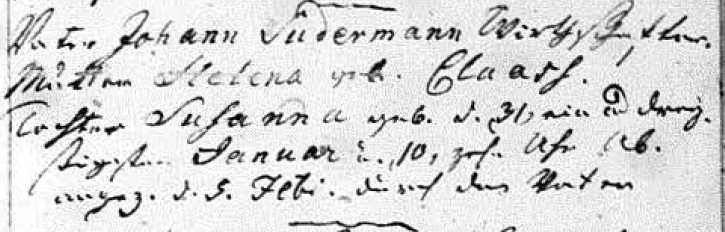 | ||
| Susanna Sudermann birth #2, XX XXXXXX 1819, Register of Mennonite births, marriages, and deaths 1813-1903, Neuteich Lutheran church records, Neuteich, West Prussia, no page, FHL film #208236. |

If you said 10 January, you would not be alone - because that is the date someone entered into the Grandma database. But you would not be right :-(
Take a closer look at the image below where I've highlighted the date information:

The words underlined in green are the day. The Germans reads "d. ,31, ein und dreÿßigsten" which means "the 31st one and thirty." In other words the day was written first as a number and then in words. (Remember that German reverses the unit and the tens when writing out or speaking numbers.) You'll also notice that thirty is not spelled the modern way - this record has "dreÿßig" but it would be "dreißig" in modern spelling.
The red underlined word is the month, "Januar," or January.
Finally the blue underlined words are the time, ",10, zehn Uhr Ab.," or "10 ten o'clock in the evening." "Ab." is an abbreviation for "Abend" or evening.
So the date is not 10 January. We do it all the time, myself included, but it's awfully risky to make assumptions about what something says if you can't read (or don't take the time to read) all the words. Her birth date was 31 January 1813 at 10pm.
If you got it right, give yourself a big, gold star!
Thursday, November 10, 2016
Another Mystery
Here's another mystery about the same Gerhard Abraham Fast #62896, my 3-greats-grandfather. He was born in West Prussia about 1787, and moved to Molotschna Colony in 1817. He appeared in the 1835 census in the village of Lichtfelde at farm #16 at age 48.
But then sometime in the 1840s, Gerhard Abraham's wife, Elisabeth Driedger #62897, appears as as the Widow Fast in the Alexanderwohl church membership list. Below is a snippet from that church book, listing Abraham Sperling, Catharina Fast, and Widow Fast as members. I'm sure it is she because the membership numbers show her as #251, the mother of Catharina Fast #250, who married Abraham Sperling #249, which fits the family information. Moreover, there is only one Fast family in Lichtfelde at this time. So Gerhard Abraham must have died by this point.
The 1847 Molotschna voter's list also shows her as Widow Fast in Lichtfelde. Here is her line from the tabulation of the votes from Lichtfelde village:
The line reads "Witwe Fast," which means Widow Fast, and then it shows the candidates for whom she voted for village mayor and district administrator. Again, a record shows that she was a widow, which means that her husband Gerhard Abraham must be dead.
Now here is the mystery - in 1874 when he would have been 86 years old, Gerhard Abraham wrote a letter to his son Jacob, my great-great-grandfather to bid farewell to Jacob as he prepared to leave for America. Here is the first page of the letter:
Clearly the name Gerhard Fast has been added in another hand to the letter, but the content of the letter makes it clear that it was written by Gerhard Abraham Fast, who should have been dead for three decades at this point. What is going on?
I have only one clue - a clue that I discovered in the Alexanderwohl church book. Gerhard Abraham's son Gerhard was baptized at Alexanderwohl on 31 May 1843.
If you read the columns from left to right, the first one is the baptismal candidate's name - Gerhard Fast. Then the year of baptism - 1843. Then the day - 31st - the month of May is omitted here, but it is in the page heading. Then the candidate's father - Gerhard Fast - is listed. Finally, his home village of Lichtfelde is given. Then below that a line of explanatory comments. First, Atest which refers to a letter of good standing given to transfer to another church, which means that Gerhard the son must have transferred to another congregation at some point. Then under the father's name are two comments, gestorben and gekommen, which means "he died" and "he came." Gestorben is even crossed out.
Could this mean that Gerhard Abraham was thought dead for some time in the 1840s but then he returned? This is the only explanation that I can think of that accounts for all the information. Did he leave on a trip to St. Petersburg or back to West Prussia and not return when expected? Was he kidnapped and held against his will for some time? It seems that such an event would have been noted in the Odessa archival files of the colony administration, but I haven't found anything yet. Until I find more information this will remain a tantalizing mystery.
 |
| Gergard" Abragamov" Fast" household, 25 February 1835, 8th Revision of Census of Russian Empire, Lichtfelde village, Molochanskii Mennonistskii Okrug, Melitopol'skii Uezd, Tavricheskaia Guberniia, household #16. Found in Odessa Region State Archives, Odessa, Ukraine, Peter J. Braun Collection, Fond 89, Inventory 1, File 357, p. 333R-334. Accessed on microfilm from California Mennonite Historical Society, Fresno, California. |
 |
| Membership record of Abraham Sperling, Catarina Fast, and Witwe Fast, members 249-251, Alexanderwohl Mennonite Church, Alexanderwohl, Molotschna Mennonite District, Tavricheskaia Guberniia, Russia, Kirchen Buch der Gemeinde zu Alexanderwohl, no page. Accessed at http://mla.bethelks.edu/archives, microfilm chr_17, congregation #15, "Russian Book," frame 16 on 25 July 2013. |
The 1847 Molotschna voter's list also shows her as Widow Fast in Lichtfelde. Here is her line from the tabulation of the votes from Lichtfelde village:
 |
| Witwe Fast [Widow Fast] entry, 12 November 1847, Wahlliste der Dorfsgemeinde Lichtfelde [Election List for Lichtfelde Town Meeting], Lichtfelde village, Molotschna Mennonite District, Tavricheskaia Guberniia, Russia, Odessa Region State Archives, Odessa, Ukraine, Fond 6, Inventory 2, File 10510, p. 47. Accessed at Center for Mennonite Brethren Studies, Hillsboro, Kansas. |
Now here is the mystery - in 1874 when he would have been 86 years old, Gerhard Abraham wrote a letter to his son Jacob, my great-great-grandfather to bid farewell to Jacob as he prepared to leave for America. Here is the first page of the letter:
 |
| Letter, Gerhard Abraham Fast to Jacob Fast, 14 February 1874. Copy held by Viola (Fast) Funk of Corn, Oklahoma. A Fast cousin in Oregon sent a copy to Minnie Fast who sent a copy to David D. Fast. |
I have only one clue - a clue that I discovered in the Alexanderwohl church book. Gerhard Abraham's son Gerhard was baptized at Alexanderwohl on 31 May 1843.
 |
| Baptism record of Gerhard Fast, 31 May 1843 O.S., Alexanderwohl Mennonite Church, Alexanderwohl, Molotschna Mennonite District, Tavricheskaia Guberniia, Russia, Kirchen Buch der Gemeinde zu Alexanderwohl, p. 90. Accessed at http://mla.bethelks.edu/archives, microfilm chr_17, congregation #15, "Earliest Kansas List," frame 45. |
If you read the columns from left to right, the first one is the baptismal candidate's name - Gerhard Fast. Then the year of baptism - 1843. Then the day - 31st - the month of May is omitted here, but it is in the page heading. Then the candidate's father - Gerhard Fast - is listed. Finally, his home village of Lichtfelde is given. Then below that a line of explanatory comments. First, Atest which refers to a letter of good standing given to transfer to another church, which means that Gerhard the son must have transferred to another congregation at some point. Then under the father's name are two comments, gestorben and gekommen, which means "he died" and "he came." Gestorben is even crossed out.
Could this mean that Gerhard Abraham was thought dead for some time in the 1840s but then he returned? This is the only explanation that I can think of that accounts for all the information. Did he leave on a trip to St. Petersburg or back to West Prussia and not return when expected? Was he kidnapped and held against his will for some time? It seems that such an event would have been noted in the Odessa archival files of the colony administration, but I haven't found anything yet. Until I find more information this will remain a tantalizing mystery.
Friday, September 30, 2016
Teach Yourself to Read German Script (Part II)
Did you do your homework? (See Part I) If you are comfortable writing the alphabet and some words, you are ready to move on to the next stage. In the first part, we learned to read the letters when formed in an ideal manner. Now we're going to look at a real-life example, where the scribe did not make every letter perfectly. But we'll start with an easy example, where the scribe had good handwriting, the Tiegenhagen, West Prussia, Mennonite church book.
You could use any handwritten German document; but this one is written clearly; and even more importantly, John Thiesen has made an exact transcription. So we can compare the handwritten German text to the typewritten transcription.
At this point, we're only interested in reading the letters and words, not yet about understanding the meaning.
Let's download a random page from the church book, p. 30-31. Then download John Thiesen's transcription for comparison - it's a large Word document, so be patient - and find page 31. We'll use the righthand page, page 31, because it has more Kurrentschrift on it than the lefthand side. (Note that personal names are usually written in Latin script not Kurrentschrift.) Start at the top and look at the Latin transcription and follow the Kurrentschrift.
Did you see that one of the column headings is missing in the transcription? Can you figure out the word on your own? (Answer at the end.)
Once you feel comfortable looking at the Latin transcription and deciphering the Kurrentschrift original, do it the other way around. Try to read the original and see if you get what is in the transcription. You may have to write out the original letter-by-letter. Download and read a few more pages until you feel comfortable with it.
Congratulations - you've made your first step into reading a real genealogical document!
ANSWER - The missing word is "Wochen," which means "weeks."
You could use any handwritten German document; but this one is written clearly; and even more importantly, John Thiesen has made an exact transcription. So we can compare the handwritten German text to the typewritten transcription.
At this point, we're only interested in reading the letters and words, not yet about understanding the meaning.
Let's download a random page from the church book, p. 30-31. Then download John Thiesen's transcription for comparison - it's a large Word document, so be patient - and find page 31. We'll use the righthand page, page 31, because it has more Kurrentschrift on it than the lefthand side. (Note that personal names are usually written in Latin script not Kurrentschrift.) Start at the top and look at the Latin transcription and follow the Kurrentschrift.
Did you see that one of the column headings is missing in the transcription? Can you figure out the word on your own? (Answer at the end.)
 |
| Source: Tiegenhagen Mennonite church book, Tiegenhagen, West Prussia, Volume 1, Page 31, held by Mennonite Library and Archives, North Newton, Kansas, accessed online at http://mla.bethelks.edu/archives/cong_314/book1/30-31.jpg on 29 September 2016. |
 |
| Portion of transcription of page 31. |
Congratulations - you've made your first step into reading a real genealogical document!
ANSWER - The missing word is "Wochen," which means "weeks."
Friday, September 9, 2016
What's That Surname?
Here's a fun one - before you scroll down too far, try to figure out the surname of Cornelius below:
Someone did an incredibly useful rough draft transcription of the Tiegenhagen, West Prussia, Mennonite church book, 1782-1831, and he took it to be "Cornelius Fast." I definitely thought the same thing for a long time. In that case, there were two Cornelius Fasts in the village of Platenhof - one died in 1793 and this one in 1810. I spent a lot of time trying to separate the children of the two men into different families without any luck.
But today I took another look at the surname. Here's a scan of a larger area:
 Notice that the second loop on what appeared to the "F" in Fast is actually the down-loop on the "z" in Schulz. If you mentally block out that second loop, could the name actually be Jost?
Let's look at some of the J's the scribe wrote on the same page:
 Here are three times where he wrote Jacob, Johan, and Jacob. These J's look very much like the first letter in the surname above. It has to Cornelius Jost.
So I can stop trying to separate the Cornelius Fast children in Platenhof, West Prussia into two families - there was only one Cornelius Fast in Platenhof!
 |
| Cornelius [guess who!] death record, 20 March 1810, Tiegenhagen Mennonite Church Book 1780-1831, West Prussia, p. 95. Downloaded from http://rep.mefor.org/kb/kb26.pdf on 28 November 2015 [link has been removed]. |
Someone did an incredibly useful rough draft transcription of the Tiegenhagen, West Prussia, Mennonite church book, 1782-1831, and he took it to be "Cornelius Fast." I definitely thought the same thing for a long time. In that case, there were two Cornelius Fasts in the village of Platenhof - one died in 1793 and this one in 1810. I spent a lot of time trying to separate the children of the two men into different families without any luck.
But today I took another look at the surname. Here's a scan of a larger area:

Let's look at some of the J's the scribe wrote on the same page:

So I can stop trying to separate the Cornelius Fast children in Platenhof, West Prussia into two families - there was only one Cornelius Fast in Platenhof!
Tuesday, August 23, 2016
Looking in the WRONG Village (Part III)
In the previous posts in this series, I explained how I
found my 5-greats-grandparents, Martin Wiens and Maria Loepp, in the West Prussian
land records. I wanted to flesh out
their lives as much as possible, so there are a few other places to look for
information.
First, the 1772 census.
When Prussia seized a large piece of Polish territory in 1772, including
the Gross Werder and other areas where many Mennonites lived, they immediately
conducted a census to establish tax liabilities for all the inhabitants. When I checked the village of
Fürstenauerweide, where Martin and Maria Wiens owned land, I found them – sort
of. There were three heads of household
named “Wientz,” but no first names or the number of family members were listed. I checked the index for the 1772 census and
found no other Martin Wiens, so I knew he must be one of these three.
 |
| 1772 census with three Wiens households. Source: _____ Wientz household, 1772-1773, households #3, #5, or #9, Contributions Catastrum, Fürstenauer Weÿde village #24, Elbingschen Niederung, West Prussia, II. HA, Abt. 9, Materien, Tit. XCIII, Nr. 9, Bd. 3, p. 109, Geheimes Staatsarchiv Preussischer Kulturbesitz, Berlin, Germany. |
In the 1776 census, there are three Wiens heads of
household listed, but this time their first names are given – Arend, Jacob, and
Martin. (Presumably, these are the same
three Wienses as in 1772, but we cannot be sure without checking each one
individually since one could have died and another married and started his own
household.) It’s very likely that this Martin
Wiens is the one I’m looking for.
 |
| Source: Martin Wiens household, 1776 Special Consignation of Mennonite families, Fuerstenauerwiede village, West Prussia, II. HA, Abt. 9, Materien, Tit. CIX, Nr. 1, Vol. 1, Geheimes Staatsarchiv Preussischer Kulturbesitz, Berlin, Germany. Accessed online at http://www.mennonitegenealogy.com/prussia/1776MasterV5.pdf on 13 August 2016. |
And on his extraction of the 1776 census, Glenn Penner
has added a serendipitous note to Martin Wiens “1739-99 (Luth/Fuerstenau).” He kindly sent me a copy of Martin Wiens’
death record from the Fürstenau Lutheran church book, which showed that he died on 5 March
1799 in Fürstenauerweide at the age of 68 years, 4 months, and was buried on 11
March. From his age at death, I could
calculate that he was born in ABT Dec 1730.
 |
| Martin Wiens death record. I have underlined "Martin Wiens," "5 Mart: (5 March)," and "68 Jahr 4 Monat (68 years 4 months)." Source: Martin Wiens death record, 5 March 1799, decedent #5, Fürstenau Lutheran death register, 1774-1819, Fürstenau, West Prussia, digital copy from Glenn Penner, Guelph, Ontario. |
Finally, I checked the 1789 census of Mennonite landowners, and I found Martin Wiens living in Fürstenauerweide and owning 18
morgens 158 ruten of land (about 26 acres).
 |
| Source: Mart. Wiens household, line #9, 1789 General-Nachweisung of Mennonite families in Marienwerder Department, Fuerstenauerweide village #35, II. Amt Elbing, West Prussia, II. HA, Abt. 9, Materien, Tit. CIX, Nr. 1, Vol. 1, Ad Nr. 1 vol. 2, Geheimes Staatsarchiv Preussischer Kulturbesitz, Berlin, Germany. Accessed at http://mennonitegenealogy.com/prussia/1789_Land_Census_West_Prussian_Mennonites.htm on 13 August 2016. |
To summarize these three posts on Martin Wiens – I started
out being curious why Jacob Barkman was not listed in any of the censuses in
Neustӓdterwald, the village where he owned land at the time of his death. When I checked for his name in the other
villages in the 1789 census, I saw that he owned land in the neighboring
village, the “wrong” village, of Fürstenauerweide. When I checked the land records for
Fürstenauerweide, I found the land that he owned and that his wife Katharina
Wiens had inherited it from her parents Martin Wiens and Maria Loepp when her
mother Maria Loepp died. I had not known
of Martin Wiens and Maria Loepp before this.
When I checked for Martin Wiens in the 1772, 1776, and 1789 census, I
found him living in Fürstenauerweide in all three. And a note on the extraction of the 1776
census led me to his death record, which gave his birth date also. So a little curiosity about Jacob Barkman led
to discovering his parents-in-law and quite a bit of information about them!
Thursday, August 18, 2016
Mennonite Church Books - Missing Records
I have noticed that West Prussian Mennonite church books are often missing records - in the sense that records of events that "should" be in there are not. I have noticed this in particular in the Danzig Flemish Mennonite church because they have records for several centuries (not because the church books were poorly kept but because they have records that span several generations so you can trace families). For example, Elder Peter Epp #15887 (1725-1789) and Catharina Wiens #15890 (1730-1776) were married in her parents' village of Nassenhuben, which was part of the Danzig parish. But their marriage on 24 April 1751, is not recorded in the church book, yet marriages are recorded every year for 1667-1808, including for 1751. But this also appears to be the case in the Tiegenhagen, Ladekopp, and Heubuden church books.
Perhaps I do not understand all the criteria by which events were recorded. Maybe the elder forgot some events if he only compiled the records periodically. But it sure is a mystery to me why some events are missing.
UPDATE - Glenn Penner pointed out that both Peter Epp and Catharina Wiens in the example above were baptized in Tiegenhagen, so they were not members of the Danzig church. They would have been married in Tiegenhagen, which explains why their marriage was not recorded in the Danzig marriage records. And the Tiegenhagen church books was burned in a fire in 1781, so the records for their marriage did not survive. But there are many other examples where expected events are not recorded in Mennonite church books.
Perhaps I do not understand all the criteria by which events were recorded. Maybe the elder forgot some events if he only compiled the records periodically. But it sure is a mystery to me why some events are missing.
UPDATE - Glenn Penner pointed out that both Peter Epp and Catharina Wiens in the example above were baptized in Tiegenhagen, so they were not members of the Danzig church. They would have been married in Tiegenhagen, which explains why their marriage was not recorded in the Danzig marriage records. And the Tiegenhagen church books was burned in a fire in 1781, so the records for their marriage did not survive. But there are many other examples where expected events are not recorded in Mennonite church books.
Friday, August 5, 2016
Checklist for West Prussian Research
If you are researching Mennonite genealogy in Poland and West Prussia, here is a checklist of items to research. This might help in doing the "reasonably exhaustive" research that is required by the Genealogical Proof Standard. I'm most familiar with the Gross Werder and Danzig regions in the late 18th and early 19th centuries, so my list will focus on those areas.
A. Censuses
Mennonites were a people of significant concern to the Prussian government because they refused to serve in the Prussian army. Consequently Prussian archival records at Berlin, Gdansk, Malbork, etc., have many files about Mennonites. Many of these can be accessed on LDS microfilms.
D. Church Records
E. Family Records
There are letters, diaries, and other personal records that have survived to the present day. I myself have never seen or used any, but I've seen them referenced in articles on Mennonite history and genealogy.
F. B. H. Unruh, Die niederländisch-niederdeutschen Hintergründe der mennonitischen Ostwanderungen im 16., 18. und 19. Jahrhundert
B. H. Unruh wrote a history of Mennonite settlement in the Vistula Delta and emigration to Russia. He included an appendix with a couple hundred pages of genealogical data - one valuable section connects Prussian emigration records with Russian immigration records.
Of course, there are many more records, but these are the most important ones that can be accessed online or on microfilms. Over time I'll write posts on each of the topics and provide more information on how to access and use them.
Do you know of any major record groups that I have missed?
A. Censuses
- Census 1772-1773 - Prussia did a census shortly after it seized a large swath of territory from Poland.
- Census 1776 - Mennonites only
- Land registration 1789 - Mennonite landowners only
- Census 1793 - Danzig region only. Taken after Prussia seized this area from Poland.
- Census 1811 - Elbing Territory, Mennonites only. This region was administered separately because the King of Poland had used Elbing as collateral for a loan from Prussia in the late 17th century.
- 1782 Grundbücher - In 1782, Prussia instituted a system of land records, some of which have survived to the present day in the Malbork, Poland, archives. Glenn Penner scanned tens of thousands of pages of these records and posted them at the Mennonite Library and Archives web site.
- Various Land Records online at MennoniteGenealogy.com/prussia. Adalbert Goertz extracted lists of land owners.
Mennonites were a people of significant concern to the Prussian government because they refused to serve in the Prussian army. Consequently Prussian archival records at Berlin, Gdansk, Malbork, etc., have many files about Mennonites. Many of these can be accessed on LDS microfilms.
D. Church Records
- Mennonite - By the latter third of the 18th century, all Mennonite churches were keeping records of marriages, births, deaths, and baptisms. Some had even started in the early 17th century. A list of most (perhaps all) of the surviving church books can be found here.
- Catholic - Before the Prussian seizure in 1772, many Mennonites were obligated to pay a fee to the Catholic parish for vital events. The priest had to record this fee in a ledger to be audited by the diocese and often recorded genealogical information as well.
- Lutheran/Evangelical - Mennonites living in Lutheran-dominated areas of Poland often had to record their vital events at the Lutheran parish. Soon after the partition of Poland in 1772, the Lutheran church books became the official registry for vital statistics, which continued until the introduction of civil registration of vital events in the 1870s.
E. Family Records
There are letters, diaries, and other personal records that have survived to the present day. I myself have never seen or used any, but I've seen them referenced in articles on Mennonite history and genealogy.
F. B. H. Unruh, Die niederländisch-niederdeutschen Hintergründe der mennonitischen Ostwanderungen im 16., 18. und 19. Jahrhundert
B. H. Unruh wrote a history of Mennonite settlement in the Vistula Delta and emigration to Russia. He included an appendix with a couple hundred pages of genealogical data - one valuable section connects Prussian emigration records with Russian immigration records.
Of course, there are many more records, but these are the most important ones that can be accessed online or on microfilms. Over time I'll write posts on each of the topics and provide more information on how to access and use them.
Do you know of any major record groups that I have missed?
Subscribe to:
Posts (Atom)