Showing posts with label census. Show all posts

Monday, March 8, 2021

Maternal Censuses - Elizabeth (Suderman) Fast 1940

I have focused much of my family research on my paternal lines. But I thought I would track my maternal lines back through census records to see what I would find. So I'll start with my paternal grandmother Elizabeth (Suderman) Fast in the most recent census in which she appears.

Source: U.S. Census of 1940, Texas County, Oklahoma, Nabisco Township, e.d. 70-14, sheets 2B-3A, family #38, household of David D. Fast, lines 74-80 and 1, accessed online at ancestry.com, 20 October 2012.

The first census to look at is the 1940 US census for Hardesty Township, Texas County, Oklahoma. She and her husband David D. Fast lived in a leased house for which they paid $5 a month in rent, what the family called the Rock House, since it had been built of soft chalk rock in 1881 by David Donaldson. Although there were two other families that rented for $5 a month, the Fasts were clearly living in one of the poorest houses in the neighborhood. (I believe this was the rent for the house, not the rent for the ranch land.) 

Location of Fast ranch in 1940.

Elisabeth was 47 years old, having been born in 1892 but not yet having had her September birthday in 1940.

David and Elizabeth had six children: Viola E. (14 years old), Rose E. (13), David E. (10), Harold E. (8), Mildred B. (7), and Jacob S. (6). The census records that Elizabeth had had six children and that all six were living at the census date. The census record can prompt interesting questions if we look carefully at the information. For example, why do the first four children have the initial "E"? I happen to know from my dad that each one was given a middle name starting with "E" in honor of his mother: Viola Elizabeth, Rose Ethel, David Ernest, and Harold Eugene in that order. But I don't know why that pattern changed for Mildred and Jake.

Elizabeth and her family.

The census also records the birthplace of each family member. Elizabeth had been born in Kansas and was now living in Oklahoma, but she made a lot of moves in between that this census does not record. Also, notice that the children were born in different states. And there is a story with each one. Viola was born at home, on the farm southeast of Hooker, Okla. But Elizabeth decided she wanted to have hospital births after that, so Rose was born across the state line in Liberal, Kans. The plan was for David to be born in Liberal as well, but he came too quickly, so he was born at the farm near Hooker, Okla. Then Harold, my dad, and Mildred were born in Liberal, Kans., both according to plan. By 1936, the Depression was hitting very hard, and babies were dying of dust pneumonia; so the Fasts made a move to California that turned out to be temporary, which is why Jake was born there. But they were back near Hardesty by the time of the 1940 census.

Next we see a question about where the family was living in 1935 - it turns out to be the same house. If we look at the neighbors, we see that most of them were also living in the same house. It's possible people were moving away because of the Dust Bowl, but they certainly weren't moving to the area. In fact, based on family stories, I think most of these people had lived here for years, so it was a stable neighborhood with close-knit relationships. These were tough people who by 1940 had stayed through a decade of the worst that the Dust Bowl and Depression could deal out.

Finally, we should look at the neighbors, and there are many whose names I have heard: Jim and Anna Beasley, Fred Mayer, Jake Neff and his son Boss, George Oiler, Jula Wood, and Willard and Alta Mae Jones. But notice that there are no Mennonite names on the two pages where the Fasts appear - when the Fast family lost its farm near Hooker and had to move to a leased ranch near Hardesty, they moved far from their church community and into an "English" one. While David and Elizabeth remained staunch Mennonite Brethren church members all their lives, it took an effort to do so. And their children were the only Mennonites in the Hardesty school. They no longer did business in Hooker, Tyrone, and Liberal where their fellow Mennonites did business - instead they did business in Hardesty and Guymon where their "English" neighbors went. Their daily social ties were with "English" neighbors.

It is amazing the amount of information that can be pulled out of a census record, especially when there are family stories with which it can be correlated.

Sunday, May 27, 2018

Putting the Sad Facts Together

I have known little of my great-great-grandfather Klaas F. Reimer #3719 (1812-1874). He was born and died in Russia and not much seems to have come down about him in our families. But I have gleaned some facts about him.

1. He married his first wife Katharina Friesen in 1836, and they had thirteen children, including my great-grandfather Heinrich F. Reimer.

2. His first wife Katharina died in 1864, and he remarried to Maria Bartel (1843-1921) four months later. A quick remarriage was common at the time, especially since he had young children in the household. He was 52 years old, and she was 22, so there was a big age difference. Such an age difference was relatively rare, but he was wealthy, so it wasn't too unusual.

3. Klaas F. Reimer died in 1874, apparently as they were preparing to emigrate to America. The rest of the family postponed the trip and left in 1875 for Jansen, Nebraska.

4. In the 1880 census in Jansen, Nebraska, the widowed second wife Maria was living with her married step-daughter and unmarried stepson. But none of her four children, who ranged in age from 6 to 14 years old, were living with her. And in the census it was recorded that she could not read or write. You might think that she couldn't read or write English, but all the other Mennonites on that page were recorded as being able to read and write, so it must have been that she couldn't read or write at all.  When I found this census several years ago, I concluded that something was badly wrong, but I didn't know what.

5. My grandmother, Margaretha H. Reimer #321744 (1895-1993) told my mom that both her maternal grandmother Katharina Barkman and paternal step-grandmother Maria (Bartel) Reimer had lived with them when she was a child. She said that the two grandmothers would argue so fiercely that her father Heinrich F. Reimer had to come in from the field to settle things between them. I haven't found a census where both of them were living in the Heinrich Reimer household, but I don't doubt the story.

For a long time, this was all I knew. But then I found a couple more facts in the Abraham F. Reimer diary, who was the brother of my great-great-grandfather Klaas F. Reimer. They must have been quite close because the two of them visited each other frequently, even though Abraham lived in Borosenko colony in Russia and Klaas lived in Molotschna. But now I have found a couple more facts in Abraham's diary.

6.  Brother Klaas started living in Heubuden in Borosenko colony in October 1871, according to Abraham's diary. Abraham didn't explain why, and it puzzled me. Klaas was wealthy and only 59, so it seemed unlikely that he would have retired from farming so young. And if he had retired, surely he would have continued living with his family in Tiege, Molotschna, instead of moving to another colony without them.

7. Then in July 1872, Abraham recorded, "Brother Klaas Reimer from Heubuden was here for faspa. He was sad and complained about the ways of his wife. He denounced [absagt] the church."

8. Then I noticed in Grandma that there was a gap in children being born at this time. In the 6 years ending in November 1871, 5 children had been born. So they were having children frequently. But then a gap of nearly two years between children, until August 1873, during this very time, before the next child was born. In fact, he was already living separately by October 1871, and their fifth child was born in November 1871. While a gap of two years is quite normal in most families, it coincided with a time when they were living separately and not getting along.

What to conclude? My guess is that Maria Bartel, the second wife, was intellectually limited since she couldn't read or write or take care of her small children in 1880. And she seems to have been difficult to get along with, based on what my grandmother said, although perhaps one shouldn't read too much into the fact that two elderly grandmothers couldn't get along when living in the same household. And it clearly affected my great-great-grandfather Klaas F. Reimer so much that he moved away and lived separately for a while. Was he also responsible? Again, we don't know the details at this remove, but I think it's fair to say that both spouses are usually at least a little bit responsible when a marriage goes bad. And it's pretty awful that he had moved out of the family about a month before his child was born, regardless of how bad the circumstances were. But then it seems that they reconciled because they had one more child born to their marriage in August 1873.

It's a sad story, and we'll never know all the details. But we're all human and make mistakes and have difficult relationships at times. It helps me to understand my great-great-grandfather Klaas F. Reimer better. And it helps me understand the family that his son, my great-grandfather Heinrich F. Reimer, grew up in.

Sunday, November 5, 2017

What Is Our Nationality?

On my grandmother's (Margaretha H. Reimer, #321744, 1895-1993) death certificate, the informant, my uncle, said that she was German.  Here's a snip from the certificate:

Margaret H. Siemens death certificate, died 26 October 1993, dated 15 November 1993, certificate #93-019194, Office of Vital Statistics, Kansas Department of Health and Environment, Topeka, Kansas.
And here is the information for her "ancestry:"

When she died in 1993, Mennonites absolutely considered themselves German.  They spoke Low German and read and wrote High German.  So my uncle's answer was correct.

But it wasn't always so.  During Word War I and the years immediately following, Mennonites usually considered themselves Dutch because of the anti-German backlash of the war.  Here is my grandfather's (Cornelius K. Siemens, #7529, 1884-1950) 1921 Canadian census record:

Census of Canada 1921, Provencher District, Manitoba, ED 19, Sheet 15A, Family 108, Household of Cornelius Seamons accessed at Ancestry.ca on 10 April 2014.
And for a closer look, my grandfather reported that the language spoken by every member of the family was "Dutch," which was the closest question to ethnicity on that census:

The language that they spoke didn't change from 1921 to 1993 - but the way that Mennonites viewed themselves (and they way they wanted outsiders to view themselves) definitely had.  And since their Low German dialect was indeed part of a group of Low German dialects that had historically been spoken in a band from modern Netherlands to modern Poland, this was an accurate description.

If we go back a century earlier when the Mennonites were living in Russia, they did not consider themselves either German or Dutch, but rather they saw Mennonite as a distinct ethnic group.  For example, my great-great-great-uncle, Jacob Siemens was murdered in Molotschna colony in Russia in April 1811 at age 19 by Nogai nomads while working on a road crew.  The official report on the crime called him a "Menonist" (менонистъ in Russian), not a German.  Here's a snippet from the report:

“Po raportu smotritelia Molochanskikh” kolonii Zibera o ubitykh” 4-kh molochanskikh” poseletsakh” [On the report of Supervisor Ziber about four murdered Molochansk settlers],” 26 April 1811, Odessa State Historical Archive, Odessa, Ukraine, Fund 6, Inventory 11, File 78, found at Mennonite Library and Archive, North Newton, Kansas.
And here's a blow-up of his nationality from the report:

You may not be able to read the Russian, but it says Menonist, or Mennonite.

BTW, this incident became a notorious crime among the Mennonites in south Russia and led to the Rusisan government disarming the Nogai nomads two years later.  So most of our ancestors would have known about and felt the fear of the nomads.

So I've given you a few documents that show how Mennonites understanding of their ethnicity or nationality has changed over the last couple centuries.


Friday, October 20, 2017

The Best Census Enumerator Ever

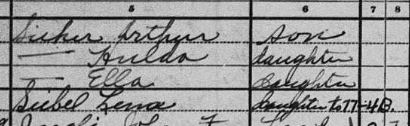
We genealogists spend a lot of time grumbling about census enumerators with illegible handwriting or those who were just plain careless.  But I stumbled across a wonderful enumerator today, surnamed Eddibert - he added the census page and line number of the head of household for people who were not living with their families.  Here's an example:

Source:  Otto W. Sisker household, 1920 US census, Hillsboro, Risley Township, Marion County, Kansas, SD 4, ED 74, pages 5A-5B, lines 47-54.  Accessed on familysearch.org on 20 October 2017.

Here Lena Siebel on the bottom line is not living with her family.  The enumerator added a note that she is a daughter to the person on line 77, page 4B.

That page is a couple pages back in the census, so let's take a look at it:
Source:  George Seibel household, 1920 US census, Hillsboro, Risley Township, Marion County, Kansas, SD 4, ED 74, page 4B, lines 77-80.  Accessed on familysearch.org on 20 October 2017.
And here on line 77, we see George Seibel, who is head of the household and Lena's father.  What a find if you are trying to untangle family relationships!  And you'll notice that the third person in this household is Grace Schmidt, whom he notes is the wife of the person on line 21, page 2A.  So he did it more than once.

I'm sure this was not standard practice, but it is valuable information today.

Wednesday, October 4, 2017

A Polish Mennonite

There have been ethnically Polish Mennonites for centuries.  That's where surnames such as Rogalsky, Sawatsky, Tilitsky, and Petkau come from.  Their forefathers were ethnic Poles, almost certainly Catholic, who became Mennonites in the 18th century or earlier.  But very few ethnic Poles have become Mennonites in North America.  One of those was John Glen #319928 (1864-1939), who joined the Kleine Gemeinde near Jansen, Nebr., having been baptized in 1891.

I came across him because he was friends with my grandparents, Cornelius #7529 (1884-1950) and Margaret Siemens; and his life intrigued me because as a Polish convert in Nebraska he was not a typical KG member.  Although he had children, none of them had any children; so he has left no descendants to research him and to preserve his memory.  So I have taken that task for myself; and he has proven to be quite an interesting, if elusive, person.

First, I decided to find his immigration record, but that proved to be a fruitless search, even with the search capabilities of Ancestry.com.  I also checked the Mennonite immigrant lists in Clarence Hiebert's book Brothers in Deed, Brothers in Need: A Scrapbook About Mennonite Immigrants from Russia, 1870-1885 and David Haury's book Index to Mennonite Immigrants on United States Passenger Lists, 1872-1904 but found nothing.  I suspected that I didn't have his Polish name and that "John Glen" was an Americanized version and that he had used his Polish name when he arrived.

So then I decided to narrow it down by finding his year of immigration in the census records.  But he reported variously that he had immigrated in 1874, 1884 (mentioned twice), 1885, and 1886.  That didn't help much.  But I did note that he said he had been naturalized, mentioning 1913 twice and 1915 once.

So I decided to look for his naturalization record since it should give his immigration date.  If either of the two years of naturalization was correct, he should have been living near Meade, Kans., since the Kleine Gemeinde had migrated there as a group in 1908.  When I searched in Ancestry, I found an index card for him in Meade, Kans., on 28 October 1913.
Naturalization index card for John Glen, 28 October 1913, Western District Court of Missouri, ARC: 572253; Records of District Courts of the United States, Record Group 21; National Archives at Kansas City, Missouri, accessed at Ancestry.com on 5 November 2016.
His naturalization card gave me a month of arrival (March 1884) and a port (New York City).  Fortunately, there were only two passenger ships that arrived in New York City in March 1884.  But Ancestry still couldn't find him with an automated search, so I browsed the records individually.  With only two ships, that was doable.

It took a while, but I came across a "Jan Glein" traveling in a group of 24 single men, mostly young, from Hungary, who arrived on 3 March 1884, on board the S.S. California from Hamburg.  The Kingdom of Hungary was part of the Austro-Hungarian Empire at that time, so that fit the fact on the naturalization card that he had been a subject or resident of Austria. But he gave an age of 24, meaning that he would have been born in 1859-1860, while the naturalization card gave a birth date of 10 May 1864.  But no one else on those two ships was even close, and enough of the facts fit so that I concluded it was probably he. 

Here is his name from the passenger manifest:
Passenger Jan Glein, Passenger Manifest of Vessels Arriving New York City, 3 March 1884, ship California, page 2, line 61.  Accessed at Ancestry.com on 2 December 2016.
Later I found him in the 1885 census records in Nebraska but not in the 1880 census records anywhere in the US (using the Ancestry search).  I also went manually through the entire 1880 Jefferson County, Nebr., census records, since that is where he was in 1885, but didn't find him.  So that was another piece of evidence that he arrived between 1880 and 1885.

I was so excited that I had manged to track down a single individual who changed his name shortly after arrival!  But of course, I wanted to find out who his parents were.

Sunday, October 1, 2017

Tracking Elderly Ancestors

Sometimes it may seem that the retirement years of a person's life are unimportant - genealogically speaking.  But tracking elderly ancestors can tell you a lot about family dynamics.  And sometimes the only way to find an ancestor in old age in the census is to look for his children since he might have been living with them.

Here's an example of my great-great-grandmother, Katharina Bergmann #7126 (1834-1916).  In 1894, her second husband Martin Barkman died.  She continued to own an eighty-acre farm near Jansen, Nebr., that she had bought in 1879, shortly after her first husband died.  But I suppose that her son-in-law, Klaas R. Friesen, farmed her land because he had purchased the neighboring eighty acres in 1892 in the inheritance settlement of her first husband.  Klaas was married to her second daughter, Aganetha Barkman (1858-1931).

Here is a snippet from a plat map.  The land in green to the south is the tract that Klaas R. Friesen had bought from the other heirs in 1892, while the land in blue to the north is the tract that Katharina had purchased herself in 1879 just after her first husband died.

Plat Book of Jefferson County, Nebraska (Northwest Publishing Co., 1900) 7.  Accessed at Fairbury Public Library, Fairbury, Nebraska.
Then in 1899, at age 64, Katharina sold her northern eighty acres to the same son-in-law, Klaas R. Friesen for $2000, which made sense because he owned the adjoining piece of land.  Klaas gave his mother-in-law a mortgage for $1000, so he must not have been able to pay the entire amount at once.  Here is a snippet from the deed:
Warranty Deed, Katharina Bergmann to Klaas R. Friesen, 27 March 1899, Jefferson County, Nebraska, Deed Book 25:165, Register of Deeds, County Courthouse, Fairbury.
A year later at age 65 in the 1900 census we find her living with her oldest daughter, Heinrich and Katharina Reimer, a couple miles away in Rock Creek Precinct just south of Jansen.
Henry Reimer household, 1900 US Census, Nebraska, Jefferson County, Rock Creek Precinct, SD 4, ED 92, p. 15, family 301, lines 31-41.  Accessed at Ancestry.com on 7 November 2012.
The census even gives her relationship as mother-in-law and her birth month of December 1834 - very helpful information in identifying her and confirming her birth date.

In the 1910 census at age 75, she was back in Cub Creek Precinct living with the Klaas R. Friesens, her second daughter's family.  At least two of her daughters and their families, Heinrich and Katharina Reimer and Jacob and Anna Reimer, had moved to Meade, Kans., in 1908; so she moved back to her second daughter then.  It was even a three-generation household, as her newly-wed granddaughter and husband, Henry and Aganetha Kroeker, were also living at home.
Klaas R. Friesen household, 1910 US Census, Nebraska, Jefferson County, Cub Creek Precinct, SD 4, ED 90, p. 11, family 117, lines 37-45.  Accessed at Ancestry.com on 7 November 2012.
Then at age 80 in 1915, she was recorded living with her third daughter's family, Jacob and Anna Reimer near Meade, Kans.  I wonder if she moved from Nebraska to Kansas because her son-in-law Klaas Friesen was getting sickly - he died in 1922 at age 65.  But this is only speculation.  Here is a snippet from the Kansas state census:
Jacob Reimer family, Kansas state census 1915, Meade County, Logan Township, p. 9, lines 10-21.  Accessed at Ancestry.com on 26 June 2016.
My grandmother has told my mother that both of her grandmothers lived in her parents' house at the same time and that sometimes they would argue so severely that her father, Heinrich Reimer, had to come in from the field to settle matters.  I haven't found them living together in any census record, but this story sounds true.

Finally my grandmother Margaretha H. Reimer #321744 (1895-1993) recorded in her family register that her grandmother Katharina Bergman died on 25 November 1916 at age 81 at Jacob Reimer's, the same place she was staying in the 1915 census.
Freundschaft Register Buch (Relatives Register Book), Family records of Margaretha H. (Reimer) Siemens, book begun in 1923, covers years 1808 – about 1980, held by Anna (Siemens) Fast, Hillsboro, Kansas.
By tracing Katharina Bergmann through the documents in her retirement years, we can see that three of her daughters cared for her.  I don't think we can say that she wasn't close to her other children - since the census records are only snapshots, perhaps they don't catch the times when she lived with them.  We also learn that she sold her land to a son-in-law and that he wasn't prosperous enough to pay the full amount at once.  It's important not to ignore the last couple decades of her life.

The key to tracing the last years of elderly ancestors is often to know the names of their sons-in-law.  Most often, they lived with their married daughters, so you need to know the names of their husbands.  If I hadn't known that her daughters married Klaas R. Friesen, Henry F. Reimer, and Jacob F. Reimer, I might not even have found some of the census or land records.  This is probably the most important reason to follow the children of your direct ancestors at least until the parents pass away.


Friday, June 2, 2017

Searching for Clusters of First Names

Sometimes you are searching for someone with a complicated or easily-misunderstood surname, he can be really hard to find.  His surname can be spelled so many different ways.

For example, last night I was searching in the census records at Ancestry.com for an Ezra Lorenz whom I knew had lived in Durham, Kansas.  My only result was an Edward Lawrence from New Jersey.  I tried different spellings of Lorenz.  I tried his wife Sara Lorenz, which didn't help either.  I tried his son Clarence - no luck.

But this morning I tried my last-ditch strategy:  I searched for all the first names that I knew in the family without the surname because first names are less-likely to be garbled.  My search parameters were

First Name - Ezra
Born - 1884
Spouse - Sara
Child - Alvina
Child - Clarence
Child - Pearl
Child - Vernedda
Location - Marion County, Kansas

And immediately the results popped up with all their census records.  When I looked at the 1920 census, I saw why my original search didn't work - the handwriting was very sloppy, and he had been indexed as "Ozra Leonz."  His wife was indexed as "Kate" and the children as "Athena," "Clarence," "Pearly," and "Beatric."  Somehow these were close enough for the Ancestry search engine to find the family.


I think this works because first names are more likely to be correctly transcribed and because there were no other clusters of identical first names.  I found my grandfather on a very messy page of the 1921 Canadian census this way when I had given up all hope of finding him.

If you're having no luck finding a family, try searching just on all the first names you know and a location.