Showing posts with label B. H. Unruh. Show all posts

Friday, August 26, 2016

Using the 1811 Elbing, West Prussia, Census


In late 1811, a census was taken of the Elbing region where many Mennonites lived.  This city was under a special administrative regime because in the late 1600s, the King of Poland had used it as collateral for a loan from the Duke of Prussia.  This led to a centuries-long dispute about whether the loan had been repaid and whether the Prussian dukes (later kings) could take the city’s revenues to repay the loan.  In 1811, the city was still under a special administration as a result.  Thus, a separate census was taken in 1811.

My 5-greats-grandfather, Gerhard Fast #660202 (1739-1828), had five siblings whom I have identified, and I am trying to piece together their descendants.  One of those siblings was Klaas Fast #706529 (ABT 1745-1820), and he had a son Gerhard #117515 (ABT 1774-1830) who lived in the village of Fürstenauerweide, which in the Elbing region.  Someone had entered the birth dates of the younger Gerhard’s six children from the Fürstenau Lutheran church book, and I found the death dates for five of those children who died young in the same church book.  (Imagine how shattering it must have been to lose five of six children before the age of nine.)  Here is how the family looked:
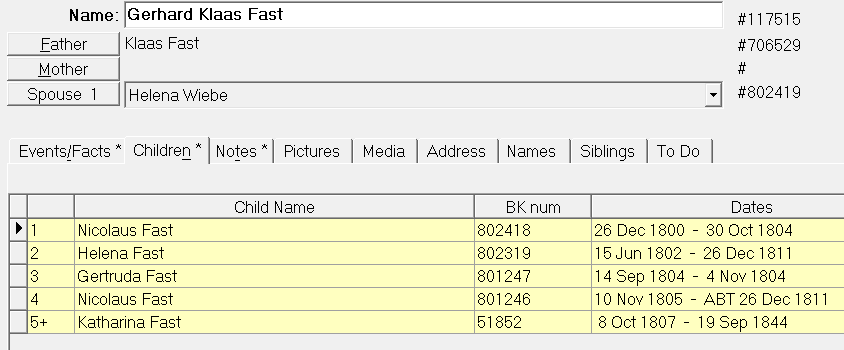
Gerhard Klaas Fast, Genealogical Registry and Database of Mennonite Ancestry, CD-ROM, version 6 as updated by author (Fresno:  California Mennonite Historical Society, 2013), individual #117515.
Then I got to wondering if he was in the 1811 Elbing census, which was taken near the end of 1811, so I checked Adalbert Goertz’extraction.  And I found him as expected in Fürstenauerweide:
Gerhard Fast household #10, 31 December 1811, Fuerstenauerweide village #4, Elbing Territory census, West Prussia, Zesp. I/10, Nr. 44, Archiwum Panstwowe w Gdansku, Gdansk, Poland, n. p.  Extraction accessed http://mennonitegenealogy.com/prussia/elbing2.htm on 26 August 2016.
I’m sure it is him because the family data matches.  Notice that no wife is listed – there is only a blank in the space where the age of the wife would be shown.  His first wife, Helena Wiebe died in October 1811, so it fits that she is not listed.  Three children’s ages are listed – 10, 8, and 3 years.  He had three children still living, Helena, Nicolaus, and Katharina, whose ages were 9, 6, and 4 years based on their exact birth dates from the Lutheran church book.  Remember that ages in census records were not very exact back then, so this fits well enough.  Two of those children, Helena and Nicolaus, died in late December 1811, but they are still listed in the census.  Since the census was taken near the end of 1811, the family information fits the census.

The census also adds another useful piece of information – he was an Arbeitsman, a laborer.  This means that there is not much point in searching for land records in Fürstenauerweide.  And it also tells us that they were poor.  In 1819, Gerhard Fast and his second wife Barbara Isaac and his remaining daughter Katharina emigrated to Russia, to start a new life as a landowner in the village of Rudnerweide, Molotschna Colony.
Gerhard Fast emigration, 1819, household #23, Emigration records, Benjamin Heinrich Unruh, Die niederländisch-niederdeutschen Hintergründe der mennonitischen Ostwanderungen im 16., 18. und 19. Jahrhundert (Karlsruhe:  Heinrich Scheider, 1954), p. 367.  Accessed on digital copy from California Mennonite Historical Society, Fresno, California.

Friday, August 5, 2016

Checklist for West Prussian Research

If you are researching Mennonite genealogy in Poland and West Prussia, here is a checklist of items to research.  This might help in doing the "reasonably exhaustive" research that is required by the Genealogical Proof Standard.  I'm most familiar with the Gross Werder and Danzig regions in the late 18th and early 19th centuries, so my list will focus on those areas.

A.  Censuses
  1. Census 1772-1773 - Prussia did a census shortly after it seized a large swath of territory from Poland.
  2. Census 1776  - Mennonites only
  3. Land registration 1789 - Mennonite landowners only
  4. Census 1793 - Danzig region only.  Taken after Prussia seized this area from Poland.
  5. Census 1811 - Elbing Territory, Mennonites only.  This region was administered separately because the King of Poland had used Elbing as collateral for a loan from Prussia in the late 17th century.
B.  Land Records
  1.  1782 Grundbücher - In 1782, Prussia instituted a system of land records, some of which have survived to the present day in the Malbork, Poland, archives.  Glenn Penner scanned tens of thousands of pages of these records and posted them at the Mennonite Library and Archives web site.
  2. Various Land Records online at MennoniteGenealogy.com/prussia.  Adalbert Goertz extracted lists of land owners.
C.  Prussian Archival Records

Mennonites were a people of significant concern to the Prussian government because they refused to serve in the Prussian army.  Consequently Prussian archival records at Berlin, Gdansk, Malbork, etc., have many files about Mennonites.  Many of these can be accessed on LDS microfilms.

D.  Church Records

  1. Mennonite - By the latter third of the 18th century, all Mennonite churches were keeping records of marriages, births, deaths, and baptisms.  Some had even started in the early 17th century.   A list of most (perhaps all) of the surviving church books can be found here
  2. Catholic - Before the Prussian seizure in 1772, many Mennonites were obligated to pay a fee to the Catholic parish for vital events.  The priest had to record this fee in a ledger to be audited by the diocese and often recorded genealogical information as well.
  3. Lutheran/Evangelical - Mennonites living in Lutheran-dominated areas of Poland often had to record their vital events at the Lutheran parish.  Soon after the partition of Poland in 1772, the Lutheran church books became the official registry for vital statistics, which continued until the introduction of civil registration of vital events in the 1870s.

E.  Family Records

There are letters, diaries, and other personal records that have survived to the present day.  I myself have never seen or used any, but I've seen them referenced in articles on Mennonite history and genealogy.

F.  B. H. Unruh, Die niederländisch-niederdeutschen Hintergründe der mennonitischen Ostwanderungen im 16., 18. und 19. Jahrhundert

B. H. Unruh wrote a history of Mennonite settlement in the Vistula Delta and emigration to Russia.  He included an appendix with a couple hundred pages of genealogical data - one valuable section connects Prussian emigration records with Russian immigration records.

Of course, there are many more records, but these are the most important ones that can be accessed online or on microfilms.  Over time I'll write posts on each of the topics and provide more information on how to access and use them.

Do you know of any major record groups that I have missed?