Showing posts with label Katharina Bergman (1834-1916). Show all posts

Sunday, October 1, 2017

Tracking Elderly Ancestors

Sometimes it may seem that the retirement years of a person's life are unimportant - genealogically speaking.  But tracking elderly ancestors can tell you a lot about family dynamics.  And sometimes the only way to find an ancestor in old age in the census is to look for his children since he might have been living with them.

Here's an example of my great-great-grandmother, Katharina Bergmann #7126 (1834-1916).  In 1894, her second husband Martin Barkman died.  She continued to own an eighty-acre farm near Jansen, Nebr., that she had bought in 1879, shortly after her first husband died.  But I suppose that her son-in-law, Klaas R. Friesen, farmed her land because he had purchased the neighboring eighty acres in 1892 in the inheritance settlement of her first husband.  Klaas was married to her second daughter, Aganetha Barkman (1858-1931).

Here is a snippet from a plat map.  The land in green to the south is the tract that Klaas R. Friesen had bought from the other heirs in 1892, while the land in blue to the north is the tract that Katharina had purchased herself in 1879 just after her first husband died.

Plat Book of Jefferson County, Nebraska (Northwest Publishing Co., 1900) 7.  Accessed at Fairbury Public Library, Fairbury, Nebraska.
Then in 1899, at age 64, Katharina sold her northern eighty acres to the same son-in-law, Klaas R. Friesen for $2000, which made sense because he owned the adjoining piece of land.  Klaas gave his mother-in-law a mortgage for $1000, so he must not have been able to pay the entire amount at once.  Here is a snippet from the deed:
Warranty Deed, Katharina Bergmann to Klaas R. Friesen, 27 March 1899, Jefferson County, Nebraska, Deed Book 25:165, Register of Deeds, County Courthouse, Fairbury.
A year later at age 65 in the 1900 census we find her living with her oldest daughter, Heinrich and Katharina Reimer, a couple miles away in Rock Creek Precinct just south of Jansen.
Henry Reimer household, 1900 US Census, Nebraska, Jefferson County, Rock Creek Precinct, SD 4, ED 92, p. 15, family 301, lines 31-41.  Accessed at Ancestry.com on 7 November 2012.
The census even gives her relationship as mother-in-law and her birth month of December 1834 - very helpful information in identifying her and confirming her birth date.

In the 1910 census at age 75, she was back in Cub Creek Precinct living with the Klaas R. Friesens, her second daughter's family.  At least two of her daughters and their families, Heinrich and Katharina Reimer and Jacob and Anna Reimer, had moved to Meade, Kans., in 1908; so she moved back to her second daughter then.  It was even a three-generation household, as her newly-wed granddaughter and husband, Henry and Aganetha Kroeker, were also living at home.
Klaas R. Friesen household, 1910 US Census, Nebraska, Jefferson County, Cub Creek Precinct, SD 4, ED 90, p. 11, family 117, lines 37-45.  Accessed at Ancestry.com on 7 November 2012.
Then at age 80 in 1915, she was recorded living with her third daughter's family, Jacob and Anna Reimer near Meade, Kans.  I wonder if she moved from Nebraska to Kansas because her son-in-law Klaas Friesen was getting sickly - he died in 1922 at age 65.  But this is only speculation.  Here is a snippet from the Kansas state census:
Jacob Reimer family, Kansas state census 1915, Meade County, Logan Township, p. 9, lines 10-21.  Accessed at Ancestry.com on 26 June 2016.
My grandmother has told my mother that both of her grandmothers lived in her parents' house at the same time and that sometimes they would argue so severely that her father, Heinrich Reimer, had to come in from the field to settle matters.  I haven't found them living together in any census record, but this story sounds true.

Finally my grandmother Margaretha H. Reimer #321744 (1895-1993) recorded in her family register that her grandmother Katharina Bergman died on 25 November 1916 at age 81 at Jacob Reimer's, the same place she was staying in the 1915 census.
Freundschaft Register Buch (Relatives Register Book), Family records of Margaretha H. (Reimer) Siemens, book begun in 1923, covers years 1808 – about 1980, held by Anna (Siemens) Fast, Hillsboro, Kansas.
By tracing Katharina Bergmann through the documents in her retirement years, we can see that three of her daughters cared for her.  I don't think we can say that she wasn't close to her other children - since the census records are only snapshots, perhaps they don't catch the times when she lived with them.  We also learn that she sold her land to a son-in-law and that he wasn't prosperous enough to pay the full amount at once.  It's important not to ignore the last couple decades of her life.

The key to tracing the last years of elderly ancestors is often to know the names of their sons-in-law.  Most often, they lived with their married daughters, so you need to know the names of their husbands.  If I hadn't known that her daughters married Klaas R. Friesen, Henry F. Reimer, and Jacob F. Reimer, I might not even have found some of the census or land records.  This is probably the most important reason to follow the children of your direct ancestors at least until the parents pass away.


Wednesday, September 20, 2017

Inheritance Anomalies

Mennonites have practiced Flemish inheritance customs since at least the 1700s, and probably before that; so when an inheritance doesn't follow the pattern, it's a big deal.

My great-great-grandmother Katharina Bergmann #7126 (1834-1916) lost her first husband, Johann Barkmann, in 1879 in Nebraska.  Within a couple years, she re-married to her brother-in-law, Martin Barkmann #3982 (1821-1894), who had also lost a couple wives.  Katharina had 80 acres of land; while Martin was a moderately wealthy man because he owned the land where Jansen, Nebr., was established in 1886.  When they got married, according to Flemish/Mennonite custom, both owned all of their property equally, regardless of who owned it before they were married.

Key Facts - Katharina had surviving children from her first marriage, but Martin had no surviving children or grandchildren from his two marriages.  He did have siblings, however.

In 1892, when Martin was 70 years old, he made a will, which would leave his wife $700 if she survived him and the rest of his estate to his siblings.  I found that will in Martin's probate file at the Jefferson Co., Nebr., courthouse.  Here is the first paragraph of the will:
Will of Martin Barkman, 20 July 1892, Probate file #251, Jefferson County, Nebraska, Clerk of the County Court, Fairbury, Courthouse.
According to Mennonite custom, after he died in 1894, his wife Katharina would keep half of their property (both of "her" 80 acres and "his" land and a substantial amount of money).  The other half would go first to his children by blood while Katharina's children (i.e. his step-children) would get nothing.

But he had no living descendants, so then his siblings would equally divide Martin's half of all their property.  Three of Martin's siblings had already died before Martin died in 1894; but since they had children, these children (Martin's nephews and nieces) would divide their parents' shares.

What actually happened was the following: 
1) Katharina kept "her" 80 acres of land - According to Mennonite custom, Martin's siblings should have gotten half of this since that land was owned jointly and since they were Martin's heirs.  But the will said nothing about what to do with "Katharina's" property.
2)  Katharina got $700 in cash - Again, according to custom, Katharina should have gotten half of "his" cash and other financial assets.
3)  Martin's eight siblings each got a one-eighth share of "his" land and other assets - They should have gotten an eighth share of half of "his" land and other assets.

Everything was done legally because Martin had made a will.  But when he made the will, he was deliberately violating centuries of Mennonite custom.  Clearly, Martin intended to manage their assets separately, even though this violated the Mennonite concept of marriage and property.  I don't know if Katharina agreed with this or not.  I've found unsourced grumbling from "the church" about their marriage not being proper, and I wonder if it was because he did not share his material assets equally with his wife.  Violating custom in this way showed that he did not accept Mennonite teaching on a very important matter.

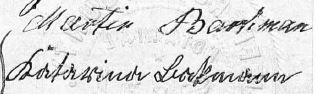
On another note - one nice thing about his will is that it contained their signatures.
I don't have many, if any, signatures of my great-great-grandmothers; so it is special to have her signature, even if it was from a document that cheated her out of part of her inheritance.

Saturday, September 16, 2017

Evidence for a Father - In a Surprising Place

Several months ago I wrote about my surprise when I found that my great-great-grandmother Katharina Bergmann's #7126 (1834-1916) father was listed as Jacob Barkman on her death certificate.  I described how I weighed the evidence and concluded that her death certificate was probably wrong and that her father was really Peter Peter Bergmann.  But I still had some doubts.

I found some evidence about her maiden name, and thus the surname of her father in a surprising place - the land records in the Jefferson County, Nebr., courthouse.  Katharina was widowed twice, when her first husband and my great-great-grandfather Johann Barkmann died in 1879 and again when her second husband Martin Barkmann died in 1894.  And each time while she was a widow, she conducted land transactions using the surname Bergmann.  In contrast, she used her married surname of Barkmann each time she was involved in a land transaction while she was married, so this is evidence of her maiden name.

A few weeks after her first husband Johann died, she used the surname Bergmann when she bought eighty acres of land that adjoined their home place.
Source:  Warranty Deed, Peter & Anganetha Heidebrecht to Katharina Bergmann, 4 November 1879, Fairbury, Nebraska, Deed Book P:202, Register of Deeds, Courthouse, Fairbury.
Her first name is cut off because it was in the crease of the deed book, but her last name is clear - "Bergmann."

After she was widowed a second time, she sold seventy-seven acres of land to her son-in-law Klaas R. Friesen and used the surname Bergmann.
Source:  Warranty Deed, Katharina Bergmann to Klaas R. Friesen, 27 March 1899, Jefferson County, Nebraska, Deed Book 25:165, Register of Deeds, County Courthouse, Fairbury.
She didn't use the surname "Bergmann" consistently - on two other deeds as a widow she used the surname "Barkmann."  But I think it's unlikely she would have used the name of Bergmann at all if it weren't her maiden name.

This is another good piece of evidence that her father's surname was Bergmann and not Barkmann.  When I analyzed her death certificate earlier, I felt that the evidence, while contradictory, was stronger that her father was Peter Peter Bergmann and not the Jacob Barkman listed on the death certificate.  Now the evidence is even stronger for Peter Peter Bergmann being her father.  And I certainly didn't expect to find it in the land records of Jefferson County, Nebr.

Collecting all the documents you can find and thinking about the implications of each one is crucial for doing good genealogy research.

Wednesday, September 7, 2016

More Death Certificate Gleanings


If you pay attention, almost any document can tell you a lot.  Let’s continue with the death certificate of my great-great-grandmother Katharina Bergman #7126 (1834-1916), about which I posted here and here.
Katherina Barkmann death certificate, died 25 November 1916, dated 27 November 1916, no. 60219, Office of Vital Statistics, Topeka, Kansas.
Date of Birth.   

First, her date of birth is only given as 28 December – no year.  But if we calculate her birth date by subtracting her age at death from her death date, we get a birth year of 1834.  Her granddaughter, Margaretha H. Reimer, recorded her birth date as 28 December 1834, in her family register, so that agrees.  But it sure would have been nice if the doctor had not failed to write the year.   Also, if you go back to the 1835 census in the previous post, you see that she was ¼ year old when the census was taken on 11 February 1835, which roughly agrees with a 28 December 1834 birth date.

Final Illness.   
Notice that the doctor attended her only on 22 November 1916, and that she died on 25 November 1916.  That means that she did not visit this doctor in the eight years that she lived in Meade from 1908 to 1916.  She was likely reasonably healthy for an elderly person and did not need to go to the doctor.  Very likely she had a stroke (the cause of death is “paralysis due to cerebral hemorrhage”) on the 22nd, so they called the doctor to come out, and he told them that it was hopeless and that there was nothing he could do.  Otherwise, he would likely have attended her in the three days before she died.

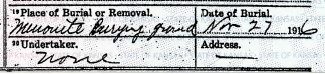
Burial.  

Next, notice that she was buried on the 27th, two days after her death.  There was no undertaker, so relatives would have prepared the body, just as had been done for thousands of years by nearly everyone. 

The burial location is “Mennonite burying ground.”  There is no cemetery with that name today, but if I didn’t know where she was buried, that at least tells me her grave is in one of the Mennonite cemeteries in Meade County.  Since I have visited her grave previously, I know that she was buried in the Emmanuel Mennonite Cemetery.
Tombstone of Katharina Barkman, Emmanuel Mennonite north cemetery, at S Road and 22nd Road, near Meade, Kansas, accessed at www.findagrave.com, memorial #25017516, on 29 June 2016.
Informant.  

Death certificates almost always list the informant who provided the non-medical information.  It is interesting to think about why this particular person was chosen as the informant.  In this case, it seems strange to me that Johann F. Bartel was the one.  She died at the home of her son-in-law, Jacob F. Reimer (according to my grandmother’s family register), so it would seem he should be the one who would talk to the doctor.  He was also the oldest among the sons and sons-in-law, so he would be the natural candidate.   But this required communicating in English with an outsider, a non-Mennonite, so perhaps Jacob F. Reimer did not feel comfortable doing that.  Or perhaps it was something as simple as Jacob F. Reimer being out in the barn when the doctor came.  I don’t have an answer, but it seems that Jacob F. Reimer would have been the natural one to be the informant, but he was not.

Don’t forget to milk a document for every bit of information that it can give you.

Tuesday, September 6, 2016

A Surprise on a Death Certificate


In a previous post, I described how I had gotten my great-great-grandmother’s [Katharina Bergman #7126 (1834-1916)], death certificate to prove her death location.  But there was a surprise on the death certificate – her father was Jacob Barkman!  This was completely unexpected because all the evidence I had said that her father was Peter Peter Bergman #12946 (b. 1810).

(Bear in mind that the surnames Barkman and Bergman are different spellings of the same name; and until about a century ago, the same individual would use both spellings interchangeably throughout his life.)
Katherina Barkmann death certificate, died 25 November 1916, dated 27 November 1916, no. 60219, Office of Vital Statistics, Topeka, Kansas.
 

At first I dismissed this new information.  After all, a death certificate is not an original source with regard to a person’s parentage.  The informant was Katharina’s son-in-law, Johann F. Bartel #63498 (1864-1937), who was born 30 years after her and in a different village.  It is likely that he never met her parents because they stayed behind in Russia when Katharina immigrated to the US with her husband and children in 1878, and he certainly wasn’t present at her birth.  And they were probably members of different churches in Russia (Ohrloff congregation for Katharina Bergman and Kleine Gemeinde for Johann Bartel), so their paths may not even have crossed in Russia.  Perhaps Johann Bartel was just wrong about her father.

Yet it is worth investigating – I would certainly like to know since I would be chasing the wrong ancestral line if he is right.  Where to start?

Let’s look at the 1835 census of Molotschna colony in Russia.  I have strong evidence that she was born on 16/28 December 1834, so she should be in the 1835 census.  In fact, we find her living with her parents Peter Peter Bergman and Aganetha Penner at Schönsee farm #3.  This census is my only evidence that her father was Peter Peter Bergman, but it’s fairly strong. 
Father Peter Bergman and daughter Katharina are boxed in red.  Source:  Petr" Iuliusov" Bergman" household, 11 February 1835, 8th Revision of Census of Russian Empire, Schoensee village, Molochanskii Mennonistskii Okrug, Melitopol'skii Uezd, Tavricheskaia Guberniia, household #3.  Found in Odessa Region State Archives, Odessa, Ukraine, Peter J. Braun Collection, Fond 89, Inventory 1, File 357, p. 167R-169.  Accessed on microfilm from California Mennonite Historical Society, Fresno, California.
Next let’s look at the Jacob Bergmans/Barkmans in the census to see if any of them have a daughter Katharina.  There is a very helpful index to the census produced by the Manitoba Mennonite Historical Society available online.  I find two Jacob Barkman’s in the 1835 census who are heads of households – one who lived at Tiege village, farm #20 and another at Rückenau #11.  (The one in Lichtfelde #23 is the same one as the one in Rückenau - he moved there in 1821 according to the census.)  The Jacob Barkman in Tiege has no daughter Katharina, but the Jacob Barkman in Rückenau does have a 3-year-old daughter Katharina.  Could this be my Katharina?  When I look for her in Grandma, I see that she is #6629, born in 1832, died in 1923, and married to Johann Koop.  So she is a completely different person.  So neither of the Jacob Bergmans in the 1835 census had a child Katharina that could be my great-great-grandmother.
Richard D. Thiessen, "Index to the 1835 Molotschna Census," Russian Mennonite Genealogical Resources web site, corrected version of 28 March 2010.  Accessed online at http://mennonitegenealogy.com/russia/1835cein.htm on 6 Sept 2016.
However, let’s go back to the census image above.  Note that Katharina Bergman had an uncle living in the same house, Jacob Bergman #102754 (b. ABT 1818).  According to the census, he is not married and has no children, which is not surprising since he is only 17 years old.  Nothing more is known about him in Grandma.  Could he have had a child out of wedlock, and it was covered up by calling my Katharina the daughter of his older brother Peter?  And then Johann Bartel revealed the family secret eight decades later to the Meade County coroner?  I think that is unlikely because if she were the illegitimate daughter, she would have been with the mother and not with the father’s family.

In this case all we can do is weigh two pieces of evidence regarding her parentage against each other – the census recorded three months after her birth versus the testimony of a son-in-law on her death certificate 81 years later.  With nothing better to go on, I have to choose the census that shows her father was Peter Peter Bergman because it is a contemporary source recorded by an enumerator from the village who should have known, but I will keep in mind that the death certificate shows Jacob Barkman as her father in case I find some new evidence later on.