Showing posts with label land records. Show all posts

Sunday, October 1, 2017

Tracking Elderly Ancestors

Sometimes it may seem that the retirement years of a person's life are unimportant - genealogically speaking.  But tracking elderly ancestors can tell you a lot about family dynamics.  And sometimes the only way to find an ancestor in old age in the census is to look for his children since he might have been living with them.

Here's an example of my great-great-grandmother, Katharina Bergmann #7126 (1834-1916).  In 1894, her second husband Martin Barkman died.  She continued to own an eighty-acre farm near Jansen, Nebr., that she had bought in 1879, shortly after her first husband died.  But I suppose that her son-in-law, Klaas R. Friesen, farmed her land because he had purchased the neighboring eighty acres in 1892 in the inheritance settlement of her first husband.  Klaas was married to her second daughter, Aganetha Barkman (1858-1931).

Here is a snippet from a plat map.  The land in green to the south is the tract that Klaas R. Friesen had bought from the other heirs in 1892, while the land in blue to the north is the tract that Katharina had purchased herself in 1879 just after her first husband died.

Plat Book of Jefferson County, Nebraska (Northwest Publishing Co., 1900) 7.  Accessed at Fairbury Public Library, Fairbury, Nebraska.
Then in 1899, at age 64, Katharina sold her northern eighty acres to the same son-in-law, Klaas R. Friesen for $2000, which made sense because he owned the adjoining piece of land.  Klaas gave his mother-in-law a mortgage for $1000, so he must not have been able to pay the entire amount at once.  Here is a snippet from the deed:
Warranty Deed, Katharina Bergmann to Klaas R. Friesen, 27 March 1899, Jefferson County, Nebraska, Deed Book 25:165, Register of Deeds, County Courthouse, Fairbury.
A year later at age 65 in the 1900 census we find her living with her oldest daughter, Heinrich and Katharina Reimer, a couple miles away in Rock Creek Precinct just south of Jansen.
Henry Reimer household, 1900 US Census, Nebraska, Jefferson County, Rock Creek Precinct, SD 4, ED 92, p. 15, family 301, lines 31-41.  Accessed at Ancestry.com on 7 November 2012.
The census even gives her relationship as mother-in-law and her birth month of December 1834 - very helpful information in identifying her and confirming her birth date.

In the 1910 census at age 75, she was back in Cub Creek Precinct living with the Klaas R. Friesens, her second daughter's family.  At least two of her daughters and their families, Heinrich and Katharina Reimer and Jacob and Anna Reimer, had moved to Meade, Kans., in 1908; so she moved back to her second daughter then.  It was even a three-generation household, as her newly-wed granddaughter and husband, Henry and Aganetha Kroeker, were also living at home.
Klaas R. Friesen household, 1910 US Census, Nebraska, Jefferson County, Cub Creek Precinct, SD 4, ED 90, p. 11, family 117, lines 37-45.  Accessed at Ancestry.com on 7 November 2012.
Then at age 80 in 1915, she was recorded living with her third daughter's family, Jacob and Anna Reimer near Meade, Kans.  I wonder if she moved from Nebraska to Kansas because her son-in-law Klaas Friesen was getting sickly - he died in 1922 at age 65.  But this is only speculation.  Here is a snippet from the Kansas state census:
Jacob Reimer family, Kansas state census 1915, Meade County, Logan Township, p. 9, lines 10-21.  Accessed at Ancestry.com on 26 June 2016.
My grandmother has told my mother that both of her grandmothers lived in her parents' house at the same time and that sometimes they would argue so severely that her father, Heinrich Reimer, had to come in from the field to settle matters.  I haven't found them living together in any census record, but this story sounds true.

Finally my grandmother Margaretha H. Reimer #321744 (1895-1993) recorded in her family register that her grandmother Katharina Bergman died on 25 November 1916 at age 81 at Jacob Reimer's, the same place she was staying in the 1915 census.
Freundschaft Register Buch (Relatives Register Book), Family records of Margaretha H. (Reimer) Siemens, book begun in 1923, covers years 1808 – about 1980, held by Anna (Siemens) Fast, Hillsboro, Kansas.
By tracing Katharina Bergmann through the documents in her retirement years, we can see that three of her daughters cared for her.  I don't think we can say that she wasn't close to her other children - since the census records are only snapshots, perhaps they don't catch the times when she lived with them.  We also learn that she sold her land to a son-in-law and that he wasn't prosperous enough to pay the full amount at once.  It's important not to ignore the last couple decades of her life.

The key to tracing the last years of elderly ancestors is often to know the names of their sons-in-law.  Most often, they lived with their married daughters, so you need to know the names of their husbands.  If I hadn't known that her daughters married Klaas R. Friesen, Henry F. Reimer, and Jacob F. Reimer, I might not even have found some of the census or land records.  This is probably the most important reason to follow the children of your direct ancestors at least until the parents pass away.


Thursday, September 28, 2017

Sorting Land Transactions by Date

When I go to a courthouse to do land research, I make spreadsheet of the land transactions that I find for each couple to summarize the information that I find.  Here's the link to a sample spreadsheet.  I feel it's important to sort the transactions by effective date - sometimes you see connections between transactions this way.

(Note that the effective date, the date that the document was signed, may differ significantly from the recording or filing date.  Occasionally someone delayed taking the deed to the courthouse for a long time.  The effective date is when the transfer of ownership and money actually happened - not the date when it was recorded in the courthouse to inform the public.)

When my great-grandfather Heinrich Reimer #317342 (1856-1923) moved from Jansen, Nebr., to Meade, Kans., in September 1908, he sold his land in Nebraska and bought land in Kansas.  Some of the transactions line up neatly.  For example:
  • He sold 80 acres in Nebraska for $5000 on 27 May 1908.  
  • Then he proceeded to buy 160 acres in Kansas for $4500 on 22 August 1908
  • And he bought another 80 acres in Kansas on 20 October 1908 for $2000.  
It seems very likely that his sale of land in Nebraska for $5000 funded a large part of his purchase of land in Kansas for $6500.  He didn't buy all of his Kansas land with the proceeds from sales in Nebraska, but there are several tracts that he bought this way.  Since I sorted the transactions by date (instead of grouping the Nebraska and Kansas transactions separately), it's easy to see which transactions occurred close together.

In another example, my great-grandfather Jacob Suderman #319370 (1856-1906) and his family moved from Buhler, Kans., to Fairchilds, Tex., in 1898.
  • In preparation for the move, he bought 334 acres in Texas for $3343 on 1 December 1897, using a lien from the seller for the purchase.  
  • But he paid that lien in full by 18 August 1898.  
  • Then he sold his Kansas land three weeks later on 8 September 1898 for $5700.  
Obviously, he didn't need the proceeds from his Kansas sale to pay the lien on his newly-purchased Texas land.  Based on this sequence of events and on other things (property tax records and his obituary), it is clear that he was a moderately wealthy man.  But I might have missed this small but significant detail if I hadn't sorted the land transactions by date.


Wednesday, September 27, 2017

Deeds of Sale May Give More Information

Sometimes when you are doing land research in the courthouse, you may run across a deed with your ancestor's name but you're not sure if this is your ancestor or a person of the same name.  This situation usually occurs when you are searching the grantor-grantee (or direct-indirect) indices and find a tract of land that you didn't know that your ancestor owned.

Here is an example.  I found a tract of land in Jefferson County, Nebr., where my great-grandfather Heinrich F. Reimer #317342 lived.  It was purchased by "Henry Reimer," but this piece of land was several miles from where he lived, so I wasn't sure if it was he or another Henry Reimer.  Here is a scan of the grantor-grantee information:
Warranty Deed, Sarah J. & Abr. F. Rempel to Henry & Katharina Reimer, 6 June 1903, Jefferson County, Nebraska, Deed Book 29:636, Register of Deeds, County Courthouse, Fairbury.

But if I check the tract index at the courthouse, I can find where "Henry Reimer" sold this piece of land.  In many, if not all, states, the sales deed shows the wife's name as well as the husband's.  This is because in most states a married couple owned property jointly if it was acquired while they were married.  So the wife would need to agree to sell her interest as well.  Here is the sales deed:
Warranty Deed, Henry & Katharina Reimer to Frank L. Rain, 27 May 1908, Jefferson County, Nebraska, Deed Book 37:431, Register of Deeds, County Courthouse, Fairbury.
The same tract of land was next sold by "Henry Reimer and Katharina Reimer, husband and wife."  BINGO!  My great-grandmother's name was Katharina, so the sales deed shows that the purchase is his.  For some reason, he bought eighty acres of land some distance from his farm and home.

Another time, I found a tract of land purchased by Katharina Fast in McPherson Co., Kans.  I knew that my great-grandmother Katharina (Penner) Fast #86813 (1852-1940) had actually lived in that section, so without question I believed it was she.  But many years later when I decided to go back to the county courthouse, I found that that tract was sold in the 1950s by a Katharina Fast living in California.  Since my great-grandmother died in 1940 and never lived in California, I realized that she was not the seller and therefore not the buyer and that I had made a faulty assumption.  Then I found a deed where her daughter Minnie Fast, my great-aunt, actually bought a nearby tract of land in that section.  So my great-grandmother never actually owned land there.  But again it was the sales deed that gave me the clue I needed.

Saturday, September 16, 2017

Evidence for a Father - In a Surprising Place

Several months ago I wrote about my surprise when I found that my great-great-grandmother Katharina Bergmann's #7126 (1834-1916) father was listed as Jacob Barkman on her death certificate.  I described how I weighed the evidence and concluded that her death certificate was probably wrong and that her father was really Peter Peter Bergmann.  But I still had some doubts.

I found some evidence about her maiden name, and thus the surname of her father in a surprising place - the land records in the Jefferson County, Nebr., courthouse.  Katharina was widowed twice, when her first husband and my great-great-grandfather Johann Barkmann died in 1879 and again when her second husband Martin Barkmann died in 1894.  And each time while she was a widow, she conducted land transactions using the surname Bergmann.  In contrast, she used her married surname of Barkmann each time she was involved in a land transaction while she was married, so this is evidence of her maiden name.

A few weeks after her first husband Johann died, she used the surname Bergmann when she bought eighty acres of land that adjoined their home place.
Source:  Warranty Deed, Peter & Anganetha Heidebrecht to Katharina Bergmann, 4 November 1879, Fairbury, Nebraska, Deed Book P:202, Register of Deeds, Courthouse, Fairbury.
Her first name is cut off because it was in the crease of the deed book, but her last name is clear - "Bergmann."

After she was widowed a second time, she sold seventy-seven acres of land to her son-in-law Klaas R. Friesen and used the surname Bergmann.
Source:  Warranty Deed, Katharina Bergmann to Klaas R. Friesen, 27 March 1899, Jefferson County, Nebraska, Deed Book 25:165, Register of Deeds, County Courthouse, Fairbury.
She didn't use the surname "Bergmann" consistently - on two other deeds as a widow she used the surname "Barkmann."  But I think it's unlikely she would have used the name of Bergmann at all if it weren't her maiden name.

This is another good piece of evidence that her father's surname was Bergmann and not Barkmann.  When I analyzed her death certificate earlier, I felt that the evidence, while contradictory, was stronger that her father was Peter Peter Bergmann and not the Jacob Barkman listed on the death certificate.  Now the evidence is even stronger for Peter Peter Bergmann being her father.  And I certainly didn't expect to find it in the land records of Jefferson County, Nebr.

Collecting all the documents you can find and thinking about the implications of each one is crucial for doing good genealogy research.

Getting Out of the Doldrums

I've been in the genealogical doldrums lately.  I had an enjoyable time working on my Fast 1776 census project that I summarized here.  I made of lot of progress on other Fast families that so far are not connected to my own, but it also wore me out.  Thus, I haven't posted for quite a while.

I decided the best way to get out of my genealogical doldrums would be to do a fun project that would likely yield some good results.  I haven't researched my Reimer family (maternal grandmother's family), who lived at Jansen, Nebr., so I decided to make a trip to the Jefferson County courthouse.  And it proved to be just what I needed.

Just seeing the beautiful and unique Jefferson County courthouse would be enough to get any person out of the doldrums.
Source:  Wikipedia


I decided to focus on land and probate records because my great-grandfather Heinrich F. Reimer #317342 (1856-1923) had gone from being a simple farmer who owned 120 acres of farmland in 1900 (per 1900 Jefferson County plat map) to a man who gave two quarters of farmland to each of his eight children (2560 acres total) by the time he died in 1923.  Clearly there is an interesting story here.

I also wanted to find the probate for my great-great-grandfather Johann Barkmann #317873 (1827-1879).  He died of typhoid fever in Jefferson County, Nebr., only a year after arriving from Russia.   I knew very little about what he did after he arrived in America, so I thought that his probate file might answer some of those questions.

I'll share the results of my trip in following posts.

Tuesday, May 2, 2017

Knocked Down a Brick Wall (Part III)

See Part II for the previous part of this story.

I had been staring at the list of baptisms and marriages from Mennonite church books in West Prussia in Part II for a couple months and not making any progress.  But then Glenn Penner sent me a record related to a Martin Fast in Schönbaum from the Schönbaum Lutheran church book on LDS film #208392, and they proved to be the key to unraveling the mystery.  Getting help from a fellow genealogist is always a good idea.

This is what Glenn sent me in blue:


Deaths:
26 Dec 1797 Frau Maria geb. Wiens eine Mennonitin, des Martin Fast Eigengaertner und Hackenbudner zu Schoenbaum 38J

The record says that Martin Fast's wife Maria Wiens died on 26 December 1797.  Suddenly I remembered another record that I had looked at months ago that contained both Martin Fast and Maria Wiens!  That was a land record from the village of Fürstenauerweide, where Maria Wiens inherited a 1/8 share of a piece of land from her parents.  Could this be the same Martin Fast and Maria Wiens in that land record?

Here is an image of that land record:
Fuerstenauerweide Grundbuch Blatt 13, Kreis Elbing, Malbork, Poland, Archive, Fond 341, File 198.  Accessed online at https://mla.bethelks.edu/archives/VI_53/Malbork/Fuerstenauerweide/Fuerstenauerweide%20Grundbuch%20Malbork%20Archives%20Fond%20341%20File%20198/IMG_0872.JPG on 25 July 2016.
Maria Wiens was one of four children who each inherited a 1/8 interest in tract #3 in Fürstenauerweide.  Since she was married, it gave her husband Martin Fast.  And it listed their six children, Peter, Johann, Isaac, Jacob, Cornelius, and Catharina.  These were six of the seven children that I suspected were children of my Martin Fast, children who were listed in my Excel database:
So now I had the six children definitely tied together.  And I had their mother Maria Wiens.  The last child Anna (line #599) turned out to be the child of Martin Fast's second wife, so she would not have been listed in the land document as an heir of the first wife.

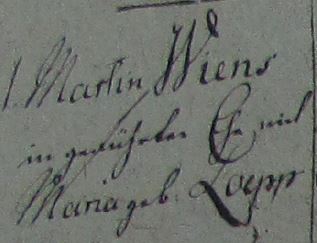
Even better, the land document listed Maria Wiens' parents, Martin Wiens and Maria Loepp:

After doing a little more research, here is the descendant chart that I ended up with.  The people that I knew about a couple months ago when I started this project are circled in red.
While it's hard to read the details on this small chart, I added Martin Fast's wife, Maria Wiens, who was my 4-greats-grandmother and her parents, my 5-greats-grandparents Martin Wiens and Maria Loepp and a bunch of collateral ancestors as well.

Some days I feel as though I don't make much progress in my genealogy research, but this was one of those days when it all came together. 

Friday, November 25, 2016

Going to the Courthouse - Land Records - Case Study

Volumes of land records piled high on a counter in the vault in a county courthouse can be a monumentally boring thing.  Or they can bring a family history to life.  Let me give an example of how I found them to put flesh on the bones of my family's history.

By 1921, my grandfather David D. Fast #112786 (1884-1974) was 37 years old, single, and owned a section of good farm land near Hooker, Oklahoma.  On 28 February 1921, he borrowed $10,000 from C. H. Bailey of Hutchinson, Kansas, something that I found in the land records at the Texas County courthouse (Mortgage, D. D. Fast to C. H. Bailey, 28 February 1921, Texas County, Oklahoma, Deed Book 96:128, County Clerk's Office, Courthouse, Guymon).  When I showed the mortgage to my uncle, he said Grandpa used that money to buy new John Deere farm equipment; and here is a picture from a local history book showing my grandfather using that equipment to harvest wheat.
Source:  Hardesty History (Hardesty, Okla.: Hardesty Extension Homemakers Group, 1973) 2.
He never paid off the loan, instead paying the interest yearly and rolling it over in 1926.  By this time he was married with four children.  When the Great Depression and the Dust Bowl hit, he couldn't pay the mortgage; and on 4 August 1931, he sold his section of farm land, which included the family home to the same C. H. Bailey, apparently for a bargain price.  My dad had been born on 10 July 1931, less than a month before the family lost the farm, so it must have been an incredibly stressful time.  Here is a copy of the deed, which I found in the courthouse, when Grandpa had to sell his farm:
Warranty deed, D. D. & Elizabeth Fast to C. H. Bailey, 4 August 1931, Texas County, Oklahoma, Deed Book 170:366, County Clerk's Office, Courthouse, Guymon.
My grandfather lost the farm equipment as well, and the family moved about ten miles away to an old house near Hardesty, Oklahoma, built in the 1880s of blocks cut from soft chalk rock.  My oldest aunt remembers the family belongings piled into a horse-drawn wagon while the family drove their car to the "new" home, known as the Rock House.  The following years of the Great Depression were incredibly trying with four small children and another one on the way and not enough food or coal to heat with.

But my grandfather was an indomitable optimist, and he managed to save a few head of cattle out of the debacle.  He had always wanted to be a rancher instead of a farmer and had made a few attempts to get into ranching.  But now he had no choice since he needed to make a living and all he had left were a few cattle.  He rented some ranch land around the Rock House and eventually built up a good herd.  By the 1950s, he owned 680 acres of excellent ranch land and rented another 1320 acres.  At the age of 78 in 1962, when most men his age were retired or already dead, he built his dream home on his ranch. He lived in it another 12 years, until he died in 1974 at age 90.

Here is the deed, again from the courthouse, for the first 80 acres of land that he bought in 1947, the first time that he had owned real estate in 16 years:
Warranty deed, Minnie Binkley to D. D. & Elizabeth Fast, 27 May 1947, Texas County, Oklahoma, Deed Book 277:451, County Clerk's Office, Courthouse, Guymon.
 Why was it important to find the mortgages and deed in the courthouse?  My aunt had written up her recollections in an excellent family history, but she was a young girl at the time and didn't know many of the financial and business details.  When I showed them to her and to my uncle, it sparked memories of the farm equipment, the bill collectors, and the move to the Rock House.  Neither of them had known exactly why their father had lost the farm, the amount borrowed, the many years spent rolling over the loan without repaying it, and exactly when it had been foreclosed.  But combining documents and memories added to the family history that my aunt had already done.

Courthouse documents alone can be fashioned into an interesting story if you think what it must have been like to experience the events that they represent.  And adding memories and family histories to the mix can make it truly exciting.

Friday, November 18, 2016

Going to the Courthouse - Land Records

One of the most interesting things to research at a courthouse is the land records.  In the United States, land records are public; so they are made available for public inspection.  You can see and use the records for free, although you usually have to pay if you want copies.  Thus, anyone can walk into the courthouse during business hours and view them.

In the county clerk's office (the holder of the land records might be called something else in your state), you should tell them that you are doing family history research and when and where your family lived in the county.  Usually an employee in the clerk's office will briefly show you where the record books are and explain how they can be used.  There is not usually much hand-holding, although most employees are glad to answer a few questions; but they do have their own work to do and guiding researchers is not part of it.  Try to be a good citizen to smooth the way for future genealogists.

Typical shelves of deed books, from Renssellaer County, New York.  Source:  http://www.timesunion.com/local/article/reverter-clause-ties-up-sale-3785686.php

If you don't have a legal description of the land, then you should tell the employee where your family lived and ask them to show you on a map the township and range.  Or if you are looking for town lots, tell them the address, and they should show you where to look for those.

If you have a legal description, go to the tract book for that township and range.  Once you locate the township and range, then find the correct section.  Usually there is at least one page for each section.  Starting about the time your ancestor bought land, scan the list of grantors and grantees for the right name.  All types of transactions are listed together - warranty deeds, quit claim deeds, mineral leases and releases, mortgages and releases, etc.  Jot down the volume and page for the transactions that interest you.

Here is a snippet from a tract book from Texas County, Oklahoma.  Notice the section, township, and range numbers across the top.  Then there are columns for the grantor (seller, mortgagor, lessor, etc.) and grantee.  Next is an abbreviation for the type of instrument, such as WD for warranty deed and QCD for quit claim deed.  Next are columns with tick marks for each quarter-quarter this is involved in the transaction.  Finally, columns for the number of acres involved and most importantly the volume and page where you can find the recorded copy of the instrument.


Usually you can pull the books off the shelves yourself, but sometimes you have to ask an employee to get it for you.  You may have to ask about the organizational scheme of the books - sometimes they are shelved strictly by number but other times warranty deeds are together, mortgages are together, etc.  Sometimes the old books that are rarely used are in a vault somewhere.  When you find the instrument, enter all the data into your spreadsheet.  If you want a copy, ask an employee how it works and the cost.  They may make copies for you, or you may need to make them yourself.  Prices vary widely.  Digital photographs are usually forbidden.

Once you have all the transactions on the known tracts of land that your family owned, I like to check the grantor-grantee index to see if they owned land that I didn't know about.  This would also be the place to start if you don't know where they lived in the county.  This is an index for a period of years where all the transactions are indexed by last name.  So you might have a book for 1908-1920, 1921-1932, etc.  You should look in both the grantor and grantee sections in all the years that your family lived there.  It usually doesn't take too long because the book has many sections, for example, not just an F section but Fa, Fe, Fi, Fo, and Fu.  The grantor-grantee index is also called the direct-indirect index, with the direct portion being that indexed by grantor and the indirect by grantee.

Sometimes it may be hard to find the right tract of land.  My grandfather Cornelius K. Siemens #7529 (1884-1950) lived at Satanta, Kansas, with his family from 1916-1918.  When I went to the Haskell County courthouse, I knew approximately where they lived; so I searched in the tract book for that township but found nothing.  Then I went to the grantor-grantee index, but again I found so Siemens.  So I went back to the tract book and searched again.  Then it dawned on me - there was a Jacob L. Plett listed as an owner of half a section.  That was Cornelius' father-in-law!  Apparently, Jacob Plett had purchased two quarters, one for each of his daughters in the Kleine Gemeinde community there.  That was why there were no Siemens in the records.  But this added an interesting dimension to the family story that I had not known.

Before you leave the county clerk's office, you should do two things.  First, check that you have a purchase and a sale transaction for every piece of land that your family owned.  Do the same for mortgages and mineral leases if you are keeping track of those.  However, often if land is transferred to heirs by probate, an instrument is not recorded, so note those items to check for in the probate records that you are going to get.  Second, ask an employee if they have any other interesting records - this could include school records, cemetery records, city directories, and many other things.

Before leaving the county, I like to go see the land in person that my ancestors owned and take a picture of myself at the site.  It gives me an appreciation for the physical environment in which they lived.  If some or all of the original buildings are there, it is even more interesting.  I also try to go by the Mennonite church where they worshiped and the cemetery if family members are buried there.

By now you should have a good idea of the socioeconomic status of your ancestors from the land they owned.  You may also have gained some insight into family dynamics based on transfers of land between family members.  I hope you will find research on land record at county courthouses to be as valuable as I have.

Wednesday, November 16, 2016

Going to the Courthouse - Legal Land Descriptions Explained

Many people are intimidated by the Public Land Survey System, the section, township, and range designations, used in much of the US; but it is a very effective way to locate land.  Surveyors laid out baselines that run east and west and meridians that run north and south, and all land in a specific area is measured from these lines.  For example, in downstate Oklahoma, the land is measured east and west of the Indian Meridian and north and south of the 1870 baseline.  But in the Oklahoma panhandle, the Cimarron Meridian and 1881 baseline are used.
Source:  https://www.blm.gov/cadastral/meridians/oklahoma.htm


Then townships that are six miles square are laid out (see the "Township Grid" in the image below), so a township contains 36 square miles.  The township number indicates how many townships the tract is north or south of the baseline.  The range number indicates how many townships the tract is east or west of the meridian.

Next each township is broken down into one-square-mile tracts called sections, and there are 36 of them in a township (see the middle white diagram of a township below).  Sections are always numbered in the same way, starting in the northeast corner of the township and running west 1-2-3-etc.  Then the next row south is numbered from the west back to the east 7-8-9-etc.  This continues until you get to 36 in the southeast corner.  A section contains 640 acres.

Sections can be broken in quarters of 160 acres and quarter-quarters of 40 acres (see the bottom left diagram below).   So you could have the northwest quarter of Section 12 (NW4 Section 12) or the northwest quarter of the southeast quarter (NW4 SE4 of Section 18), for example.  Tracts could also be divided into halves, e.g. the west of the southwest quarter (W2 SW4).  And here is a specific example - one small piece of my grandfather's ranch in Oklahoma was the southwest quarter of the southeast quarter of Section 11, Township 2 North, Range 17 East of the Cimarron Meridian.  This would be abbreviated SW4 SE4 11-2N-17ECM.  The directional part of the township and range numbers (north/south and east/west) and the meridian name are often left out when it is obvious what they would be (SW4 SE4 11-2-17).

Here is a diagram that shows how the system works:
Source:  http://www.geocommunicator.gov/geocomm/lsis_home/home/lsis-plss-description.html

Land in Canada from Manitoba and provinces west is described by the Dominion Land Survey, which is very similar to the US Public Land Survey.  A couple of main differences are that sections are numbered from the southeast corner of the township, unlike in the US where they are numbered from the northeast corner.  Also, there one prime meridian in eastern Manitoba - land in Manitoba east of this meridian is ranges designated as "east."  All land west of this was in ranges designated "west."  Finally, townships were numbered starting from the south at the US border.  Farther north, surveyors ran baselines and the township numbering restarted at these baselines.  So the Canadian system is more a unified whole.

Next we'll discuss how to research land ownership at the courthouse.

Going to the Courthouse - Getting Ready

Most people dread going to the courthouse.  In the worst case, you could be going for a criminal trial.  But even going to pay your property taxes or renew your driver license is no fun.  But genealogists love going to the courthouse because it is a treasure trove of documents.
A random county courthouse from commons.wikimedia.org

My experience will be based on courthouses in Kansas, Oklahoma, and Texas.  I suspect that most states west of the Mississippi are similar, but you should be aware that each state and even each county is different.

Preparation is key - there are lots of records to look at, so you will want to know what you're looking for.  First, have family group sheets ready for all your ancestors who lived there because you'll want to know all the family members and their birth, marriage, and death dates. 

Make sure you know what churches they attended and where they are (or might be) buried.

Check when they were naturalized as those records are often at the county courthouse.

Make a list of ancestors who died while resident in that county (not necessarily the place of death) and be ready to look for the probate of their estates.  Generally people who owned real estate went through probate, and even some people who only had personal property did so as well.

Next, look on the county website to see what records are available electronically.  I once went to the Fort Bend County, Texas, courthouse only to learn when I got there that they charged a dollar a page to print land records in the courthouse but that they could be printed for free if you accessed them online.  Other places charge a dollar a page online but a quarter in the courthouse, so you never know.

Determine as exactly as possible when and where your ancestors lived and owned land - the more precisely you know the location, the less time it will take to find their deed records.  If they were within city limits, try to get the street address.  If they lived in the country in state-land states (most of the states west of the Mississippi), you need the section, township, and range.  Or if you know how many miles they lived from a certain town, you can figure out the section, township, and range from maps at the courthouse.  The courthouse should have maps available to locate their property exactly if you know the address or the legal description.

I have an Excel spreadsheet for each couple where I write the land transactions they were involved in.  This way I don't forget any details, and I don't have to sort through chicken scratches in a notebook when I get home.  I've uploaded the template to Google Drive so that you can download it.

Look at the county website to see which departments have which records.  For instance, in Oklahoma the county clerk has the deed records, but in Kansas they are held by the register of deeds.  Check the department hours and holidays while you are on the website.  And then a day before you leave, give them a call to see if they will be open - if the county judge's funeral is the day you plan to go, your entire trip may be wasted.

In the next post, I will explain how legal descriptions work.

Wednesday, October 26, 2016

Finding School Land Records

I was on a business trip to Oklahoma City last week, and my meeting ended at 3:30.  Since it wasn't yet 5:00, I decided to do a bit of genealogy at the Oklahoma State Archives.

According to a snippet of a 1913 plat map that my aunt gave me, my great-grandmother Eva (Pauls) Suderman Richert (1859-1920) leased school land in Kiowa County, Oklahoma, in 1913.  Since she leased land, I am unlikely to find any land records in the Kiowa County courthouse.  But there is another source - the records of the Commissioners of the Land Office, which administers the school lands, are located at the Oklahoma State Archive.  I had found this little bit of knowledge on the Oklahoma Historical Society web page, and added it to my to-do list for Eva Pauls.  (BTW, the J. P. Richert who leased the adjoining quarter became her second husband in 1914).
Eva Sudermann, Lessee, Portion of Plat Map, Harrison Township, Kiowa County, Oklahoma, 1913.  Original held by Viola (Fast) Funk of Corn, Oklahoma.

Once my meeting ended, I headed off to the State Archives, which is located in the Oklahoma Department of Libraries in Oklahoma City.


As is typical in my experience, the archival staff were a bit skeptical when I came in and asked for the school land records from Kiowa County for the 1910s.  But once they realized that I wasn't the kind of genealogist who comes in and asks them to give me everything about my great-grandmother, they became more friendly.

There are scores of volumes of school land records, with copies of leases, lists of every tract leased, lists of every payment received, and many other records.  I picked a few volumes that I thought might give me a record for Eva Suderman.  None of the records were indexed or alphabetical, so I quickly realized that the fastest way to search for her land was to scan the legal description column for the township number 7 (her legal description was NE quarter of section 34, township 7 north, range 16 west or NE4 34-7-16).

I didn't find any lease records for Eva Suderman, but I did find a lease record for her future husband Jacob Richert (she was a widow at the time as her first husband Jacob Suderman, my great-grandfather, was deceased).  But it's a lease for the SE quarter of section 25, not the NW quarter of section 35 that he is shown leasing in the map above, so I don't know what to make of that.

Jacob P. Richert, Lessee, 16 December 1909, School Land Lease Records, 1902-1910, 3 vol., p. 307-308, Record Group 3 Records of the Commissioners of the Land Office, State of Oklahoma.  Held by Oklahoma State Archives, Department of Libraries, Oklahoma City, Oklahoma.
At 5:00 it was time to close up, so I reluctantly had to leave.  There were still a lot of volumes that I had not looked at.  Maybe sometime I'll be able to go back to Oklahoma City and finish the research, so I noted the volumes that I had searched and my meager results so that I won't repeat the same work next time.

I didn't get any results for Eva Sudermann, but at least I did prove the concept.  Now I know how to find Oklahoma school land records, I know there are lots of detailed records, and I can expect that other states have similar records in some repository somewhere.  Although it was a bit disappointing, I did gain some experience.

Teach Yourself to Read German Script (Part IV)

If you've been keeping up with our series on learning to read German script, you learned to form the letters and write words (Part I), transcribe some clearly-written German script (Part II), and translate some printed German text (Part III).  For this part, we'll show how to translate handwritten German texts.


For hard translations I like to work on paper because I can write individual words or letters on the original as I decipher them next to the word or sentence.  I'll describe the process that way, but most of it could be done on a computer.

I like to lay the original text out along with two blank sheets of paper.  If there is room, I will write a transcription of the German text in Latin letters on a copy of the original.  The first blank sheet of paper is to re-create the scribe's alphabet, and the second blank sheet is to write the English translation.

Re-creating the scribe's alphabet is a crucial step, something that professional paleographers do.  Write the Latin alphabet down the side of the page - as you work through the text, write the examples of how the scribe makes the letters, both capital and small, on the page.  If he makes them a few different ways, write all the variants that you find.  This will help you recognize letters in tough words.
Scribal alphabet that I recreated for a translation.

Now work through the text from the beginning, writing German words in Latin letters above the original script.  Each time you decipher a new letter, write it on your alphabet page.  As you start to get words, look them up and write the English on your translation page and start to massage them into English sentences.  If you just can't get a word, write down the letters that you do know and leave the rest blank for now.  Professional paleographers work letter-by-letter on tough translations, and you should too.  I usually have to go through a text several times before I get most or all of the words.  Sometimes I never get all the words and have to guess at the meaning of a sentence.

Finally, quality check your work.  Read it to make sure the English is smooth and sounds like native English and not a mechanical translation.  Think about whether each sentence makes sense in the context - if you have made a translation mistake, then a word or the whole sentence often won't fit the context.  If you know a German speaker, you could ask him to review your transcribed text to see if you got the translation right.

Here's a sample transcription that I did of a West Prussian land document where my 5-greats-grandfather Gerhard Fast (1739-1828) was a mayor of a village in 1782 and affirmed the veracity of a real estate contract.
Source:  Act on Land Sale from Arnd Warkentien to Peter Engbrecht, Actum Elbing beij den Stadtgericht [Act of Elbing at the City Court], 10 January 1782, Lit. D. No. 10, Neustadter Ellerwald, Pages 2-3 from Neustaedterwald Grundbuch Blatt 10, State Archives of Malbork, Poland, Fond 502, File 1623. Found at http://mla.bethelks.edu/archives/VI_53/Malbork/Neustaedterwald/Neustaedterwald%20Blatt%2010%20Malbork%20Archives%20Fond%20502%20File%201623/IMG_0280.JPG on 26 November 2014.

And here is my final translation.  Notice that I have several words that I couldn't read for sure (e.g. insonderheit) and some that are not standard 21st-century German words (e.g. Leud instead of Leute for people).  This is simply a reality when you are translating old texts.  But I hope that this translation demonstrates that someone who starts with no knowledge of German can, with persistence and practice, translate a moderately difficult text.
I had planned to add some exercises with texts to translate of increasing difficulty, but this post has been in the draft box for far too long.  I suggest that you take some of your own German texts and work on translating them.  Start with some easier ones and work up to harder ones. 

Good luck and let us know in a comment how you are progressing.