Showing posts with label handwriting. Show all posts

Tuesday, January 10, 2017

Can you figure out this date?

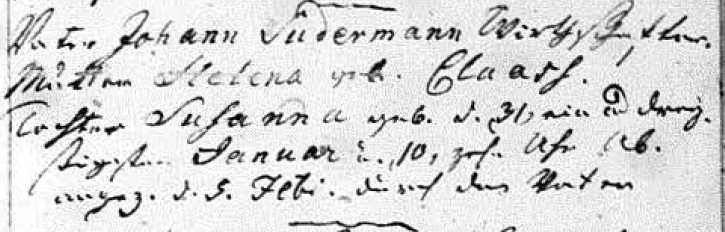
Take a look at this birth record of Susanna Sudermann, daughter of Johann Sudermann, from the Neuteich Lutheran parish's register of Mennonite births in 1819 in West Prussia.  What is the date of birth (don't scroll down until you have an answer)?

Susanna Sudermann birth #2,  XX XXXXXX 1819, Register of Mennonite births, marriages, and deaths 1813-1903, Neuteich Lutheran church records, Neuteich, West Prussia, no page, FHL film #208236.

If you're having trouble, I've highlighted the month for you:


If you said 10 January, you would not be alone - because that is the date someone entered into the Grandma database. But you would not be right :-(

Take a closer look at the image below where I've highlighted the date information:


The words underlined in green are the day.  The Germans reads "d. ,31, ein und dreÿßigsten" which means "the 31st one and thirty."  In other words the day was written first as a number and then in words.  (Remember that German reverses the unit and the tens when writing out or speaking numbers.)  You'll also notice that thirty is not spelled the modern way - this record has "dreÿßig" but it would be "dreißig" in modern spelling.

The red underlined word is the month, "Januar," or January.

Finally the blue underlined words are the time, ",10, zehn Uhr Ab.," or "10 ten o'clock in the evening."  "Ab." is an abbreviation for "Abend" or evening.

So the date is not 10 January.  We do it all the time, myself included, but it's awfully risky to make assumptions about what something says if you can't read (or don't take the time to read) all the words.  Her birth date was 31 January 1813 at 10pm.

If you got it right, give yourself a big, gold star!

Wednesday, October 26, 2016

Training Seminar on Deciphering German Texts

I'll be doing a training seminar at Tabor College's Center for Mennonite Brethren Studies on deciphering printed and handwritten German texts.

Date - 5 November 2016
Time - 10am
Place - Library Conference Center, Tabor College, Hillsboro, Kans.

Here's the link with the details to RSVP.

Teach Yourself to Read German Script (Part IV)

If you've been keeping up with our series on learning to read German script, you learned to form the letters and write words (Part I), transcribe some clearly-written German script (Part II), and translate some printed German text (Part III).  For this part, we'll show how to translate handwritten German texts.


For hard translations I like to work on paper because I can write individual words or letters on the original as I decipher them next to the word or sentence.  I'll describe the process that way, but most of it could be done on a computer.

I like to lay the original text out along with two blank sheets of paper.  If there is room, I will write a transcription of the German text in Latin letters on a copy of the original.  The first blank sheet of paper is to re-create the scribe's alphabet, and the second blank sheet is to write the English translation.

Re-creating the scribe's alphabet is a crucial step, something that professional paleographers do.  Write the Latin alphabet down the side of the page - as you work through the text, write the examples of how the scribe makes the letters, both capital and small, on the page.  If he makes them a few different ways, write all the variants that you find.  This will help you recognize letters in tough words.
Scribal alphabet that I recreated for a translation.

Now work through the text from the beginning, writing German words in Latin letters above the original script.  Each time you decipher a new letter, write it on your alphabet page.  As you start to get words, look them up and write the English on your translation page and start to massage them into English sentences.  If you just can't get a word, write down the letters that you do know and leave the rest blank for now.  Professional paleographers work letter-by-letter on tough translations, and you should too.  I usually have to go through a text several times before I get most or all of the words.  Sometimes I never get all the words and have to guess at the meaning of a sentence.

Finally, quality check your work.  Read it to make sure the English is smooth and sounds like native English and not a mechanical translation.  Think about whether each sentence makes sense in the context - if you have made a translation mistake, then a word or the whole sentence often won't fit the context.  If you know a German speaker, you could ask him to review your transcribed text to see if you got the translation right.

Here's a sample transcription that I did of a West Prussian land document where my 5-greats-grandfather Gerhard Fast (1739-1828) was a mayor of a village in 1782 and affirmed the veracity of a real estate contract.
Source:  Act on Land Sale from Arnd Warkentien to Peter Engbrecht, Actum Elbing beij den Stadtgericht [Act of Elbing at the City Court], 10 January 1782, Lit. D. No. 10, Neustadter Ellerwald, Pages 2-3 from Neustaedterwald Grundbuch Blatt 10, State Archives of Malbork, Poland, Fond 502, File 1623. Found at http://mla.bethelks.edu/archives/VI_53/Malbork/Neustaedterwald/Neustaedterwald%20Blatt%2010%20Malbork%20Archives%20Fond%20502%20File%201623/IMG_0280.JPG on 26 November 2014.

And here is my final translation.  Notice that I have several words that I couldn't read for sure (e.g. insonderheit) and some that are not standard 21st-century German words (e.g. Leud instead of Leute for people).  This is simply a reality when you are translating old texts.  But I hope that this translation demonstrates that someone who starts with no knowledge of German can, with persistence and practice, translate a moderately difficult text.
I had planned to add some exercises with texts to translate of increasing difficulty, but this post has been in the draft box for far too long.  I suggest that you take some of your own German texts and work on translating them.  Start with some easier ones and work up to harder ones. 

Good luck and let us know in a comment how you are progressing.

Wednesday, October 12, 2016

Teach Yourself to Read German Script (Part III)

Once you've practiced transcribing some real German script (see Part II), you're ready to start deciphering the meaning.  In a real translation, transcribing the text and translating it is an iterative process - you'll go back and forth between translating what you have transcribed and using the already-translated words to help you transcribe words you couldn't decipher before.  But I've broken it into two parts for ease of learning.  Here we will focus on the translation of printed text to make it easier.

Leave enough room between your lines of German transcription to write a word-for-word translation of English above it.  Once you understand a sentence or a paragraph, you can massage it into good English and write or type it on a separate page.

Nouns, verbs, and adjectives are usually fairly easy to translate.  (It certainly helps to know some grammar, but it's not essential.)  You look them up in a dictionary and can get an English equivalent.  Words may have several related meanings, and initially you may not know which meaning fits in your sentence, so you may write several meanings for one word until you figure out the whole sentence.  Online dictionaries I like are Reverso and LEO, but there are many out there.  If you want a physical dictionary, Oxford-Duden is a good one; but I find that I rarely use it because it is so much easier to look up words online.

These are dictionaries of modern German, but the language we will be reading is a century or two old, so there will be archaic words and expressions.  Plus our ancestors wrote a High German that was influenced by Low German and by Russian, so pay special attention to the meanings that are marked as "obsolete" or "dialect" when doing your translation.

It's also helpful to have a 19th-century German-English dictionary, and G. J. Adler published the first one, A Dictionary of the German and English Languages, in the mid-1800s.  You can buy it used online, but it is not cheap.  However, Google scanned a copy, and it can be downloaded free as a PDF.  Since it is a scan, not all the pages are readable, but most are.  Adler's dictionary has helped me figure out more than one tough translation.

Ernest Thode's German-English Genealogical Dictionary is also frequently recommended, but I have not used it.  Also, Edna M. Bentz wrote If I Can, You Can Decipher Germanic Records which is cheaper and has a good glossary, as well as lots of examples of how letters are formed.  You may find yourself consulting many other dictionaries, such as legal, medical, or agricultural, when you run across a tough word, many of which are online.

What about Google Translate or other machine translators?  I find it has a role to play as an aid.  Sometimes, if I can't figure out a word or a sentence, I may try Google Translate to see what it says.  Sometimes it's right, and sometimes it's not, especially on older and less formal language.  I also like it when I have a long passage to translate and just need to get the gist of it.

Harder than the nouns, verbs, and adjectives is translating the adverbs, conjunctions, and prepositions and the endings that show verb tense and sentence structure (what linguists would call the inflection).  Reverso has a page where you can get the conjugation (past, present, future, etc.) of any German verb, which can help a lot for figuring out the meaning of a sentence.

University of Michigan has a good page on German conjunctions that can help you understand sentence structure.  And here is a page on German pronouns.

Now for some practice - here is part of the obituary of my great-great-grandfather, Jacob Fast.  First, the scan of a couple paragraphs from the Mennonitische Rundschau and then below that my English translation.  Try to translate the German and see if you can get something similar to my English translation.  BTW, translations by two different people that are equally correct will be different in wording and phrasing, so don't worry if yours is a little different than mine.
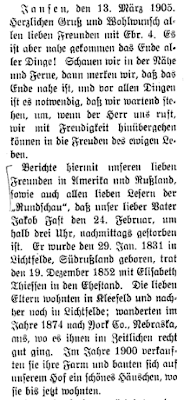
Jacob Fast, Letter to the Editor, Mennonitische Rundschau under Herold der Wahrheit, Elkhart, Indiana, 22 March 1905, p. 3.  Held by Centre for Mennonite Brethren Studies, Winnipeg, Manitoba.
Translation by Steve Fast

Next find some German documents relevant to your family and practice translating them.  It's easier to work with printed documents so that you don't have to worry about deciphering script at this point.  And working with documents from your family should motivate you to persevere as you discover new things about your ancestors.

BTW, I get mentally tired of translating after a while, sometimes 30 minutes, sometimes a couple hours.  Then I take a break and come back - often the second time around, sentences that were impossible to understand become clear.

You've got your homework - good luck!
Friday, September 30, 2016

Teach Yourself to Read German Script (Part II)

Did you do your homework?  (See Part I)  If you are comfortable writing the alphabet and some words, you are ready to move on to the next stage.  In the first part, we learned to read the letters when formed in an ideal manner.  Now we're going to look at a real-life example, where the scribe did not make every letter perfectly.  But we'll start with an easy example, where the scribe had good handwriting, the Tiegenhagen, West Prussia, Mennonite church book.

You could use any handwritten German document; but this one is written clearly; and even more importantly, John Thiesen has made an exact transcription.  So we can compare the handwritten German text to the typewritten transcription.

At this point, we're only interested in reading the letters and words, not yet about understanding the meaning.

Let's download a random page from the church book, p. 30-31.  Then download John Thiesen's transcription for comparison - it's a large Word document, so be patient - and find page 31.  We'll use the righthand page, page 31, because it has more Kurrentschrift on it than the lefthand side.  (Note that personal names are usually written in Latin script not Kurrentschrift.)  Start at the top and look at the Latin transcription and follow the Kurrentschrift.

Did you see that one of the column headings is missing in the transcription?  Can you figure out the word on your own? (Answer at the end.)
Source:  Tiegenhagen Mennonite church book, Tiegenhagen, West Prussia, Volume 1, Page 31, held by Mennonite Library and Archives, North Newton, Kansas, accessed online at http://mla.bethelks.edu/archives/cong_314/book1/30-31.jpg on 29 September 2016.
Portion of transcription of page 31.
Once you feel comfortable looking at the Latin transcription and deciphering the Kurrentschrift original, do it the other way around.  Try to read the original and see if you get what is in the transcription.  You may have to write out the original letter-by-letter.  Download and read a few more pages until you feel comfortable with it.

Congratulations - you've made your first step into reading a real genealogical document!

ANSWER - The missing word is "Wochen," which means "weeks."

Thursday, September 29, 2016

Teach Yourself to Read German Script (Part I)

Many important genealogical records are written in German script - if you don't learn to read German script, you will always be dependent on the kindness of others to translate for you.  And there will be vast troves of material that you will never access because you can't read them.  While it takes persistence to read German script, anyone can learn to do it.

When I started teaching myself to read German script about four years ago, I knew practically no German.  I had picked up some German words and phrases as a kid from my parents, but I had forgotten most of those, and I had traveled some in German and learned airport and railroad German (Flughafen, Hauptbahnhof, etc.).  But I knew very little that was relevant to genealogy.  So don't think that I am some super German speaker.

German script is properly called Kurrentschrift, and it developed from medieval cursive and was used in Germany until the Nazis banned it in 1941.  It is often called Gothic script, but this is not correct as Gothic refers to a type of printing with wide black letters used in many European languages.

Here is an example of Kurrentschrift handwriting:
Source:  https://upload.wikimedia.org/wikipedia/commons/5/59/Deutsche_Kurrentschrift.svg
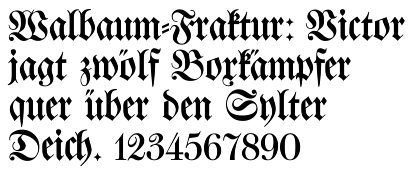
And this is an example of German Fraktur, a type of Gothic printing:
Source:  https://en.wikipedia.org/wiki/Fraktur#/media/File:Fraktur_walbaum.png
As you can see, Kurrentschrift is what is used in old handwritten German documents.

The first and most important step to teaching yourself to read Kurrentschrift is to determine that you will keep at it until you succeed.  I guarantee it will be frustrating at times, but you can't quit until have succeeded.  If you're not willing to make this resolve, don't waste your time starting.  When you get discouraged, remember the genealogical treasures troves you will uncover by persisting.

Second, the Family History Library in Salt Lake City, Utah, has a good guide to the alphabet.  Read it and practice writing the letters several times until you are comfortable with them.  This is just like learning the alphabet in kindergarten.

Third, Brigham Young University has a tutorial to teach you to read Kurrentschrift.  Go through each section of the tutorial (listed on the left side of the home page) and learn to write words in Kurrentschrift.  Writing it yourself is important because that burns it into your active memory (as opposed to reading which is only passive).  Then you can take a little test at the end to see how well you are doing.

You have your homework - get started and let us know about your progress with a comment.

(In the next post, we will discuss how to read an actual page from a Mennonite church book.)


Friday, September 9, 2016

What's That Surname?

Here's a fun one - before you scroll down too far, try to figure out the surname of Cornelius below:
Cornelius [guess who!] death record, 20 March 1810, Tiegenhagen Mennonite Church Book 1780-1831, West Prussia, p. 95.  Downloaded from http://rep.mefor.org/kb/kb26.pdf on 28 November 2015 [link has been removed].

Someone did an incredibly useful rough draft transcription of the Tiegenhagen, West Prussia, Mennonite church book, 1782-1831, and he took it to be "Cornelius Fast."  I definitely thought the same thing for a long time.  In that case, there were two Cornelius Fasts in the village of Platenhof - one died in 1793 and this one in 1810.  I spent a lot of time trying to separate the children of the two men into different families without any luck.

But today I took another look at the surname.  Here's a scan of a larger area:
Notice that the second loop on what appeared to the "F" in Fast is actually the down-loop on the "z" in Schulz.  If you mentally block out that second loop, could the name actually be Jost?

Let's look at some of the J's the scribe wrote on the same page:
Here are three times where he wrote Jacob, Johan, and Jacob.  These J's look very much like the first letter in the surname above.  It has to Cornelius Jost.

So I can stop trying to separate the Cornelius Fast children in Platenhof, West Prussia into two families - there was only one Cornelius Fast in Platenhof!