Showing posts with label Gerhard Fast (1739-1828). Show all posts

Tuesday, August 8, 2017

Analyzing the 1776 Census

For the last several months, I've been working on this huge project to analyze all the Fasts in the 1776 census of Mennonites in West Prussia.  My goal was to try to identify the parents of Gerhard Fast #660202 (1739-1828), my 7th-great-grandfather and earliest known Fast ancestor.  Since his oldest known sibling was born in ABT 1737, I realized that his parents would probably have been in their early 60s in the 1776 census.  Thus it is likely that one or both of them were enumerated in that census; but of course without knowing their names, they could be listed in plain sight and wouldn't even know it was them.  So my plan was to find out as much as possible out each of the 31 Fasts in that census to try to identify his parents.  I didn't identify either parent, but I was able to eliminate most of them as possible candidates.

I chose the 1776 census because it was only of Mennonites in West Prussia, so I didn't have to worry about sorting out people who had "Mennonite-sounding" names.  Glenn Penner has already identified quite a few people in it, so a good start has been made.  Finally, I have scans of all the originals for the 1776 census.  I decided against the 1772 census because it included everyone in West Prussia - not just the Mennonites.  Very little work has been done on it, and I have only about half the scans for "Mennonite" villages in the Gross Werder, and ordering them from the Geheimes Staatsarkhiv in Berlin is slow and expensive.

Glenn Penner's extraction of the 1776 census is found here.  He (and perhaps others) had already identified 11 of the 31 Fasts with Grandma (GM) numbers.  I added 10 more during my project, so 21 of the 31 are now identified in GM.

The results of my efforts can be downloaded from Google Drive.  A few comments about the spreadsheet - the names and dates that I added are in red.  On a few people, I just looked them up and found the family in GM, just waiting to have a GM number associated with them on the census spreadsheet.  Others took a lot more work to research.  And a few were not in GM at all.

I started by looking for the head of household in my giant spreadsheet of Fasts that I have extracted over the last few years.  Any time I looked at church book or microfilm, I put all the names of Fasts (and in-laws) into a giant spreadsheet - even if I wasn't interested in them at the time.  Now I could just look at it and see all the records, for example, for Claas Fast, even if they were scattered among different sources.  Many times a family would come together just like that.

The sources that I checked included
  • Prussian Mennonite church books (Tiegenhagen, Ladekopp, Rosenort, Bärwalde, Montau, Tragheimerweide, Heubuden, Danzig, etc.) - I used the extractions at MennoniteGenealogy.com, Andreas Riesen's extractions, and the originals at Bethel College's Mennonite Library and Archives
  • Lutheran/Evangelical church books (Jungfer, Fürstenau, Neuteich, etc.) - Mostly from LDS microfilms
  • West Prussia Censuses - 1772, 1776, 1789, 1793 (Danzig), 1811 (Elbing)
  • Russian Censuses - 1806, 1808, 1811, 1835
  • Property Records 
  • Emigration Records - BH Unruh, Peter Rempel, MennoniteGenealogy.com
The key to successful genealogical research in West Prussia is to combine all the sources.  There are lots of West Prussian records, but most of them are fragmented  - there are only a few Mennonite Familienbücher where the entire family is listed together and most of these are fairly late.  Most West Prussian records give one data point, e.g. a certain child was born on a certain date and his father was a certain man.  If you pull everything together, suddenly the whole family pops into view.

To handle all this data, you need several things:
  • A method to store and organize all the data - such as my spreadsheet of Fast extractions
  • Access to all the records - online, microfilm, orders from archives
  • Research collateral lines - With fragmented data, researching siblings of your direct ancestor helps to pull everything together.
 I would encourage you to try the same thing for your surname.


Sunday, July 16, 2017

Update on 1776 Census Project

I've been working on a project to identify all the Fasts in the 1776 census of Mennonites in West Prussia.  Glenn Penner's extraction of the data is found here.  My theory was that one or both of the parents of my earliest known Fast ancestor, Gerhard Fast #660202 (1739-1829) might be listed in that census, and I wouldn't even have known about it.  His oldest known sibling was born ABT 1737 - if his parents were about 20 years old when their first child was born, they might have been born about 1717.  Thus in 1776, they would have been about 60 years old.

There were 31 Fast families listed in the 1776 census, and 11 of them had previously been identified in Grandma.  I was able to identify 11 more Fasts, so now 22 of the 31 are identified in GM.

My methodology was to look for them first in GM.  Then I checked my spreadsheet in which I have extracted 431 individual records over the years from the Mennonite, Lutheran/Evangelical, and Catholic church books to see if I could find the person.  I checked the Mennonite church books that Andreas Riesen extracted.  I checked the 1772 and 1789 census, the immigration records to Russia in BH Unruh, Peter Rempel, and that I have gotten from the Prussian archives in Berlin, and the land records that Glenn Penner has posted online.

Unfortunately, none of the Fasts whom I was able to identify were old enough to be the parents of my Gerhard.  There are 3-4 Fasts whom I could not identify who lived in the Gross Werder and are potential candidates to be Gerhard's parents, but I found no information to identify them.  I was able to tie many, many children to the 22 identified Fast families, so I've added a lot to the store of knowledge about the Fasts in GM, so it's been a useful exercise.  But I didn't accomplish the goal that I set out to achieve.

I'm planning a trip to Poland in 1-2 years to do research in the archives there, and this work was a necessary prelude to that trip.  I wouldn't want to make an expensive trip to the Polish archives without having done everything that I could with data that is available to me while sitting at home.

I'll post the spreadsheet with my results in the near future, but I need to clean up the spreadsheet first.

Sunday, February 12, 2017

New Approach to West Prussian Censuses

At least it's a new approach for me - maybe it's old hat for a lot of you.  But I thought I would share it in case you haven't ever used it before.

I have a brick wall in the person of my five-greats-grandfather, Gerhard Fast #660202 (1739-1828).  It's going to be a tough one to break through that will probably require finding new record sets.  But before I embark on the expense of archival research to find more record sets, I thought I should organize the information about the earliest Fasts that is available in the area where he lived, the Gross Werder in West Prussia.

I even realized that Gerhard's father or mother might be mentioned in the 1772 or 1776 censuses - but if they are, I wouldn't recognize them because I don't know their names.  Since Gerhard's oldest known sibling was born ABT 1737, his parents might have been born about 1715, which would make them about 60 years old in those two censuses.  So it would be quite possible for one or both of them to be listed there.

I started with the 1776 census for three reasons:  1) Glenn Penner had already extracted the data, so it was easy to work with, 2) it was specifically of Mennonites, and 3) I had copied all the pages of the census from LDS microfilm #105655, so I can check the original.
Source:  1776 Special Consignation of Mennonite families, West Prussia, II. HA, Abt. 9, Materien, Tit. CIX, Nr. 1, Vol. 1, p. 17-125, Geheimes Staatsarchiv Preussischer Kulturbesitz, Berlin, Germany.  Accessed on FHL film #1056552. 
I have worked through five of the thirty-one Fasts in the census, and I have made a lot of connections with their children who were in Grandma. 

Abraham Fast might be #1350958
Anthon Fast #932518 (1732-1782)
Claas Fast #706529 (1745-1820)
Cornelius Fast #932218 (ABT 1722-1807)
Gerhard Fast #660202 (1739-1828) my ancestor
Jacob Fast #531527 (ABT 1752-1808)


None of them solved my brick wall, but they are all someone's brick wall.  Since Mennonites lived in clusters, I highly recommend this technique for whatever region you are stuck.  Try to piece together the families of the other people with the same surname living in the same Mennonite cluster - there is a good chance you will find relatives there.

I'll post more on specific results from this project as I go along, but I wanted to get some preliminary results posted here to motivate others to do the same.


Wednesday, October 26, 2016

Teach Yourself to Read German Script (Part IV)

If you've been keeping up with our series on learning to read German script, you learned to form the letters and write words (Part I), transcribe some clearly-written German script (Part II), and translate some printed German text (Part III).  For this part, we'll show how to translate handwritten German texts.


For hard translations I like to work on paper because I can write individual words or letters on the original as I decipher them next to the word or sentence.  I'll describe the process that way, but most of it could be done on a computer.

I like to lay the original text out along with two blank sheets of paper.  If there is room, I will write a transcription of the German text in Latin letters on a copy of the original.  The first blank sheet of paper is to re-create the scribe's alphabet, and the second blank sheet is to write the English translation.

Re-creating the scribe's alphabet is a crucial step, something that professional paleographers do.  Write the Latin alphabet down the side of the page - as you work through the text, write the examples of how the scribe makes the letters, both capital and small, on the page.  If he makes them a few different ways, write all the variants that you find.  This will help you recognize letters in tough words.
Scribal alphabet that I recreated for a translation.

Now work through the text from the beginning, writing German words in Latin letters above the original script.  Each time you decipher a new letter, write it on your alphabet page.  As you start to get words, look them up and write the English on your translation page and start to massage them into English sentences.  If you just can't get a word, write down the letters that you do know and leave the rest blank for now.  Professional paleographers work letter-by-letter on tough translations, and you should too.  I usually have to go through a text several times before I get most or all of the words.  Sometimes I never get all the words and have to guess at the meaning of a sentence.

Finally, quality check your work.  Read it to make sure the English is smooth and sounds like native English and not a mechanical translation.  Think about whether each sentence makes sense in the context - if you have made a translation mistake, then a word or the whole sentence often won't fit the context.  If you know a German speaker, you could ask him to review your transcribed text to see if you got the translation right.

Here's a sample transcription that I did of a West Prussian land document where my 5-greats-grandfather Gerhard Fast (1739-1828) was a mayor of a village in 1782 and affirmed the veracity of a real estate contract.
Source:  Act on Land Sale from Arnd Warkentien to Peter Engbrecht, Actum Elbing beij den Stadtgericht [Act of Elbing at the City Court], 10 January 1782, Lit. D. No. 10, Neustadter Ellerwald, Pages 2-3 from Neustaedterwald Grundbuch Blatt 10, State Archives of Malbork, Poland, Fond 502, File 1623. Found at http://mla.bethelks.edu/archives/VI_53/Malbork/Neustaedterwald/Neustaedterwald%20Blatt%2010%20Malbork%20Archives%20Fond%20502%20File%201623/IMG_0280.JPG on 26 November 2014.

And here is my final translation.  Notice that I have several words that I couldn't read for sure (e.g. insonderheit) and some that are not standard 21st-century German words (e.g. Leud instead of Leute for people).  This is simply a reality when you are translating old texts.  But I hope that this translation demonstrates that someone who starts with no knowledge of German can, with persistence and practice, translate a moderately difficult text.
I had planned to add some exercises with texts to translate of increasing difficulty, but this post has been in the draft box for far too long.  I suggest that you take some of your own German texts and work on translating them.  Start with some easier ones and work up to harder ones. 

Good luck and let us know in a comment how you are progressing.

Wednesday, August 31, 2016

1811 Elbing census online

I just found the 1811 Elbing census online at the Mennonite Library and Archives (Bethel College, North Newton, Kans.) web site.  They were scanned by Glenn Penner.  Previously I had ordered LDS film #1344433, where it is also found.  But the digital images at the MLA web site are better quality; and most importantly for a Mennonite, they are FREE!

Here is the page with my 5-greats-grandfather Gerhard Fast #660202 (1739-1828) at age 72 in Neustaedterwald.  (I think the age of 75 that is given is wrong.)
Gerhard Fast household, 31 December 1811, Neustetterwald village #17, Elbing Territory census, West Prussia, Zesp. I/10, Nr. 44, Archiwum Panstwowe w Gdansku, Gdansk, Poland, p. 28.  Accessed online at https://mla.bethelks.edu/archives/cong_301/Nachweisung1812/IMG_2050.JPG on 31 August 2016.

NB:  The MLA web site calls it the 1812 census - it was taken at the end of 1811 for the 1812 year.

Friday, August 26, 2016

Using the 1811 Elbing, West Prussia, Census


In late 1811, a census was taken of the Elbing region where many Mennonites lived.  This city was under a special administrative regime because in the late 1600s, the King of Poland had used it as collateral for a loan from the Duke of Prussia.  This led to a centuries-long dispute about whether the loan had been repaid and whether the Prussian dukes (later kings) could take the city’s revenues to repay the loan.  In 1811, the city was still under a special administration as a result.  Thus, a separate census was taken in 1811.

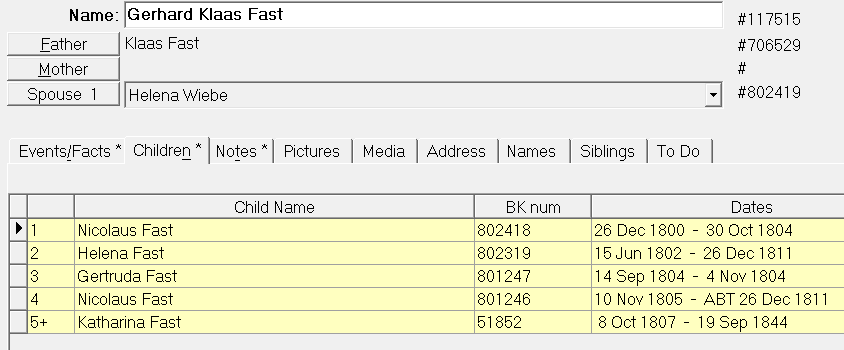
My 5-greats-grandfather, Gerhard Fast #660202 (1739-1828), had five siblings whom I have identified, and I am trying to piece together their descendants.  One of those siblings was Klaas Fast #706529 (ABT 1745-1820), and he had a son Gerhard #117515 (ABT 1774-1830) who lived in the village of Fürstenauerweide, which in the Elbing region.  Someone had entered the birth dates of the younger Gerhard’s six children from the Fürstenau Lutheran church book, and I found the death dates for five of those children who died young in the same church book.  (Imagine how shattering it must have been to lose five of six children before the age of nine.)  Here is how the family looked:
Gerhard Klaas Fast, Genealogical Registry and Database of Mennonite Ancestry, CD-ROM, version 6 as updated by author (Fresno:  California Mennonite Historical Society, 2013), individual #117515.
Then I got to wondering if he was in the 1811 Elbing census, which was taken near the end of 1811, so I checked Adalbert Goertz’extraction.  And I found him as expected in Fürstenauerweide:
Gerhard Fast household #10, 31 December 1811, Fuerstenauerweide village #4, Elbing Territory census, West Prussia, Zesp. I/10, Nr. 44, Archiwum Panstwowe w Gdansku, Gdansk, Poland, n. p.  Extraction accessed http://mennonitegenealogy.com/prussia/elbing2.htm on 26 August 2016.
I’m sure it is him because the family data matches.  Notice that no wife is listed – there is only a blank in the space where the age of the wife would be shown.  His first wife, Helena Wiebe died in October 1811, so it fits that she is not listed.  Three children’s ages are listed – 10, 8, and 3 years.  He had three children still living, Helena, Nicolaus, and Katharina, whose ages were 9, 6, and 4 years based on their exact birth dates from the Lutheran church book.  Remember that ages in census records were not very exact back then, so this fits well enough.  Two of those children, Helena and Nicolaus, died in late December 1811, but they are still listed in the census.  Since the census was taken near the end of 1811, the family information fits the census.

The census also adds another useful piece of information – he was an Arbeitsman, a laborer.  This means that there is not much point in searching for land records in Fürstenauerweide.  And it also tells us that they were poor.  In 1819, Gerhard Fast and his second wife Barbara Isaac and his remaining daughter Katharina emigrated to Russia, to start a new life as a landowner in the village of Rudnerweide, Molotschna Colony.
Gerhard Fast emigration, 1819, household #23, Emigration records, Benjamin Heinrich Unruh, Die niederländisch-niederdeutschen Hintergründe der mennonitischen Ostwanderungen im 16., 18. und 19. Jahrhundert (Karlsruhe:  Heinrich Scheider, 1954), p. 367.  Accessed on digital copy from California Mennonite Historical Society, Fresno, California.