Showing posts with label Fuerstenauerweide. Show all posts

Friday, August 26, 2016

Using the 1811 Elbing, West Prussia, Census


In late 1811, a census was taken of the Elbing region where many Mennonites lived.  This city was under a special administrative regime because in the late 1600s, the King of Poland had used it as collateral for a loan from the Duke of Prussia.  This led to a centuries-long dispute about whether the loan had been repaid and whether the Prussian dukes (later kings) could take the city’s revenues to repay the loan.  In 1811, the city was still under a special administration as a result.  Thus, a separate census was taken in 1811.

My 5-greats-grandfather, Gerhard Fast #660202 (1739-1828), had five siblings whom I have identified, and I am trying to piece together their descendants.  One of those siblings was Klaas Fast #706529 (ABT 1745-1820), and he had a son Gerhard #117515 (ABT 1774-1830) who lived in the village of Fürstenauerweide, which in the Elbing region.  Someone had entered the birth dates of the younger Gerhard’s six children from the Fürstenau Lutheran church book, and I found the death dates for five of those children who died young in the same church book.  (Imagine how shattering it must have been to lose five of six children before the age of nine.)  Here is how the family looked:
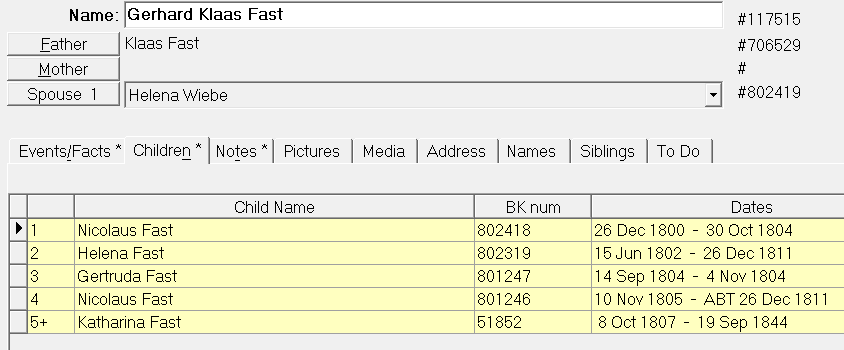
Gerhard Klaas Fast, Genealogical Registry and Database of Mennonite Ancestry, CD-ROM, version 6 as updated by author (Fresno:  California Mennonite Historical Society, 2013), individual #117515.
Then I got to wondering if he was in the 1811 Elbing census, which was taken near the end of 1811, so I checked Adalbert Goertz’extraction.  And I found him as expected in Fürstenauerweide:
Gerhard Fast household #10, 31 December 1811, Fuerstenauerweide village #4, Elbing Territory census, West Prussia, Zesp. I/10, Nr. 44, Archiwum Panstwowe w Gdansku, Gdansk, Poland, n. p.  Extraction accessed http://mennonitegenealogy.com/prussia/elbing2.htm on 26 August 2016.
I’m sure it is him because the family data matches.  Notice that no wife is listed – there is only a blank in the space where the age of the wife would be shown.  His first wife, Helena Wiebe died in October 1811, so it fits that she is not listed.  Three children’s ages are listed – 10, 8, and 3 years.  He had three children still living, Helena, Nicolaus, and Katharina, whose ages were 9, 6, and 4 years based on their exact birth dates from the Lutheran church book.  Remember that ages in census records were not very exact back then, so this fits well enough.  Two of those children, Helena and Nicolaus, died in late December 1811, but they are still listed in the census.  Since the census was taken near the end of 1811, the family information fits the census.

The census also adds another useful piece of information – he was an Arbeitsman, a laborer.  This means that there is not much point in searching for land records in Fürstenauerweide.  And it also tells us that they were poor.  In 1819, Gerhard Fast and his second wife Barbara Isaac and his remaining daughter Katharina emigrated to Russia, to start a new life as a landowner in the village of Rudnerweide, Molotschna Colony.
Gerhard Fast emigration, 1819, household #23, Emigration records, Benjamin Heinrich Unruh, Die niederländisch-niederdeutschen Hintergründe der mennonitischen Ostwanderungen im 16., 18. und 19. Jahrhundert (Karlsruhe:  Heinrich Scheider, 1954), p. 367.  Accessed on digital copy from California Mennonite Historical Society, Fresno, California.

Tuesday, August 23, 2016

Looking in the WRONG Village (Part III)


See Part I and Part II for the beginning of this story.

In the previous posts in this series, I explained how I found my 5-greats-grandparents, Martin Wiens and Maria Loepp, in the West Prussian land records.  I wanted to flesh out their lives as much as possible, so there are a few other places to look for information.

First, the 1772 census.  When Prussia seized a large piece of Polish territory in 1772, including the Gross Werder and other areas where many Mennonites lived, they immediately conducted a census to establish tax liabilities for all the inhabitants.  When I checked the village of Fürstenauerweide, where Martin and Maria Wiens owned land, I found them – sort of.  There were three heads of household named “Wientz,” but no first names or the number of family members were listed.  I checked the index for the 1772 census and found no other Martin Wiens, so I knew he must be one of these three.

1772 census with three Wiens households.  Source:  _____ Wientz household, 1772-1773, households #3, #5, or #9, Contributions Catastrum, Fürstenauer Weÿde village #24, Elbingschen Niederung, West Prussia, II. HA, Abt. 9, Materien, Tit. XCIII, Nr. 9, Bd. 3, p. 109, Geheimes Staatsarchiv Preussischer Kulturbesitz, Berlin, Germany.
In the 1776 census, there are three Wiens heads of household listed, but this time their first names are given – Arend, Jacob, and Martin.  (Presumably, these are the same three Wienses as in 1772, but we cannot be sure without checking each one individually since one could have died and another married and started his own household.)  It’s very likely that this Martin Wiens is the one I’m looking for.

Source:  Martin Wiens household, 1776 Special Consignation of Mennonite families, Fuerstenauerwiede village, West Prussia, II. HA, Abt. 9, Materien, Tit. CIX, Nr. 1, Vol. 1, Geheimes Staatsarchiv Preussischer Kulturbesitz, Berlin, Germany.  Accessed online at http://www.mennonitegenealogy.com/prussia/1776MasterV5.pdf on 13 August 2016.
And on his extraction of the 1776 census, Glenn Penner has added a serendipitous note to Martin Wiens “1739-99 (Luth/Fuerstenau).”  He kindly sent me a copy of Martin Wiens’ death record from the Fürstenau Lutheran church book, which showed that he died on 5 March 1799 in Fürstenauerweide at the age of 68 years, 4 months, and was buried on 11 March.  From his age at death, I could calculate that he was born in ABT Dec 1730.
Martin Wiens death record.  I have underlined "Martin Wiens," "5 Mart: (5 March)," and "68 Jahr 4 Monat (68 years 4 months)."  Source:  Martin Wiens death record, 5 March 1799, decedent #5, Fürstenau Lutheran death register, 1774-1819, Fürstenau, West Prussia, digital copy from Glenn Penner, Guelph, Ontario.

Finally, I checked the 1789 census of Mennonite landowners, and I found Martin Wiens living in Fürstenauerweide and owning 18 morgens 158 ruten of land (about 26 acres). 
Source:  Mart. Wiens household, line #9, 1789 General-Nachweisung of Mennonite families in Marienwerder Department, Fuerstenauerweide village #35, II. Amt Elbing, West Prussia, II. HA, Abt. 9, Materien, Tit. CIX, Nr. 1, Vol. 1, Ad Nr. 1 vol. 2, Geheimes Staatsarchiv Preussischer Kulturbesitz, Berlin, Germany.  Accessed at http://mennonitegenealogy.com/prussia/1789_Land_Census_West_Prussian_Mennonites.htm on 13 August 2016.
To summarize these three posts on Martin Wiens – I started out being curious why Jacob Barkman was not listed in any of the censuses in Neustӓdterwald, the village where he owned land at the time of his death.  When I checked for his name in the other villages in the 1789 census, I saw that he owned land in the neighboring village, the “wrong” village, of Fürstenauerweide.  When I checked the land records for Fürstenauerweide, I found the land that he owned and that his wife Katharina Wiens had inherited it from her parents Martin Wiens and Maria Loepp when her mother Maria Loepp died.  I had not known of Martin Wiens and Maria Loepp before this.  When I checked for Martin Wiens in the 1772, 1776, and 1789 census, I found him living in Fürstenauerweide in all three.  And a note on the extraction of the 1776 census led me to his death record, which gave his birth date also.  So a little curiosity about Jacob Barkman led to discovering his parents-in-law and quite a bit of information about them!

Monday, August 15, 2016

Looking in the WRONG Village (Part II)


See Part I of “Looking in the Wrong Village” for the beginning of this story.


Since I had unexpectedly discovered that my 4-greats-grandfather Jacob Barkman #7070 (ABT 1745-1809) owned land in the village of Fürstenauerweide, Elbing, West Prussia, in the 1789 census, I decided to investigate further.  It is possible that I could find him in the West Prussian land records that Glenn Penner has scanned and that have been posted at the Mennonite Library and Archives web site.  These records of land transactions have valuable information on family relationships since husbands and wives owned land jointly.  Here is the opening screen for the land records web page:


The Malbork, Poland, archive covers the Gross Werder area of the Vistula Delta that I am interested in, while the Bydgoszcz and Toruń cover areas farther south.  So I choose the Malbork link.


A list of village names comes up, and I scroll down to find Fuerstenauerweide, on which I click.  (Note that not all villages have surviving records.)


This brings up a link to one Grundbuch.  Some villages have many Grundbücher, while others just have one.  I clicked on the link.
 
This gives me a list of images.  I went through the images one by one scanning for names.  At first, when I started looking at Grundbücher a couple years ago, it was really hard to decipher the names or even to figure out which words were names, but after some practice, they pop out of the page because they are usually written in Latin and not Gothic script.


Eventually on Image 872, I found gold.  

In the left-hand column about halfway down the left page, the list of grantees reads “1/8 Catharina geehlighte Jacob Bargmann (1/8 Catharina married to Jacob Bargmann).”  BINGO!  Jacob Barkman’s second wife, and my 4-greats-grandmother, was Catharina Wiens.   

Even better, it listed her parents, whom I had not known, at the top of the page:  Martin Wiens and Maria geb. (born) Loepp.  So I added a 5-greats-grandfather and grandmother to my ancestry chart![1]


It took me a while to figure out the substance of the transaction, but Martin Wiens and his first wife Maria Loepp had apparently bought this property in 1763 from Thomas Sawadski but had only partially paid for it.  In 1786 when his first wife Maria Loepp died, their four children inherited half of the property from her.  Thus each one got a 1/8 share, which explains the “1/8” next to Catharina’s name.  But they also were required to pay Thomas Sawadski 1/8 of the unpaid balance of the purchase price.


So now I have figured out how Jacob Barkman came to be a landowner in Fürstenauerweide:  his wife inherited land from her mother’s estate.  (Note that even though Jacob Barkman is the one listed in the census, he and his wife Catharina Wiens owned the land jointly.)   I also found his parents-in-law and a year of death for his mother-in-law.  And here is the updated ancestry chart from myself to Martin Wiens and Maria Loepp:


But at this point my knowledge of the parents-in-law, Martin Wiens and Maria Loepp, is very scanty.  Can I find more information on them?  Part III coming up.


[1] Fuerstenauerweide Grundbuch Blatt 13, Kreis Elbing, Malbork, Poland, Archive, Fond 341, File 198.  Accessed online at https://mla.bethelks.edu/archives/VI_53/Malbork/Fuerstenauerweide/Fuerstenauerweide%20Grundbuch%20Malbork%20Archives%20Fond%20341%20File%20198/IMG_0872.JPG on 25 July 2016.