Showing posts with label United States. Show all posts

Saturday, January 21, 2017

Nebraska Gives Me a "Yes" and a "No"

A few weeks ago, I did a project to see which vital records I had and which ones I needed to order.  I wrote a post about it here.  In that project, I realized that both my great-great-grandparents Fast, Jacob Fast #35385 (1831-1905) and Elisabeth (Thiessen) Fast #35386 (1832-1912) had died after Nebraska started to require death certificates to be filed with the state.  So I sent a request and $16 each to the vital records section.  A few days ago my answer came in the mail with a "yes" and a "no."
Jacob and Elisabeth Fast and their daughter Katharina.  Probably taken in the mid- to late-1890s.


Let's begin with the "no."  Nebraska started to require death certificates in 1904, and Jacob Fast died in February 1905, so a record should have been filed with the state.  However, the state web site warns that it took some time before the law was generally complied with.  I imagine that compliance was poorer in rural areas and those farther from Omaha and Lincoln.  Jacob Fast died near Jansen, a village in southeastern Nebraska.  So I was disappointed but not terribly surprised to get a "no" from the state - all indices had been searched but no death certificate for Jacob Fast was found.

Of course, the state kept my $16 because you are paying for the search not the certificate.  But it's a risk you have to take if you want to get any records from the state.
Jacob Fast, died 24 February 1905, no death certificate found, Health Records Management Section, State of Nebraska, Lincoln, Nebraska, searched 5 January 2017.


But I had better luck and a "yes" for his wife and my great-great-grandmother, Elisabeth (Thiessen) Fast, who died in 1912.  Her death certificate didn't reveal any new information other than her burial date (12 July 1912), but it did confirm her death date (10 July 1912), place of death (Cub Creek Township, Jefferson County, Nebraska), and her parents' names (David Thiessen and Elisabeth Franz).  I knew these latter three pieces of information from obituaries and family histories, but it's nice to get a government document that confirms them.
Elizabeth Fast death certificate, died 10 July 1912, dated 11 July 1912, #6027, Vital Records Office, Nebraska Department of Health and Human Services, Lincoln, Nebraska.

Perhaps the most interesting thing was the doctor's note about cause of death, "Did not attend deceased.  Was called and patient died before I arrived.  Death undoubtedly from natural causes.  Never saw deceased alive."  Even though she died at age 80, she might have never been to the doctor, certainly not in the last few years of her life.  Her obituary in the Mennonitische Rundschau (28 August 1912, p. 8) says that she had experienced chest pains in the couple days before she died but she insisted on going to visit her other children and grandchildren anyway and then died of a heart attack.  She must have been one tough lady.

Wednesday, January 4, 2017

Main Sources for Each Country

What are the main sources for each country where Mennonites have lived?  If you're just getting into Mennonite genealogy, these might be the places to start looking.  So in reverse chronological order:

Canada and United States
1.  Family stories from older relatives
2.  State/provincial vital records
3.  Federal and state/provincial censuses
4.  Land deeds and probate files
5.  Mennonite church books
6.  Diaries and letters
7.  Passenger manifests for immigration

Russia/Soviet Union
1.  EWZ records - German World War II family trees and life histories of Germans in occupied countries
2.  Molotschna school records
3.  Censuses
4.  Newspapers - Mennonitische Rundschau and others were a main form of communication between Russia and North America
5.  Diaries and letters
6.  Archival materials from Odessa and other state archives
7.  Immigration records from Prussia

Poland and Prussia
1.  Mennonite church books
2.  Lutheran and Catholic church books - many Mennonite vital records were recorded in these for various reasons
3.  Censuses
4.  Land records
5.  Emigration records to Russia

Netherlands - I don't know much about researching these
1.  Dutch Mennonite church archives
2. ???

Latin America and Germany are postwar destinations for Mennonites that also deserve some mention, but I know little about those.

Thursday, December 15, 2016

Not Finding a Grave

I've been searching for and not finding the grave of Elisabeth (Fast) Sudermann #26678 (1817-1892).  Sometimes even when there are a billion graves, you need the billion-and-first grave.  OK, enough of the bad puns.

Elisabeth Sudermann was my great-great-grandmother, and she died near Newton, Kansas, on 15 May 1892, on the farm of her daughter and son-in-law, John and Katharina (Suderman) Thiessen.[1]

Find A Grave says that she is buried at Greenwood Cemetery in Newton, Kansas.

Tombstone of Elisabeth Fast Sudermann, #30387659, Greenwood Cemetery, Newton, Kansas.  Accessed at Findagrave.com on 15 December 2016.

I quickly noticed a couple things - there is no photograph of the tombstone and no plot information.  Often records that are missing this information have problems, so a red flag went up.  After procrastinating on going out there for a couple years, I decided to go to the cemetery yesterday to see what I could find.

But first I did some research at home.  Her obituaries gave no information about her burial location.  The City of Newton has a really nice search function for the Greenwood Cemetery online, so I tried that.  It came up with a possible hit, Elizabeth Suderman, but the burial date of 13 January 1898, didn't agree with the burial date of 19 May 1892 in her obituary.
Search for "Suderman" at http://www.newtonkansas.com/how-do-i-/request-/cemetery-plot-information on 15 December 2016
When I clicked on the link for her name, I got an age of 60 years, 11 months, which would mean a birth date of about 1837, and I was hoping for 1817, so it's not getting any better.
But it gave me a plot number, so I could go out there and easily find the grave.

Using the same process, I did find her son-in-law, Jacob Thiessen, with whom she was living when she died.  I know it's him because his death date and age match and because he was a member at 1st Mennonite in Newton, which used the Greenwood Cemetery.  He was buried on 1 August 1910, in plot 1st Addition 12-30-5, so at least I know that the family did use the cemetery.

Then I went to the cemetery, and the sexton was very helpful.  We looked in the index book and found the same information as I had found online.  But he also had a card index that showed all the burials in a lot.
Index card, First Addition 5-29, Greenwood Cemetery, Newton, Kansas.
So the Elizabeth Suderman whom I found in the online index was buried in plot #8 (circled in red), along with what turns out to be her son and husband.  The top of Abraham Sudermann's tombstone had his parents' information on it.  I took a picture, but the tombstone was really worn, and it was cold and windy (enough excuses for the bad photo).  But the transcription says, "Elizabeth Sudermann geb. Ediger Jan. 21, 1837 - gest. Jan. 12, 1898."  "Geb." is geboren or born, and "gest." is gestorben or died in German.
Tombstone of Elizabeth Sudermann, died 12 January 1898, Greenwood Cemetery, Newton, Kansas, 1st Addition, plot 5-29-8A, photo by author on 14 December 2016.
She turned out to be Elisabeth Ediger, #104305 in Grandma, and her husband was Herrmann Sudermann, whose inscription is just above hers on the tombstone.  According to Grandma, these Sudermans are not related to my Sudermans.

I found all the people who were buried in this plot in Grandma, as well as those in her son-in-law Jacob Thiessen's plot.  None of them, other than Jacob Thiessen, were related.  I'm guessing that someone confused the Elisabeth (Ediger) Sudermann who is buried here with my Elisabeth (Fast) Sudermann.

The only thing that gives me pause is a little note in the lower righthand corner of the index card (circled in blue) that says (I think), "Space 5? POEncl 2/5/92."  Since my Elisabeth Sudermann died in 1892, could this be a possible reference to her?  I doubt it since I don't see a name, and the date is 5 February 1892, which is not the same as her burial date of 19 May 1892.  But I can't be sure.


What next?  I sent an e-mail to First Mennonite in Newton, where her daughter was a member.  Since she was living with her daughter when she died, perhaps they have more information.  I also want to go to the Harvey County courthouse to find the land records for Jacob Thiessen so that I can find exactly where their farm was - perhaps she was buried on the farm, which was a common practice in the early years after immigration.


[1] Johann J. Sudermann and Maria Sudermann, Letter to the Editor, Mennonitische Rundschau und Herold der Wahrheit, Elkhart, Indiana, 25 May 1892, p.1, held by Centre for Mennonite Brethren Studies, Winnipeg, Manitoba.

Sunday, December 4, 2016

Going to the Courthouse - Other Records

There are many more minor groups of records in courthouses that can still be of great interest to genealogists.  You may not be able to find all of these in all counties, but they are all worth pursuing.

Cemetery Records.  Most courthouses have a list of cemeteries in the county, including small and private cemeteries and single burials, most commonly in the county clerk's office.  Don't miss the chance to find your ancestor's grave.

School Records.  As recently as half a century ago, counties were blanketed with rural school districts.  The county clerk may have records from these school districts, including censuses of school-age children, board meeting minutes, and even children's grades, although many have been lost or destroyed.  Was your ancestor on the school board?  You'll need to find a map of school districts for the county to figure out which school your ancestor attended.  Here is an example I found when my grandmother Elisabeth (Suderman) Fast was listed among the school-age children of Paris School District #23 in Harvey County, Kansas, in 1898.
Census of School Population, 30 July 1898, Paris School District #23, Harvey County, Kansas, Register of Deeds, Courthouse, Newton.
This school census showed that the Suderman family was still living in Kansas in the middle of 1898, even though their father had bought land in south Texas in December 1897.

Criminal and Civil Court Records.  I suspect that far more of our ancestors were involved in criminal and civil cases than we realize today.  Occasionally these records are indexed, but far more often they are unindexed and located in dusty volumes in a vault.  If there is an index, I always check it for my ancestors.  On the rare occasion that I know that they were involved in a case, I will search for it, but this is usually a hard set of documents to search.

Vital Records.  Sometimes counties kept vital records of births, marriages, and deaths before the official state-mandated recording began; so these may be the only official source for these events.  For example, I found the marriage license for my great-grandparents Heinrich F. Reimer #317342 (1856-1923) and Katharina Barkman #317343 (1856-1943), who were married on 5 February 1880.  Nebraska did not keep state marriage records until 1909, but Jefferson County started in 1864.
Marriage license of Heinrich Reimer and Catharina Barkmann, 5 February 1880, Jefferson County, Nebraska, No. 473437, County Clerk's Office, Courthouse, Fairbury.
This document gave me the date and place of their marriage, their parents, the witnesses, and the minister who performed the wedding.  And it was issued by the county a full twenty-nine years before the state required them to do so.  Writing to Lincoln would not have produced this gem.

While you are in town, make sure to visit the genealogy room at the city or county library and the local historical museum.  They may have city directories, farm directories, newspaper clippings, town and county histories, family histories, collections of local letters and diaries, photographs, and much, much more.  Go to the church where your ancestor worshiped to look at their records.  If you still have relatives, even distant cousins, in the county, connect with them as they may have valuable records and stories that need to be written down as well.

By now you should have at least a week's worth of research to do in any county where your ancestor lived.  Good luck and happy hunting!

Saturday, December 3, 2016

Going to the Courthouse - Naturalization Records

Amazingly to those of us living in the early 21st century when immigration and citizenship is highly contentious and tighly controlled by the federal government, until the 1920s, a state of laissez-faire existed.  Congress had given the authority to almost any municipal, state, or federal court to make immigrants citizens of the United States once they had lived in the US for five years.  Until 1906, courts even used whatever forms they wished.  Since state district courts were the most accessible to residents, these were the most common destination for the immigrant who wished to become an American citizen.  Thus, if you are going to a county where an immigrant ancestor lived, you should definitely check for naturalization documents.  But note that if you don't find it there, they may have been naturalized in a municipal or federal court or even in some other place.  And a fair number of immigrants never naturalized.

The naturalization process.  The process changed over time, but for most of the time we are concerned about (post-1874), the prospective citizen could file a declaration of intention (or "first papers") once he had been in the United States for two years.  He received a document that he had to submit to the court when he filed his petition for naturalization ("final papers"), which he could file with a court once he had been in the US for five years.  Once approved, the court would give him a certificate of naturalization.  Until 1906, the only documents were held at the court that naturalized the citizen.  After 1906, a copy was forwarded to the Immigration and Naturalization Service in Washington, but the original file stayed at the court.

Until 1940, wives and children under age 21 were automatically naturalized when the husband/father was naturalized.  Only after 1906 are they even listed on the documents.  Single women and widows might undergo a separate naturalization, but this is quite rare.  And minor children who came to the US would only have a naturalization file if their father (or perhaps widowed mother) was not naturalized.  For example, my great -grandfather David Fast #86812 (1858-1932) arrived as a 16-year-old boy with his parents.  His father never naturalized, so he did file for naturalization as an adult when he wanted to homestead land.

Getting Ready.  Doing some research ahead of time will speed up your work at the courthouse.  The 1900, 1910, 1920, and 1930 censuses asked the year of immigration and citizenship status for each foreign-born person, so it can tell whether or not you should look for naturalization documents for a certain person (assuming that the census information is correct).  The citizenship status is indicated with three abbreviations, Al (alien), Pa (submitted first papers), and Na (naturalized).  The 1920 census added a question about the year of naturalization.  By 1940, the only question asked was the citizenship status of the foreign-born.  Some state censuses also asked about naturalization.

For example, in the 1900 census, my great-grandfather Heinrich F. Reimer #317342 (1856-1923) was reported to have immigrated in 1875 and was still an alien "Al".  Absent any other information from other censuses, it's probably not worth searching for his naturalization papers.  But another great-grandfather Jacob Suderman #319370 (1856-1906) reported that he had immigrated in 1882 (it was actually 1878) and had been naturalized (I haven't been to the courthouse to search for his file yet).  Since he had lived in two counties (Harvey County, Kansas, and Fort Bend County, Texas) between his immigration and the 1900 census, I should check the district courts in those two counties first.

You should also search in Ancestry.com for naturalization information.  There is an extensive card file from the INS that has brief information about many naturalizations, so it can give you a place to start.  Here is the index card for David Fast, my great-grandfather:
Naturalization index card for David Fast, 26 October 1909, Western District Court of Missouri, ARC: 572253; Records of District Courts of the United States, Record Group 21; National Archives at Kansas City, Missouri, accessed at Ancestry.com on 10 January 2014.
 Although brief, every piece of information is pure gold, including the date of naturalization, the court, date of immigration, port of arrival, residence, birth date, and names of two witnesses.  Most give a certificate number.  You can take this card to the courthouse and go right to the file, using the certificate number or date of naturalization.

At the Courthouse.  The naturalization records are generally stored with the clerk of the district court.  Most clerks know little or nothing about these records because they have not done naturalizations for several decades, although some clerks do know about them.  These records are usually not indexed but are in bound volumes by date - if you don't know the date, you may have to go through them page by page, which is why the census records and the INS card index are so helpful.

In the Texas County, Okla., courthouse, the clerk knew nothing about them until she recalled that her predecessor had mentioned boxes of old records stored on the top floor in the old jail.  I rode the elevator up with the clerk to the abandoned jail where we went to a cell being used to store records.  I climbed on a desk to get a box of papers from the top of a shelf, and there were bound volumes of naturalization records!  Later once I told the ladies at the genealogy room at the city library, they rescued the records.

Examples of Documents.  Here is the petition that I found in that old jail cell for my great-grandfather David Fast.  Actually, he had filed the petition in Fort Bend County, Texas, in 1906, where the court had given him this document as proof.  Then he submitted it to the court in Texas County, Oklahoma, with his petition for naturalization.
Declaration of intention of David Fast, 12 October 1906, District Court of Fort Bend County, Texas, no. 1, Clerk of District Court, Texas County Court House, Guymon, Oklahoma.
My favorite part is the personal description:  auburn beard, height of 5'4", weight of 151 pounds, etc.

Next is the petition that he filed three years later in 1909:
Petition for naturalization of David Fast, 4 March 1909, District Court of Texas County, Oklahoma, no. 67, Clerk of District Court, Court House, Guymon, Oklahoma.

Finally there was the plain-looking certificate that the court issued seven months later:
Certificate of naturalization of David Fast, 26 October 1909, District Court of Texas County, Oklahoma, vol. 4126, no. 66275, Clerk of District Court, Court House, Guymon, Oklahoma.

The new citizen got a more formal certificate to keep as proof, and my family is fortunate to have that in its possession.  My aunt gave me a copy:
Certificate of naturalization of David Fast, 26 October 1909, District Court of Texas County, Oklahoma,no. 66275, original held by Viola (Fast) Funk of Corn, Oklahoma.
Since this was a post-1906 naturalization, there is more information in the file, but even the pre-1906 files have good information.  Plus it's just fun to have the proof of your ancestor's naturalization in your hand.  So make it a priority to look for your immigrant ancestor's naturalization records any time you go to a county where he lived.

Thursday, December 1, 2016

Going to the Courthouse - Tax Records

Given the inevitability of death and taxes, it is also inevitable that taxes had to be recorded at the courthouse.  Most counties levied property tax on those who owned real estate and livestock and on other assets as well.  Property tax records are valuable for two reasons - first, they are annual, so they fill in the gaps between the decennial censuses and purchases and sales of land.  Second, they show the major property that a person owned.  So definitely don't skip the property tax records.

Usually the older property tax records are no longer in the county assessor's office but archived somewhere.  These records are less used, so they are a bit harder to find.  But ask at the county assessor's office first.  I've really dug into them one time, and that was for Fort Bend County, Texas, and there they turned out to be in the Fort Bend County library's genealogy room on microfilm.  I've also found them at the county seat's historical library.  And they are probably not indexed, so it will take a bit of time to search them.

Here is an example of a property tax record for my great-grandfather David Fast #86812 (1858-1932) when he lived in Fort Bend County, Texas, in 1903.
G. J. Fast, Peter J. Fast, and David Fast, lines #8-10, Form B, Tax Rolls, 1903, Fort Bend County, Texas, no page, Fort Bend County Tax Rolls 1838-1910, George Memorial Library, Richmond, Texas, reel #1079-03.
There are three brothers, Gerhard, Peter, and David, who are living next to each other in the Mennonite settlement.  It gives the legal description for their land, the number of acres and the value of the land, and how many head of each kind of livestock and their value.  The second page, which I have not included here, shows the number and value of wagons and carriages, the value of stocks and bonds, the value of business inventory and other taxable property, and the amount of each type of tax due.  So even one property tax assessment shows a lot about a family. 

But even more interesting is to compare the three brothers over time since I found tax assessments for them for 1898 to 1906.  David was the oldest brother, and he had significantly more than the other two.  But all of them improved over time.  David started with 2 cows in 1898 but had 23 by 1905.  Brother Gerhard started with 1 cow and built up to 11 by 1906.  Brother Peter started with 2 cows and eventually had 8.  But my other great-grandfather who lived there, Jacob Suderman #319370 (1856-1906), started with 13 cows in 1899 and had 61 at his peak in 1903.  He had three times as much land as David Fast did and many more cattle, so he was clearly a wealthier man.  In fact, he had the largest piece of land in the Mennonite settlement.

Here's a little piece of a spreadsheet I made to analyze the tax information from all my ancestors and relatives in the county.  Putting it all together like this really showed the contrasts between them.

I was living in Houston, Texas, at the time, so it was easier to go to Richmond and spend 3-4 afternoons there digging the property tax records out of the microfilm.  The records will help to show residence and socioeconomic status for each year that the family lived in the county and owned taxable property.  No doubt, they will take some time, but they are well worth finding.


Saturday, November 26, 2016

Going to the Courthouse - Probate Records

The second area I like to research in a courthouse is the probate records.  Probate is the legal process of settling the affairs of a deceased person.  Probate isn't usually mandatory, but it does provide the approval of a court and law on the decisions made by the heirs in dealing with the assets and liabilities of the deceased and gives legal protection to those decision-makers.  So if someone did not own real estate or financial assets such as stocks and bonds, his heirs may not have felt the time and expense of probate were justified.  Nonetheless, there are probate records for most deceased ancestors.

Mennonite Inheritance Traditions.  Mennonites had very strong and clear beliefs about inheritance, which were based on I Peter 3:7:  "Husbands, in the same way be considerate as you live with your wives, and treat them with respect as the weaker partner and as heirs with you of the gracious gift of life, so that nothing will hinder your prayers." (NIV)  Since husbands and wives were joint heirs of the gift of new life in Christ, the Mennonites believed that they should share equally in the inheritance of mere material possessions.  They had followed this rule in Poland and Prussia; and when they moved to Russia, they had negotiated a special exemption so that they could continue to regulate their own inheritance matters.  There a Waisenamt (orphans' office) in each colony regulated inheritance matters.  In Canada, the Mennonites set up Waisenamter in Manitoba, but not in other provinces.  But in the United States, they were not able to do so, so they followed state inheritance laws or made wills.  Only in the 20th century did it become common for US Mennonites to prepare wills.  So many of our ancestors died intestate, i.e. without a will.

The Mennonite tradition dictated that the surviving spouse, if any, should inherit one half of all the property and that the children of the deceased spouse should divide the remaining part.  So children from a deceased spouse's previous marriage(s) and of the current marriage would inherit, but children of a surviving spouse's previous marriage(s) would not.  As an exception, if the wife had acquired real estate before the marriage in her own right, it would go only to her children.  Mennonites practiced impartible inheritance, so the farms were not divided into smaller tracts.  Instead a family auction was held and the winning bidder owed the other heirs for their share of the winning bid.  Often the winning bidder could not pay the full amount immediately; so in Russia and Canada, the Waisenamt would ensure that payments were made to the other family members annually.  Unfortunately the other heirs were left with no farm land of their own and only an annual payment of their share.  This practice of impartible inheritance was one of the main drivers of the frequent migrations to new places to find cheap farm land for young families.

Watch for any deviation from this inheritance pattern.  In particular, English common law, on which both US and Canadian inheritance laws are based, only gave a surviving wife a one-third life interest (not even complete, or fee simple, ownership) in the estate.  This was a serious deviation from Mennonite beliefs, so when it happened it indicated either that the deceased husband was not aware of the need to make a will or that the family had only a tenuous connection with the Mennonite community left.

Where to Look for Records.  Another question is in which county (or state) probate records might be filed.  Usually the probate is done in the county where someone was resident when he died, which be might different than the county in which he died.  If someone owns property in another county, there may be a small file in that county showing the final disposition of property, but it is usually not the main probate file.  For instance, my maternal grandmother died in McPherson County, Kansas, in the nursing home, but she had lived for seven decades in Meade County, Kansas, and all her real estate was in Meade County.  The probate was done in McPherson County because that is where she was resident when she died.  There were some probate records in Meade County, though, because her land had to be taken care of.  However, my paternal grandmother died in Washita County, Oklahoma, in the nursing home; but she owned real estate in Texas County, Oklahoma.  But her probate was done entirely in Texas County, Oklahoma.  So it's worth checking for probate records both where the person was resident when he died and where he owned real estate.

Probate records are usually held by the Clerk of the District Court, but sometimes there may be a separate family or probate court.  You will need to look in an index for your ancestor's name to get a file number, and then you request that file.  Old records may be bound in books or on microfilm.  If you have to search without an index, probate cases are usually ordered by the date when the case was opened, which may be from a few weeks to a few years after a person's death.

Which Records to Copy.  The case file may be voluminous, so you usually don't want to copy the whole thing.  Here are the items that I like to copy:

a)  Appointment of the Executor or Administrator.  It's interesting to see which person is appointed, whether other people refused, or whether there was a legal fight over the appointment - all of these things can tell you a lot about family dynamics.  (In discussions of probate, there is usually a lot made of whether a person died testate [with a will], in which case an executor is appointed, or intestate [without a valid will], in which case an administrator is appointed, but this need not concern us here.)
Extract from Appointment of Cornelius K. Siemens Administrator, Gerhard Siemens probate file, probate case 154, Surrogate Court, Moose Jaw Judicial District, Saskatchewan.  Accessed at FamilySearch.org, database Saskatchewan, Probate Estate Files, 1887-1931, 9 Jun 2014.
 b)  Bond - In general an executor or administrator must put up a bond, commensurate with the size of the estate, as a guarantee that he will properly handle his responsibilities.  Usually, a will contains a provision that the executor need not put up a bond.  But there is no such provision to exempt the administrator of an intestate estate - since most Mennonites died intestate, the relative size of the bond can tell you a lot about the wealth of the deceased.  For example, when my great-great-grandmother Katharina Fast #51804 (1814-1890) died in Nebraska, the bond for her administrators was only $200, while the bonds for most other estates at that time in that county were $3000-6000.  This is a strong indication that she did not leave a large estate.
Extract from Administrator's bond for Henry Penner, Estate of Franz Penner and Catharine Penner, 28 February 1891, Case #247, Page 494, County Court files, York County, Nebraska, Courthouse, York.  Accessed on LDS film #2168519.

c) Will - Usually the only place you will find someone's will is in the probate file because family rarely keep a copy of a probated will.
Extract from Will of David D. Fast, 15 August 1967, Texas County, Oklahoma, Probate Records, Clerk of District Court, Courthouse, Guymon.

d)  Estate Inventory - There should be a listing of all the assets and liabilities owned by the estate, including valuations.  This can tell you about the socioeconomic status of the deceased and what kind of business or employment he had.  Sometimes an inventory has great detail and other times it is quite simple.
Extract from Estate inventory, C. K. Siemens probate, case no. 1466, filed 1950, Meade County, Kansas, Clerk of District Court, Courthouse, Meade.

e)  Determination of Descent - This should give you a list of all a person's children.  Take note if there are any documents relating to disputes about whether or not a person is an heir.  Note that in the list below the wife got only a one-third share (not one-half).  I think this happened because my great-grandfather had only recently moved from Manitoba, where there were Waisenamter, to Saskatchewan, where there were not; so he had not thought to make a will.
Determination of descent, Gerhard Siemens probate file, probate case 154, Surrogate Court, Moose Jaw Judicial District, Saskatchewan.  Accessed at FamilySearch.org, database Saskatchewan, Probate Estate Files, 1887-1931, 9 Jun 2014.

f)  Final Determination - This will be the document that shows how assets are divided among the heirs.  Take note if anyone doesn't get his expected share or if particular pieces of property goes to a particular person (instead of an equal share of money).
Extract from Final Account of Executors of Elizabeth Fast Estate, 5 November 1983, Texas County, Oklahoma, Probate Records, Clerk of District Court, Courthouse, Guymon.

Of course, keep an eye out for other documents of importance.  Also, note when the case was opened and when it was closed - this can tell you about the legal and business acumen of the executor and the complexity of the estate.

By now you should have learned a lot about the socioeconomic status of your ancestor and about the dynamics of his family.

Friday, November 18, 2016

Going to the Courthouse - Land Records

One of the most interesting things to research at a courthouse is the land records.  In the United States, land records are public; so they are made available for public inspection.  You can see and use the records for free, although you usually have to pay if you want copies.  Thus, anyone can walk into the courthouse during business hours and view them.

In the county clerk's office (the holder of the land records might be called something else in your state), you should tell them that you are doing family history research and when and where your family lived in the county.  Usually an employee in the clerk's office will briefly show you where the record books are and explain how they can be used.  There is not usually much hand-holding, although most employees are glad to answer a few questions; but they do have their own work to do and guiding researchers is not part of it.  Try to be a good citizen to smooth the way for future genealogists.

Typical shelves of deed books, from Renssellaer County, New York.  Source:  http://www.timesunion.com/local/article/reverter-clause-ties-up-sale-3785686.php

If you don't have a legal description of the land, then you should tell the employee where your family lived and ask them to show you on a map the township and range.  Or if you are looking for town lots, tell them the address, and they should show you where to look for those.

If you have a legal description, go to the tract book for that township and range.  Once you locate the township and range, then find the correct section.  Usually there is at least one page for each section.  Starting about the time your ancestor bought land, scan the list of grantors and grantees for the right name.  All types of transactions are listed together - warranty deeds, quit claim deeds, mineral leases and releases, mortgages and releases, etc.  Jot down the volume and page for the transactions that interest you.

Here is a snippet from a tract book from Texas County, Oklahoma.  Notice the section, township, and range numbers across the top.  Then there are columns for the grantor (seller, mortgagor, lessor, etc.) and grantee.  Next is an abbreviation for the type of instrument, such as WD for warranty deed and QCD for quit claim deed.  Next are columns with tick marks for each quarter-quarter this is involved in the transaction.  Finally, columns for the number of acres involved and most importantly the volume and page where you can find the recorded copy of the instrument.


Usually you can pull the books off the shelves yourself, but sometimes you have to ask an employee to get it for you.  You may have to ask about the organizational scheme of the books - sometimes they are shelved strictly by number but other times warranty deeds are together, mortgages are together, etc.  Sometimes the old books that are rarely used are in a vault somewhere.  When you find the instrument, enter all the data into your spreadsheet.  If you want a copy, ask an employee how it works and the cost.  They may make copies for you, or you may need to make them yourself.  Prices vary widely.  Digital photographs are usually forbidden.

Once you have all the transactions on the known tracts of land that your family owned, I like to check the grantor-grantee index to see if they owned land that I didn't know about.  This would also be the place to start if you don't know where they lived in the county.  This is an index for a period of years where all the transactions are indexed by last name.  So you might have a book for 1908-1920, 1921-1932, etc.  You should look in both the grantor and grantee sections in all the years that your family lived there.  It usually doesn't take too long because the book has many sections, for example, not just an F section but Fa, Fe, Fi, Fo, and Fu.  The grantor-grantee index is also called the direct-indirect index, with the direct portion being that indexed by grantor and the indirect by grantee.

Sometimes it may be hard to find the right tract of land.  My grandfather Cornelius K. Siemens #7529 (1884-1950) lived at Satanta, Kansas, with his family from 1916-1918.  When I went to the Haskell County courthouse, I knew approximately where they lived; so I searched in the tract book for that township but found nothing.  Then I went to the grantor-grantee index, but again I found so Siemens.  So I went back to the tract book and searched again.  Then it dawned on me - there was a Jacob L. Plett listed as an owner of half a section.  That was Cornelius' father-in-law!  Apparently, Jacob Plett had purchased two quarters, one for each of his daughters in the Kleine Gemeinde community there.  That was why there were no Siemens in the records.  But this added an interesting dimension to the family story that I had not known.

Before you leave the county clerk's office, you should do two things.  First, check that you have a purchase and a sale transaction for every piece of land that your family owned.  Do the same for mortgages and mineral leases if you are keeping track of those.  However, often if land is transferred to heirs by probate, an instrument is not recorded, so note those items to check for in the probate records that you are going to get.  Second, ask an employee if they have any other interesting records - this could include school records, cemetery records, city directories, and many other things.

Before leaving the county, I like to go see the land in person that my ancestors owned and take a picture of myself at the site.  It gives me an appreciation for the physical environment in which they lived.  If some or all of the original buildings are there, it is even more interesting.  I also try to go by the Mennonite church where they worshiped and the cemetery if family members are buried there.

By now you should have a good idea of the socioeconomic status of your ancestors from the land they owned.  You may also have gained some insight into family dynamics based on transfers of land between family members.  I hope you will find research on land record at county courthouses to be as valuable as I have.

Wednesday, November 16, 2016

Going to the Courthouse - Legal Land Descriptions Explained

Many people are intimidated by the Public Land Survey System, the section, township, and range designations, used in much of the US; but it is a very effective way to locate land.  Surveyors laid out baselines that run east and west and meridians that run north and south, and all land in a specific area is measured from these lines.  For example, in downstate Oklahoma, the land is measured east and west of the Indian Meridian and north and south of the 1870 baseline.  But in the Oklahoma panhandle, the Cimarron Meridian and 1881 baseline are used.
Source:  https://www.blm.gov/cadastral/meridians/oklahoma.htm


Then townships that are six miles square are laid out (see the "Township Grid" in the image below), so a township contains 36 square miles.  The township number indicates how many townships the tract is north or south of the baseline.  The range number indicates how many townships the tract is east or west of the meridian.

Next each township is broken down into one-square-mile tracts called sections, and there are 36 of them in a township (see the middle white diagram of a township below).  Sections are always numbered in the same way, starting in the northeast corner of the township and running west 1-2-3-etc.  Then the next row south is numbered from the west back to the east 7-8-9-etc.  This continues until you get to 36 in the southeast corner.  A section contains 640 acres.

Sections can be broken in quarters of 160 acres and quarter-quarters of 40 acres (see the bottom left diagram below).   So you could have the northwest quarter of Section 12 (NW4 Section 12) or the northwest quarter of the southeast quarter (NW4 SE4 of Section 18), for example.  Tracts could also be divided into halves, e.g. the west of the southwest quarter (W2 SW4).  And here is a specific example - one small piece of my grandfather's ranch in Oklahoma was the southwest quarter of the southeast quarter of Section 11, Township 2 North, Range 17 East of the Cimarron Meridian.  This would be abbreviated SW4 SE4 11-2N-17ECM.  The directional part of the township and range numbers (north/south and east/west) and the meridian name are often left out when it is obvious what they would be (SW4 SE4 11-2-17).

Here is a diagram that shows how the system works:
Source:  http://www.geocommunicator.gov/geocomm/lsis_home/home/lsis-plss-description.html

Land in Canada from Manitoba and provinces west is described by the Dominion Land Survey, which is very similar to the US Public Land Survey.  A couple of main differences are that sections are numbered from the southeast corner of the township, unlike in the US where they are numbered from the northeast corner.  Also, there one prime meridian in eastern Manitoba - land in Manitoba east of this meridian is ranges designated as "east."  All land west of this was in ranges designated "west."  Finally, townships were numbered starting from the south at the US border.  Farther north, surveyors ran baselines and the township numbering restarted at these baselines.  So the Canadian system is more a unified whole.

Next we'll discuss how to research land ownership at the courthouse.

Going to the Courthouse - Getting Ready

Most people dread going to the courthouse.  In the worst case, you could be going for a criminal trial.  But even going to pay your property taxes or renew your driver license is no fun.  But genealogists love going to the courthouse because it is a treasure trove of documents.
A random county courthouse from commons.wikimedia.org

My experience will be based on courthouses in Kansas, Oklahoma, and Texas.  I suspect that most states west of the Mississippi are similar, but you should be aware that each state and even each county is different.

Preparation is key - there are lots of records to look at, so you will want to know what you're looking for.  First, have family group sheets ready for all your ancestors who lived there because you'll want to know all the family members and their birth, marriage, and death dates. 

Make sure you know what churches they attended and where they are (or might be) buried.

Check when they were naturalized as those records are often at the county courthouse.

Make a list of ancestors who died while resident in that county (not necessarily the place of death) and be ready to look for the probate of their estates.  Generally people who owned real estate went through probate, and even some people who only had personal property did so as well.

Next, look on the county website to see what records are available electronically.  I once went to the Fort Bend County, Texas, courthouse only to learn when I got there that they charged a dollar a page to print land records in the courthouse but that they could be printed for free if you accessed them online.  Other places charge a dollar a page online but a quarter in the courthouse, so you never know.

Determine as exactly as possible when and where your ancestors lived and owned land - the more precisely you know the location, the less time it will take to find their deed records.  If they were within city limits, try to get the street address.  If they lived in the country in state-land states (most of the states west of the Mississippi), you need the section, township, and range.  Or if you know how many miles they lived from a certain town, you can figure out the section, township, and range from maps at the courthouse.  The courthouse should have maps available to locate their property exactly if you know the address or the legal description.

I have an Excel spreadsheet for each couple where I write the land transactions they were involved in.  This way I don't forget any details, and I don't have to sort through chicken scratches in a notebook when I get home.  I've uploaded the template to Google Drive so that you can download it.

Look at the county website to see which departments have which records.  For instance, in Oklahoma the county clerk has the deed records, but in Kansas they are held by the register of deeds.  Check the department hours and holidays while you are on the website.  And then a day before you leave, give them a call to see if they will be open - if the county judge's funeral is the day you plan to go, your entire trip may be wasted.

In the next post, I will explain how legal descriptions work.

Wednesday, September 7, 2016

More Death Certificate Gleanings


If you pay attention, almost any document can tell you a lot.  Let’s continue with the death certificate of my great-great-grandmother Katharina Bergman #7126 (1834-1916), about which I posted here and here.
Katherina Barkmann death certificate, died 25 November 1916, dated 27 November 1916, no. 60219, Office of Vital Statistics, Topeka, Kansas.
Date of Birth.   

First, her date of birth is only given as 28 December – no year.  But if we calculate her birth date by subtracting her age at death from her death date, we get a birth year of 1834.  Her granddaughter, Margaretha H. Reimer, recorded her birth date as 28 December 1834, in her family register, so that agrees.  But it sure would have been nice if the doctor had not failed to write the year.   Also, if you go back to the 1835 census in the previous post, you see that she was ¼ year old when the census was taken on 11 February 1835, which roughly agrees with a 28 December 1834 birth date.

Final Illness.   
Notice that the doctor attended her only on 22 November 1916, and that she died on 25 November 1916.  That means that she did not visit this doctor in the eight years that she lived in Meade from 1908 to 1916.  She was likely reasonably healthy for an elderly person and did not need to go to the doctor.  Very likely she had a stroke (the cause of death is “paralysis due to cerebral hemorrhage”) on the 22nd, so they called the doctor to come out, and he told them that it was hopeless and that there was nothing he could do.  Otherwise, he would likely have attended her in the three days before she died.

Burial.  

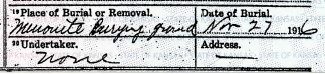
Next, notice that she was buried on the 27th, two days after her death.  There was no undertaker, so relatives would have prepared the body, just as had been done for thousands of years by nearly everyone. 

The burial location is “Mennonite burying ground.”  There is no cemetery with that name today, but if I didn’t know where she was buried, that at least tells me her grave is in one of the Mennonite cemeteries in Meade County.  Since I have visited her grave previously, I know that she was buried in the Emmanuel Mennonite Cemetery.
Tombstone of Katharina Barkman, Emmanuel Mennonite north cemetery, at S Road and 22nd Road, near Meade, Kansas, accessed at www.findagrave.com, memorial #25017516, on 29 June 2016.
Informant.  

Death certificates almost always list the informant who provided the non-medical information.  It is interesting to think about why this particular person was chosen as the informant.  In this case, it seems strange to me that Johann F. Bartel was the one.  She died at the home of her son-in-law, Jacob F. Reimer (according to my grandmother’s family register), so it would seem he should be the one who would talk to the doctor.  He was also the oldest among the sons and sons-in-law, so he would be the natural candidate.   But this required communicating in English with an outsider, a non-Mennonite, so perhaps Jacob F. Reimer did not feel comfortable doing that.  Or perhaps it was something as simple as Jacob F. Reimer being out in the barn when the doctor came.  I don’t have an answer, but it seems that Jacob F. Reimer would have been the natural one to be the informant, but he was not.

Don’t forget to milk a document for every bit of information that it can give you.