Thursday, September 28, 2017

Sorting Land Transactions by Date

When I go to a courthouse to do land research, I make spreadsheet of the land transactions that I find for each couple to summarize the information that I find.  Here's the link to a sample spreadsheet.  I feel it's important to sort the transactions by effective date - sometimes you see connections between transactions this way.

(Note that the effective date, the date that the document was signed, may differ significantly from the recording or filing date.  Occasionally someone delayed taking the deed to the courthouse for a long time.  The effective date is when the transfer of ownership and money actually happened - not the date when it was recorded in the courthouse to inform the public.)

When my great-grandfather Heinrich Reimer #317342 (1856-1923) moved from Jansen, Nebr., to Meade, Kans., in September 1908, he sold his land in Nebraska and bought land in Kansas.  Some of the transactions line up neatly.  For example:
  • He sold 80 acres in Nebraska for $5000 on 27 May 1908.  
  • Then he proceeded to buy 160 acres in Kansas for $4500 on 22 August 1908
  • And he bought another 80 acres in Kansas on 20 October 1908 for $2000.  
It seems very likely that his sale of land in Nebraska for $5000 funded a large part of his purchase of land in Kansas for $6500.  He didn't buy all of his Kansas land with the proceeds from sales in Nebraska, but there are several tracts that he bought this way.  Since I sorted the transactions by date (instead of grouping the Nebraska and Kansas transactions separately), it's easy to see which transactions occurred close together.

In another example, my great-grandfather Jacob Suderman #319370 (1856-1906) and his family moved from Buhler, Kans., to Fairchilds, Tex., in 1898.
  • In preparation for the move, he bought 334 acres in Texas for $3343 on 1 December 1897, using a lien from the seller for the purchase.  
  • But he paid that lien in full by 18 August 1898.  
  • Then he sold his Kansas land three weeks later on 8 September 1898 for $5700.  
Obviously, he didn't need the proceeds from his Kansas sale to pay the lien on his newly-purchased Texas land.  Based on this sequence of events and on other things (property tax records and his obituary), it is clear that he was a moderately wealthy man.  But I might have missed this small but significant detail if I hadn't sorted the land transactions by date.


Wednesday, September 27, 2017

Deeds of Sale May Give More Information

Sometimes when you are doing land research in the courthouse, you may run across a deed with your ancestor's name but you're not sure if this is your ancestor or a person of the same name.  This situation usually occurs when you are searching the grantor-grantee (or direct-indirect) indices and find a tract of land that you didn't know that your ancestor owned.

Here is an example.  I found a tract of land in Jefferson County, Nebr., where my great-grandfather Heinrich F. Reimer #317342 lived.  It was purchased by "Henry Reimer," but this piece of land was several miles from where he lived, so I wasn't sure if it was he or another Henry Reimer.  Here is a scan of the grantor-grantee information:
Warranty Deed, Sarah J. & Abr. F. Rempel to Henry & Katharina Reimer, 6 June 1903, Jefferson County, Nebraska, Deed Book 29:636, Register of Deeds, County Courthouse, Fairbury.

But if I check the tract index at the courthouse, I can find where "Henry Reimer" sold this piece of land.  In many, if not all, states, the sales deed shows the wife's name as well as the husband's.  This is because in most states a married couple owned property jointly if it was acquired while they were married.  So the wife would need to agree to sell her interest as well.  Here is the sales deed:
Warranty Deed, Henry & Katharina Reimer to Frank L. Rain, 27 May 1908, Jefferson County, Nebraska, Deed Book 37:431, Register of Deeds, County Courthouse, Fairbury.
The same tract of land was next sold by "Henry Reimer and Katharina Reimer, husband and wife."  BINGO!  My great-grandmother's name was Katharina, so the sales deed shows that the purchase is his.  For some reason, he bought eighty acres of land some distance from his farm and home.

Another time, I found a tract of land purchased by Katharina Fast in McPherson Co., Kans.  I knew that my great-grandmother Katharina (Penner) Fast #86813 (1852-1940) had actually lived in that section, so without question I believed it was she.  But many years later when I decided to go back to the county courthouse, I found that that tract was sold in the 1950s by a Katharina Fast living in California.  Since my great-grandmother died in 1940 and never lived in California, I realized that she was not the seller and therefore not the buyer and that I had made a faulty assumption.  Then I found a deed where her daughter Minnie Fast, my great-aunt, actually bought a nearby tract of land in that section.  So my great-grandmother never actually owned land there.  But again it was the sales deed that gave me the clue I needed.

Tuesday, September 26, 2017

A Tradition of Inheritance Messes

My Barkmann ancestors had a tradition of inheritance messes.  As far as I can tell, they never got burned by it legally, but it sure creates headaches for the genealogist who is trying to figure out what they did with their land and other assets.  I'll share what I've learned about one of those messes, that of my great-great-grandfather Johann Barkmann's #317873 (1827-1879) inheritance.

Johann and his wife Katharina immigrated from Russia to Jefferson County, Nebr., in July 1878.  In January 1879, he bought eighty acres of land from the Burlington and Missouri River Railroad Co.; so he was a landowner when he died.
Warranty Deed, Burlington and Missouri River Railroad Co. to Johann Barkmann, 8 January 1879, Fairbury, Nebraska, Deed Book W:275, Register of Deeds, Courthouse, Fairbury.
Then in October 1879, he died of typhoid fever at the young age of 52, according to the 1880 census mortality schedule.
John Barkman decedent, US Census 1880, Mortality Schedule, Nebraska, Jefferson County, Cub Creek Precinct, p. 1, line 5.  Accessed online at Ancestry.com on 3 June 2014.


As best I can tell, he died intestate; and he left a widow, Katharina Bergmann, and six children.  (I searched the index of probate files in Jefferson County and didn't find his name.  And I looked in the box where the probate file should have been and didn't find it.  And I found a couple deeds in 1886 where the "heirs of Johann Barkmann" sold land, which would seem to indicate that no probate had been done by then.)

In Nebraska at this time, inheritance laws followed English common law principles, which decreed that a widow had a one-third life estate in her deceased husband's land, known as dower rights.  (I found the Consolidated Statutes of Nebraska, 1893 chapter 12, section 1123-1, p. 361 on Google Books as my source for early Nebraska inheritance law.)  A "life estate" means that she didn't own the land but that she could use it as long as she lived.  And her life estate was only in one third of the land.  So she could have used 26 2/3 acres (1/3 of the total of 80 acres) until she died.

Now the mess begins.  Twenty-five days after her husband died, Katharina Barkmann purchased eighty acres of land that adjoined the tract that her husband had purchased.  No doubt, she used money from her husband's estate to purchase the land - but the money belonged to their children, NOT to her under Nebraska law (section 1124).  Very likely, her husband had arranged the sale before he died, and she completed it.  But legally the money was not hers, and her right of dower only gave her the right to use the income from 1/3 of the land and the interest from 1/3 of the money.  The land that she (illegally) bought technically belonged to her children.

Seven years passed after Johann's death.  Then in 1886, the Chicago, Kansas, and Nebraska Railroad Co., a subsidiary of what was popularly known as the Rock Island Railroad, wanted to build a line through the tract of land that was still showing in the land registry as belonging to Johann Barkmann.  Only he wasn't around any more to sell them a right-of-way.  So on 25 August 1886, the railroad purchased a right-of-way for $125 from his six surviving children, who were listed in the deed as his heirs.  The only problem was that his widow Katharina still had dower rights in that land, and she wasn't named in the deed as relinquishing those rights.  Since she never pursued her rights, it didn't matter.

Here is deed of the right-of-way to the railroad:

Warranty Deed, Martin & Elizabeth Barkmann, Katharina & Henry Reimer, Anna & Jacob Reimer, Agnetha & Claas Friesen, Maria & John Bartel, and Franz Kroeker guardian of Elizabeth Barkmann to Chicago, Kansas, and Nebraska Railroad Company, 24 August 1886, Fairbury, Nebraska, Deed Book 8:271, Register of Deeds, Courthouse, Fairbury.


But this must have alerted Johann's children to the problem because the next day, 26 August, they prepared a deed in which five of them sold their undivided 5/6 interest in the land to the husband of one of Johann's daughters, Klaas R. Friesen, for $1.  Again, they ignored the dower rights of their mother to a 1/3 life estate in the land; and again she never pursued her rights; so it didn't matter.

Why did they do this?  I think they were following Mennonite inheritance principles and creating documents after the fact to try to make the decisions follow Nebraska state law.  Remember that his wife Katharina purchased eighty acres using money from the estate shortly after he died.  According to Mennonite custom, the wife should get half the property.  Since she used money from the estate, in effect, she wound up with half of the land.

Mennonite custom dictated that the children should also get half of the land.  The other half of the land, the eighty acres that Johann owned when he died, went to his six children, which also followed Mennonite custom.  Most likely, Klaas R. Friesen, the husband of one daughter, had purchased the interests of the other five children soon after father Johann had died and was farming it.  But they didn't do any paperwork to make this official.  Only in 1886, when the railroad wanted to buy a right-of-way, did they realize that they needed to register a deed in the courthouse.  So they sold the right-of-way to the railroad and then filed a deed with a nominal price of a dollar to transfer the land legally to the husband of one of the daughters.

In the end, justice was served according to Mennonite customs because both the wife and the children got half each.  And they made it (more or less) legal under Nebraska law.  But what a mess!  And it could have been even worse if the widow Katharina had pursued her legal right of dower under Nebraska law.


Monday, September 25, 2017

Thanks

Just wanted to add my thanks to Glenn Penner, Conrad Stoesz, and Bruce Wiebe for consulting with me and giving really helpful details of Mennonite inheritance practices in the previous post.  I forgot to mention them.

Wednesday, September 20, 2017

Inheritance Anomalies

Mennonites have practiced Flemish inheritance customs since at least the 1700s, and probably before that; so when an inheritance doesn't follow the pattern, it's a big deal.

My great-great-grandmother Katharina Bergmann #7126 (1834-1916) lost her first husband, Johann Barkmann, in 1879 in Nebraska.  Within a couple years, she re-married to her brother-in-law, Martin Barkmann #3982 (1821-1894), who had also lost a couple wives.  Katharina had 80 acres of land; while Martin was a moderately wealthy man because he owned the land where Jansen, Nebr., was established in 1886.  When they got married, according to Flemish/Mennonite custom, both owned all of their property equally, regardless of who owned it before they were married.

Key Facts - Katharina had surviving children from her first marriage, but Martin had no surviving children or grandchildren from his two marriages.  He did have siblings, however.

In 1892, when Martin was 70 years old, he made a will, which would leave his wife $700 if she survived him and the rest of his estate to his siblings.  I found that will in Martin's probate file at the Jefferson Co., Nebr., courthouse.  Here is the first paragraph of the will:
Will of Martin Barkman, 20 July 1892, Probate file #251, Jefferson County, Nebraska, Clerk of the County Court, Fairbury, Courthouse.
According to Mennonite custom, after he died in 1894, his wife Katharina would keep half of their property (both of "her" 80 acres and "his" land and a substantial amount of money).  The other half would go first to his children by blood while Katharina's children (i.e. his step-children) would get nothing.

But he had no living descendants, so then his siblings would equally divide Martin's half of all their property.  Three of Martin's siblings had already died before Martin died in 1894; but since they had children, these children (Martin's nephews and nieces) would divide their parents' shares.

What actually happened was the following: 
1) Katharina kept "her" 80 acres of land - According to Mennonite custom, Martin's siblings should have gotten half of this since that land was owned jointly and since they were Martin's heirs.  But the will said nothing about what to do with "Katharina's" property.
2)  Katharina got $700 in cash - Again, according to custom, Katharina should have gotten half of "his" cash and other financial assets.
3)  Martin's eight siblings each got a one-eighth share of "his" land and other assets - They should have gotten an eighth share of half of "his" land and other assets.

Everything was done legally because Martin had made a will.  But when he made the will, he was deliberately violating centuries of Mennonite custom.  Clearly, Martin intended to manage their assets separately, even though this violated the Mennonite concept of marriage and property.  I don't know if Katharina agreed with this or not.  I've found unsourced grumbling from "the church" about their marriage not being proper, and I wonder if it was because he did not share his material assets equally with his wife.  Violating custom in this way showed that he did not accept Mennonite teaching on a very important matter.

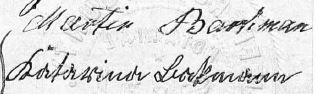
On another note - one nice thing about his will is that it contained their signatures.
I don't have many, if any, signatures of my great-great-grandmothers; so it is special to have her signature, even if it was from a document that cheated her out of part of her inheritance.

Saturday, September 16, 2017

Evidence for a Father - In a Surprising Place

Several months ago I wrote about my surprise when I found that my great-great-grandmother Katharina Bergmann's #7126 (1834-1916) father was listed as Jacob Barkman on her death certificate.  I described how I weighed the evidence and concluded that her death certificate was probably wrong and that her father was really Peter Peter Bergmann.  But I still had some doubts.

I found some evidence about her maiden name, and thus the surname of her father in a surprising place - the land records in the Jefferson County, Nebr., courthouse.  Katharina was widowed twice, when her first husband and my great-great-grandfather Johann Barkmann died in 1879 and again when her second husband Martin Barkmann died in 1894.  And each time while she was a widow, she conducted land transactions using the surname Bergmann.  In contrast, she used her married surname of Barkmann each time she was involved in a land transaction while she was married, so this is evidence of her maiden name.

A few weeks after her first husband Johann died, she used the surname Bergmann when she bought eighty acres of land that adjoined their home place.
Source:  Warranty Deed, Peter & Anganetha Heidebrecht to Katharina Bergmann, 4 November 1879, Fairbury, Nebraska, Deed Book P:202, Register of Deeds, Courthouse, Fairbury.
Her first name is cut off because it was in the crease of the deed book, but her last name is clear - "Bergmann."

After she was widowed a second time, she sold seventy-seven acres of land to her son-in-law Klaas R. Friesen and used the surname Bergmann.
Source:  Warranty Deed, Katharina Bergmann to Klaas R. Friesen, 27 March 1899, Jefferson County, Nebraska, Deed Book 25:165, Register of Deeds, County Courthouse, Fairbury.
She didn't use the surname "Bergmann" consistently - on two other deeds as a widow she used the surname "Barkmann."  But I think it's unlikely she would have used the name of Bergmann at all if it weren't her maiden name.

This is another good piece of evidence that her father's surname was Bergmann and not Barkmann.  When I analyzed her death certificate earlier, I felt that the evidence, while contradictory, was stronger that her father was Peter Peter Bergmann and not the Jacob Barkman listed on the death certificate.  Now the evidence is even stronger for Peter Peter Bergmann being her father.  And I certainly didn't expect to find it in the land records of Jefferson County, Nebr.

Collecting all the documents you can find and thinking about the implications of each one is crucial for doing good genealogy research.

Getting Out of the Doldrums

I've been in the genealogical doldrums lately.  I had an enjoyable time working on my Fast 1776 census project that I summarized here.  I made of lot of progress on other Fast families that so far are not connected to my own, but it also wore me out.  Thus, I haven't posted for quite a while.

I decided the best way to get out of my genealogical doldrums would be to do a fun project that would likely yield some good results.  I haven't researched my Reimer family (maternal grandmother's family), who lived at Jansen, Nebr., so I decided to make a trip to the Jefferson County courthouse.  And it proved to be just what I needed.

Just seeing the beautiful and unique Jefferson County courthouse would be enough to get any person out of the doldrums.
Source:  Wikipedia


I decided to focus on land and probate records because my great-grandfather Heinrich F. Reimer #317342 (1856-1923) had gone from being a simple farmer who owned 120 acres of farmland in 1900 (per 1900 Jefferson County plat map) to a man who gave two quarters of farmland to each of his eight children (2560 acres total) by the time he died in 1923.  Clearly there is an interesting story here.

I also wanted to find the probate for my great-great-grandfather Johann Barkmann #317873 (1827-1879).  He died of typhoid fever in Jefferson County, Nebr., only a year after arriving from Russia.   I knew very little about what he did after he arrived in America, so I thought that his probate file might answer some of those questions.

I'll share the results of my trip in following posts.

Wednesday, August 23, 2017

How to Spell Shakespeare

Genealogists will certainly understand the dilemma about how to spell how to spell Shakespeare's name that USC faced when it mentioned him on a statue.

Is it Barkman, Barckman, Barkmann, Barckman, Barckmann, Bergman, Bergmann, Berkman, Berckman, etc. etc.  And which one is right?

Tuesday, August 8, 2017

Analyzing the 1776 Census

For the last several months, I've been working on this huge project to analyze all the Fasts in the 1776 census of Mennonites in West Prussia.  My goal was to try to identify the parents of Gerhard Fast #660202 (1739-1828), my 7th-great-grandfather and earliest known Fast ancestor.  Since his oldest known sibling was born in ABT 1737, I realized that his parents would probably have been in their early 60s in the 1776 census.  Thus it is likely that one or both of them were enumerated in that census; but of course without knowing their names, they could be listed in plain sight and wouldn't even know it was them.  So my plan was to find out as much as possible out each of the 31 Fasts in that census to try to identify his parents.  I didn't identify either parent, but I was able to eliminate most of them as possible candidates.

I chose the 1776 census because it was only of Mennonites in West Prussia, so I didn't have to worry about sorting out people who had "Mennonite-sounding" names.  Glenn Penner has already identified quite a few people in it, so a good start has been made.  Finally, I have scans of all the originals for the 1776 census.  I decided against the 1772 census because it included everyone in West Prussia - not just the Mennonites.  Very little work has been done on it, and I have only about half the scans for "Mennonite" villages in the Gross Werder, and ordering them from the Geheimes Staatsarkhiv in Berlin is slow and expensive.

Glenn Penner's extraction of the 1776 census is found here.  He (and perhaps others) had already identified 11 of the 31 Fasts with Grandma (GM) numbers.  I added 10 more during my project, so 21 of the 31 are now identified in GM.

The results of my efforts can be downloaded from Google Drive.  A few comments about the spreadsheet - the names and dates that I added are in red.  On a few people, I just looked them up and found the family in GM, just waiting to have a GM number associated with them on the census spreadsheet.  Others took a lot more work to research.  And a few were not in GM at all.

I started by looking for the head of household in my giant spreadsheet of Fasts that I have extracted over the last few years.  Any time I looked at church book or microfilm, I put all the names of Fasts (and in-laws) into a giant spreadsheet - even if I wasn't interested in them at the time.  Now I could just look at it and see all the records, for example, for Claas Fast, even if they were scattered among different sources.  Many times a family would come together just like that.

The sources that I checked included
  • Prussian Mennonite church books (Tiegenhagen, Ladekopp, Rosenort, Bärwalde, Montau, Tragheimerweide, Heubuden, Danzig, etc.) - I used the extractions at MennoniteGenealogy.com, Andreas Riesen's extractions, and the originals at Bethel College's Mennonite Library and Archives
  • Lutheran/Evangelical church books (Jungfer, Fürstenau, Neuteich, etc.) - Mostly from LDS microfilms
  • West Prussia Censuses - 1772, 1776, 1789, 1793 (Danzig), 1811 (Elbing)
  • Russian Censuses - 1806, 1808, 1811, 1835
  • Property Records 
  • Emigration Records - BH Unruh, Peter Rempel, MennoniteGenealogy.com
The key to successful genealogical research in West Prussia is to combine all the sources.  There are lots of West Prussian records, but most of them are fragmented  - there are only a few Mennonite Familienbücher where the entire family is listed together and most of these are fairly late.  Most West Prussian records give one data point, e.g. a certain child was born on a certain date and his father was a certain man.  If you pull everything together, suddenly the whole family pops into view.

To handle all this data, you need several things:
  • A method to store and organize all the data - such as my spreadsheet of Fast extractions
  • Access to all the records - online, microfilm, orders from archives
  • Research collateral lines - With fragmented data, researching siblings of your direct ancestor helps to pull everything together.
 I would encourage you to try the same thing for your surname.


Sunday, July 16, 2017

A Book That Speaks (Part II)

In my last post, I shared a bit about a book that I received.  Now I'm going to tell you why the book is so special to me.

First, when I opened the cover, I saw that my grandfather, Cornelius Siemens, stamped his name in the book in red, so it's a nice memory from him.  It's actually the only thing that I have from him.  He died in 1950, twenty-one years before I was born.  Plus, he had 26 grandchildren, and I was born second-to-last, so all his things had been divided long before I was around. 


 But when I got to the back of the book, I was amazed.  The book was signed by Cornelius Janzen #6468 (1848-1873) of Neukirch, Molotschna Colony, Russia, in 1866.  He's not my relative, so why should I care?  Because he was the first husband of my great-grandmother Aganetha Klassen.  They married in about 1871, and he died suddenly in March 1873 at age 25.


He signed the book at age 18, which is about the age that he would have been baptized.  Probably, it was an influential book in his spiritual growth as he matured into adulthood.  He was a school teacher also, so he would have been respected as an intellectual as well.

But how did the book come to my grandfather?  Presumably my great-grandmother Aganetha kept the book after her husband died.  She re-married four months later, in July 1873, to my great-grandfather Gerhard Siemens.  And the book must have been important enough for her to bring it as one of a few possessions that would have fit into their trunk of freight when they immigrated to Canada in August 1874.  And then my grandfather Cornelius Siemens was born in 1884 in Manitoba.

The next notation in the book is that it is a gift from to my grandfather with wishes from his parents in 1890.  The date 1890 is significant because that is when my great-grandmother Aganetha died in childbirth.  So the book was a memory saved for my grandfather Cornelius from his mother - he was only 5 years old when she died.

And then my grandfather signed his name in the back of the book.

Not only is this a memory of my grandfather whom I never met - it's a memory of my great-grandmother and of her first husband.  It's a memory of what spiritual life was like in Russia for them.  When I hold the book, I hold something that was dear to my great-grandmother.  The book was surely a bittersweet memory for her, a memory of the man she loved in her youth and a memory of how he was taken from her all too soon.

Cornelius Janzen left no descendants, but when I hold this book, I count myself a spiritual and intellectual descendant of his.

Update on 1776 Census Project

I've been working on a project to identify all the Fasts in the 1776 census of Mennonites in West Prussia.  Glenn Penner's extraction of the data is found here.  My theory was that one or both of the parents of my earliest known Fast ancestor, Gerhard Fast #660202 (1739-1829) might be listed in that census, and I wouldn't even have known about it.  His oldest known sibling was born ABT 1737 - if his parents were about 20 years old when their first child was born, they might have been born about 1717.  Thus in 1776, they would have been about 60 years old.

There were 31 Fast families listed in the 1776 census, and 11 of them had previously been identified in Grandma.  I was able to identify 11 more Fasts, so now 22 of the 31 are identified in GM.

My methodology was to look for them first in GM.  Then I checked my spreadsheet in which I have extracted 431 individual records over the years from the Mennonite, Lutheran/Evangelical, and Catholic church books to see if I could find the person.  I checked the Mennonite church books that Andreas Riesen extracted.  I checked the 1772 and 1789 census, the immigration records to Russia in BH Unruh, Peter Rempel, and that I have gotten from the Prussian archives in Berlin, and the land records that Glenn Penner has posted online.

Unfortunately, none of the Fasts whom I was able to identify were old enough to be the parents of my Gerhard.  There are 3-4 Fasts whom I could not identify who lived in the Gross Werder and are potential candidates to be Gerhard's parents, but I found no information to identify them.  I was able to tie many, many children to the 22 identified Fast families, so I've added a lot to the store of knowledge about the Fasts in GM, so it's been a useful exercise.  But I didn't accomplish the goal that I set out to achieve.

I'm planning a trip to Poland in 1-2 years to do research in the archives there, and this work was a necessary prelude to that trip.  I wouldn't want to make an expensive trip to the Polish archives without having done everything that I could with data that is available to me while sitting at home.

I'll post the spreadsheet with my results in the near future, but I need to clean up the spreadsheet first.

Tuesday, June 27, 2017

Immigrant Trunk Exhibit - Hillsboro, Kans., Museums

Hillsboro (Kansas) Museums, where I am museum coordinator, will be having an exhibit of immigrant and traveling trunks running July - September 2017.  Our grand opening will be on 1 July at 10am.  We would love to have you join us.

We have 14 immigrant trunks from the 1870s in our collection - most of them Mennonite in origin.  They range from simple freight trunks built for the voyage to America all the way to heirloom dowry chests passed down for many generations.

Monday, June 26, 2017

A Book That Speaks (If You Know How to Listen)

I've just been given a book that was destined for the trash.  It's an old German book, Ausgewählte Schriften (Selected Writings), by Pieter Pietersz (or Peter Peters in German), a Dutch Anabaptist builder of windmills, preacher, and writer, who lived 1574 - 1651.  He was a popular preacher  and writer in his own time, but he didn't have the sustained influence of someone such Menno Simons.  As Mennonites shifted from reading Dutch to High German when they lived in West Prussia, the writings of many of the Dutch founders of the Anabaptist movement lost favor.  However, his popularity rose again among the Kleine Gemeinde in Russia as they revived many of the old Dutch Anabaptists by translating their works into the German that their members could read.

Here's the cover page of the book:


The book was published in Stuttgart, Germany, in 1865, and Harold Bender in his article on the Kleine Gemeinde at GAMEO suggests that the Kleine Gemeinde sponsored the publication of this book.  (BTW, the article is quite biased against the KG, so don't take the rest of it at face value.)

In the next post, I'll share why this book was so important to me.

Wednesday, June 21, 2017

Y-DNA for Mennonites (Part III)

You may read my last post on Y-DNA for Mennonites for the beginning of this series.

Next Steps.  Whether or not you have already tested your Y-DNA, you should download the Excel spreadsheet (table) mentioned at the beginning of this web page.  You can at least see how many different groups there are with the surname(s) you are interested in.  Just be aware that there might be more surname groups discovered as more men of your surname get tested.  You might get lucky and see that a descendant of one of your ancestors has been tested already.

Next read the discussion that Tim Janzen wrote for most Mennonite surnames and their groupings.  And if you have one of a few Mennonite surnames that are commonly confused, you'll want to read this page.

Getting Tested.  Currently Family Tree DNA is the only company that tests Y-DNA; and since they have a monopoly, their prices have stayed high while the prices of autosomal DNA have dropped as competitors have come into the market.  Getting the 37-marker test currently costs $169, and the 67-marker test costs $268.  The 37-marker test is a good place to start, and you can upgrade to the 67-marker test later if you need to.

I've only tested the Y-DNA of two lines, my own and that of my mother's brother, so I have the lines of two of my four grandparents.  I would do more if it weren't so pricey.

Remember if you are female, you can have a male relative tested for you.  It just needs to be a direct male descendant of the ancestor that you are targeting.  And this applies to males who are testing anything but their direct paternal line, as well.  So I could test my mother's brother to get results for my maternal grandfather.

Leave a comment telling us about your experience with Y-DNA.

Monday, June 19, 2017

Y-DNA for Mennonites (Part II)

In my last post, I briefly explained how I think you can use Y-DNA to show that all Mennonite Fasts in West Prussia are likely descended from a fairly recent ancestor.

But the situation is a little different for my maternal lines, the Siemens.  If you look at the table of Mennonite Y-DNA and surnames maintained by Glenn Penner, you can see how the Mennonite surnames break down into groups.  For instance, if you scroll down to the Siemens, you can see that Glenn has broken them up into two groups, separated by the bold line. The first four men tested share virtually the same Y chromosome, while the second five men do as well.  But the first and second groups are different from each other.  The columns on the right are the number of times certain sequences of DNA molecules repeat.  Here's a snip from the spreadsheet:


I had my uncle, my mom's brother, tested before he passed away; and his Y-DNA matched the first group.  If I would research the ancestries of those three men, they should converge at some point, perhaps in the 1600s.  It also means that there is no point trying to connect to the ancestries of the Siemens men in the second group.

When I checked in Grandma, I found that the man on the third line, Jacob Siemens #2169, was born in Alt-Muensterberg in 1764, which is the same village in which my 4-greats-grandfather Klaas Johann Siemens #46557 was married in 1787.  That would make them of about the same generation.

I haven't started on this project yet because I am working on connecting Fasts in the 1776 census.  But once I finish with the Fasts, I will take up this group of Siemens and see where it leads.

BTW, I have had no success using the list of matches at FTDNA for my Y-DNA.  Out of the hundred or more matches for each of my two surnames tested, Fast and Siemens, I have had only one match with a Fast surname and none with a Siemens surname.  I think this is because both these lines are of Dutch and Flemish origin, and the Dutch only took surnames late in history.  It's much better to use the Mennonite Y-DNA table that Glenn Penner has put together.

Y-DNA for Mennonites (Part I)

Autosomal DNA is all the rage in the genealogy world.  But it seems to me that Y-DNA is actually more useful for most Mennonites.  Since we are an endogamous people, it's a lot harder to get useful results with autosomal DNA (see my last post on this topic) because distant cousins appear to be much more closely related than they actually are, which makes it much harder to figure out the relationship with them.  However, Y-DNA is a different story.

Y-DNA is the genetic material that is handed down from father to son - mostly unchanged.  The key word is "mostly."  Since Y-DNA changes slowly, we can use it to determine how closely related the paternal lines of two men are likely to be.  (Women are not left out - you can have a brother or cousin or some other male relative test for you.)  The number of changes in the Y chromosome can give you an estimate of how far back you had a common ancestor.  It's only an estimate - for example, a 90% chance that your common ancestor lived 7 generations ago.  This fact can be used to group Mennonite men of the same surname into groups who are more closely related to each other.

I have tested myself for my Fast line and my maternal uncle for my Siemens line.  All the Mennonite Fasts test previously had proven to be closely related to one another.  (By closely, I mean that the earliest ancestors of these Fasts in the 1700s were probably distant cousins.)  And my Y-DNA test showed the same.  My earliest known Fast ancestor, Gerhard Fast #660202 (1739-1828) was related to all the other Fasts tested.  In fact, the common ancestor of all of them might have lived in the 1600s or perhaps 1500s.

This means that I can profitably pursue researching any of the Fast lines to try to get them to connect.


 This is a schematic of how I think the Fast lines in West Prussia in the 1700s connect.  Say that the red line traces my ancestry back to Gerhard Fast #660202 (1739-1828).  The other solid lines are known ancestral lines that connect back to the other Fasts in West Prussia.  At the top of each line, for example, would be one of the 33 Fasts in the 1776 census of Mennonites in West Prussia.  We don't know how any of them relate based on genealogical proof.  But based on Y-DNA results, we can be pretty sure that they all go back to some common Fast ancestor who lived 100-200 years earlier.  The dotted lines represent the pedigree chart going from the current known ancestors back to the earliest Fast, the generations we don't know yet.  So if I work to connect them, it's not a wild goose chase because they should all connect at some point.

Friday, June 2, 2017

Autosomal DNA for Mennonites

Autosomal DNA (atDNA) testing is all the rage these days.  Webinars, conferences, and lectures all tout the benefits; but if you are of Mennonite descent, should you be so excited?  My answer is, generally, no.  Low German Mennonites have been a highly endogamous people until recently, and atDNA is very difficult to use with endogamous groups.

A few definitions - autosomal DNA is the DNA on your 22 pairs of chromosomes that come half from your father and half from your mother.  This DNA test is used to find stretches of identical DNA that you likely inherited from any of your ancestors.  Here is a wiki with more information.

An endogamous group is one that has mostly married within itself for a long period of time.  As a result, members of an endogamous group are related to each other in many different ways.  You can inherit pieces of identical DNA from multiple ancestors and thus appear to be related much more closely to someone than you really are.  For example, my parents are 3rd cousins once removed in two different ways, 4th cousins, 5th cousins, and 7th cousins once removed.  And these are just the ones I know about.

For example, I have Klaas Johann Siemens #46557 (ABT 1758-1834) as a 3-greats-grandfather on my mom's side and a 4-greats-grandfather on my dad's side.  This is one of the relationships that makes them third cousins once removed.  Very likely Klaas Johann Siemens passed the same piece (or several pieces) of DNA to me via both my dad and my mom.  If I have a DNA match with another of his descendants, it looks as though we are much more closely related than we really are because I am getting DNA from two paths from Klaas Johan Siemens, not just the normal one path from one parent.  And then when you have several of these kind of relationships in your ancestry, it really starts to add up.

So someone who appears to be a 2nd cousin based on the amount of shared DNA might really be a 4th or 5th cousin or even more distant.   In fact, I have a number of matches that are supposed to be 1st and 2nd cousins (based on DNA testing) whom I know are NOT actually 1st and 2nd cousins.  It would require the testing of many, many cousins (probably dozens or scores of cousins) to untangle all these relationships.


In my personal case, I tested at 23andMe in 2012, and I think it was a waste of money.  I also uploaded my results for free to Gedmatch.  Neither produced any genealogical results.

There is one case where atDNA would be useful for someone of Low German Mennonite descent.  If you are searching for a recent ancestor, say a parent, grandparent, or great-grandparent, then it would be worth doing.  This would occur in cases of adoption, recent non-paternal events, or if your family has lost information about the most recent generations.  You will still get results that show matches who are supposedly more closely related than they actually are.  But these are easier to work through for recent generations.  And you may not have any other good options for doing research.

In the comments please share your experiences, positive and negative, with atDNA.

Searching for Clusters of First Names

Sometimes you are searching for someone with a complicated or easily-misunderstood surname, he can be really hard to find.  His surname can be spelled so many different ways.

For example, last night I was searching in the census records at Ancestry.com for an Ezra Lorenz whom I knew had lived in Durham, Kansas.  My only result was an Edward Lawrence from New Jersey.  I tried different spellings of Lorenz.  I tried his wife Sara Lorenz, which didn't help either.  I tried his son Clarence - no luck.

But this morning I tried my last-ditch strategy:  I searched for all the first names that I knew in the family without the surname because first names are less-likely to be garbled.  My search parameters were

First Name - Ezra
Born - 1884
Spouse - Sara
Child - Alvina
Child - Clarence
Child - Pearl
Child - Vernedda
Location - Marion County, Kansas

And immediately the results popped up with all their census records.  When I looked at the 1920 census, I saw why my original search didn't work - the handwriting was very sloppy, and he had been indexed as "Ozra Leonz."  His wife was indexed as "Kate" and the children as "Athena," "Clarence," "Pearly," and "Beatric."  Somehow these were close enough for the Ancestry search engine to find the family.


I think this works because first names are more likely to be correctly transcribed and because there were no other clusters of identical first names.  I found my grandfather on a very messy page of the 1921 Canadian census this way when I had given up all hope of finding him.

If you're having no luck finding a family, try searching just on all the first names you know and a location.


Tuesday, May 30, 2017

Obituary Scrapbooks

Ouch!  It's been nearly a month since I posted last.  I've been putting siding on and painting the garage that I'm building, so I do have an excuse, but I'll try to post more consistently.

My aunt let me scan two obituary scrapbooks that my grandfather David D. Fast #112786 and great-aunt Minnie Fast #315950 (brother and sister) had kept.  This is a great resource for a couple reasons.

First, they contain obituaries of people I'm interested in but haven't had the time to find - for example, their sister Margaret died at age 29, and I have always wondered why.  Aunt Minnie pasted her obituary into her scrapbook, so I will translate it to see what the cause of death was.  There are lots of other collateral ancestors whom I would never take the time to research, but the obituaries contain brief life histories of them.

Second, these scrapbooks add members to their FAN club (Friends, Associates, Neighbors) and to that of their parents (since they were collecting obituaries, many of them are from an older generation).

Here's a clip from Aunt Minnie's scrapbook:


I'm not going to write a formal source here because I don't want to put the name and residence of my aunt online for privacy reasons.

Tuesday, May 2, 2017

Knocked Down a Brick Wall (Part III)

See Part II for the previous part of this story.

I had been staring at the list of baptisms and marriages from Mennonite church books in West Prussia in Part II for a couple months and not making any progress.  But then Glenn Penner sent me a record related to a Martin Fast in Schönbaum from the Schönbaum Lutheran church book on LDS film #208392, and they proved to be the key to unraveling the mystery.  Getting help from a fellow genealogist is always a good idea.

This is what Glenn sent me in blue:


Deaths:
26 Dec 1797 Frau Maria geb. Wiens eine Mennonitin, des Martin Fast Eigengaertner und Hackenbudner zu Schoenbaum 38J

The record says that Martin Fast's wife Maria Wiens died on 26 December 1797.  Suddenly I remembered another record that I had looked at months ago that contained both Martin Fast and Maria Wiens!  That was a land record from the village of Fürstenauerweide, where Maria Wiens inherited a 1/8 share of a piece of land from her parents.  Could this be the same Martin Fast and Maria Wiens in that land record?

Here is an image of that land record:
Fuerstenauerweide Grundbuch Blatt 13, Kreis Elbing, Malbork, Poland, Archive, Fond 341, File 198.  Accessed online at https://mla.bethelks.edu/archives/VI_53/Malbork/Fuerstenauerweide/Fuerstenauerweide%20Grundbuch%20Malbork%20Archives%20Fond%20341%20File%20198/IMG_0872.JPG on 25 July 2016.
Maria Wiens was one of four children who each inherited a 1/8 interest in tract #3 in Fürstenauerweide.  Since she was married, it gave her husband Martin Fast.  And it listed their six children, Peter, Johann, Isaac, Jacob, Cornelius, and Catharina.  These were six of the seven children that I suspected were children of my Martin Fast, children who were listed in my Excel database:
So now I had the six children definitely tied together.  And I had their mother Maria Wiens.  The last child Anna (line #599) turned out to be the child of Martin Fast's second wife, so she would not have been listed in the land document as an heir of the first wife.

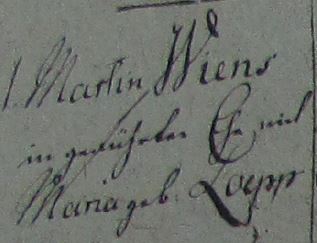
Even better, the land document listed Maria Wiens' parents, Martin Wiens and Maria Loepp:

After doing a little more research, here is the descendant chart that I ended up with.  The people that I knew about a couple months ago when I started this project are circled in red.
While it's hard to read the details on this small chart, I added Martin Fast's wife, Maria Wiens, who was my 4-greats-grandmother and her parents, my 5-greats-grandparents Martin Wiens and Maria Loepp and a bunch of collateral ancestors as well.

Some days I feel as though I don't make much progress in my genealogy research, but this was one of those days when it all came together.